
By: Kemo Kanyi
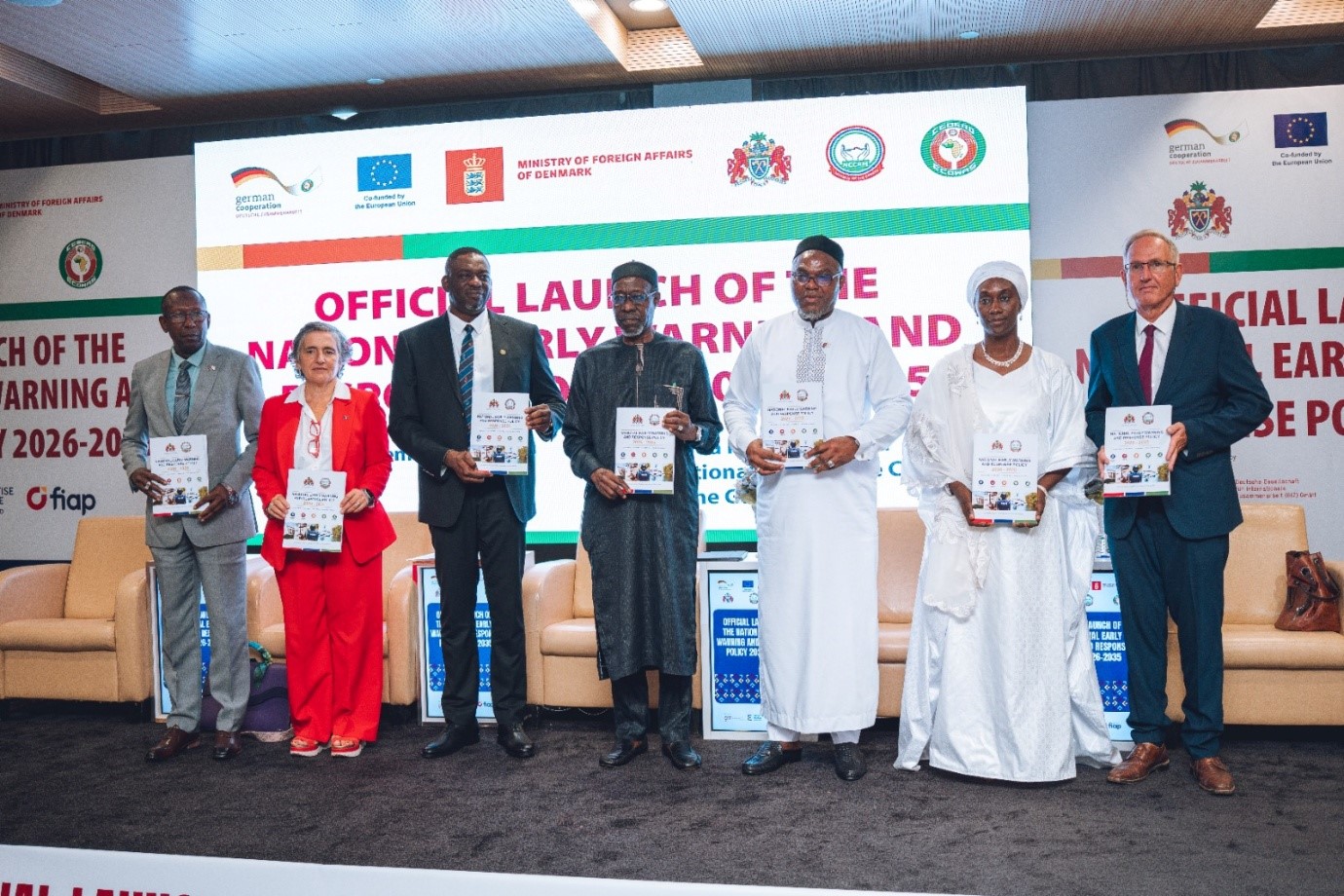
The Government of The Gambia and the European Union (EU), through the National Early Warning and Response Mechanism Coordinating Centre (NCCRM), have launched the National Early Warning and Response (NEWAR) Policy, covering the period 2026–2035.
The policy provides a national framework for strengthening early warning systems, improving coordinated responses to emerging risks and safeguarding peace and human security.
It establishes guidelines for monitoring risks across sectors including health, security, crime, governance and the environment, while providing mechanisms for timely and coordinated responses.
The policy is also aligned with ECOWAS regional frameworks and international best practices on early warning and conflict prevention.
Speaking at the launch, Vice President Mohammed B.S. Jallow said the increasingly complex and interconnected nature of risks facing societies made early warning and early response essential to national peace and security.
“This Policy provides us with a framework to move decisively from a culture of reaction to a culture of anticipation, prevention and preparedness,” he said.
European Union Ambassador to The Gambia, Imma Roca i Cortés, said anticipating risks and acting early were important to crisis preparedness, stability and sustainable peace.
“As a close partner and friend of The Gambia, it is important for the European Union to accompany this National Early Warning and Response Mechanism Policy, which will be instrumental in strengthening The Gambia’s early warning systems,” she said.
NCCRM Director General Binta Singhateh said early warning and response was not the responsibility of a single institution but required collaboration among government institutions, local authorities, communities, civil society organisations, traditional and religious leaders and other stakeholders.
“The best crisis is the prevented crisis and the best warning is the one that leads to timely action,” she said.
The NEWAR Policy is expected to serve as the official reference framework for national and partner interventions in early warning and response.
NCCRM said stakeholders in government, civil society and international organisations were encouraged to align their strategies and programmes with the policy to promote coherence, sustainability and effective implementation.
The Centre will also provide technical guidance to institutions and development partners on integrating the policy into their programmes and operations.
The NCCRM was established by Executive Order No. 88 in 2019 and launched as a public institution under the Office of the Vice President in 2022.
It now operates under the National Early Warning and Response Mechanism Act, 2025, with a mandate to coordinate and harmonise early warning and response systems in The Gambia and advise the government on human security threats.
The development of the policy received technical and financial support through the European Union Support to ECOWAS in Peace, Security and Governance (EPSG) Project.
The EPSG project is commissioned by Germany and co-financed by the European Union and Denmark. It is implemented under a Team Europe approach by the Deutsche Gesellschaft für Internationale Zusammenarbeit (GIZ) GmbH, in cooperation with Expertise France and the Fundación para la Internacionalización de las Administraciones Públicas (FIAP).
The project supports national centres for the coordination of response mechanisms, strengthens the ECOWAS early warning system and promotes the use of data and analysis for preventive action in conflict prevention and crisis management.
About The Author