
Feature
By Sheriff Musa Sheriff
Banjul, The Gambia — President Adama Barrow has undertaken a wide-ranging tour of the Central River Region (CRR) and Upper River Region (URR), where he inaugurated a newly constructed mosque in Demba Kunda and laid foundation stones for major road infrastructure projects under the government’s flagship “Connect Gambia Initiative”.
The four-day engagement, which also included inspection of ongoing works in the Greater Banjul Area and West Coast Region, forms part of the administration’s accelerated infrastructure drive aimed at improving national connectivity and supporting economic development.
Mosque inauguration in Demba Kunda
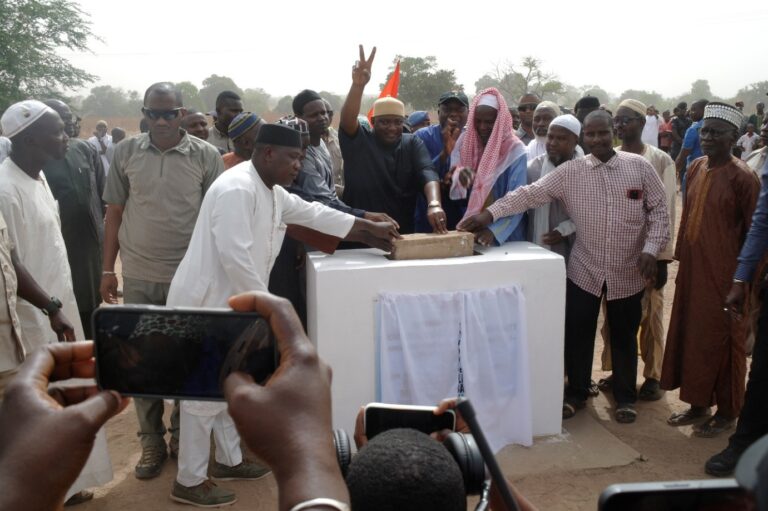
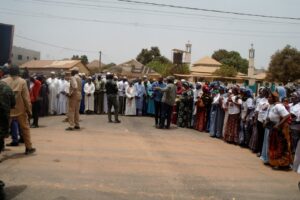
On Friday, 15 May 2026, President Barrow inaugurated the newly constructed Demba Kunda mosque in the Jimara District of URR, where he joined worshippers for Friday prayers.
The President commended the local community for their collective effort in constructing the religious facility, describing it as a reflection of unity, solidarity, and community-driven development.
He also used the occasion to appeal for peace, unity, and tolerance as the country approaches a new electoral cycle, stressing that national stability remains essential for sustained development.
“National peace and social harmony are critical pillars for sustainable development,” he said, urging religious leaders to continue promoting messages of peace in their sermons.
Community representatives, including Alhagie Bubou Drammeh, expressed gratitude to the President for his support, assuring him of continued cooperation with government development programmes.
Following the inauguration, President Barrow inspected a culvert under construction at the entrance of Demba Kunda and reviewed progress on the road linking the community to Basse Manneh Kunda.
Launch of major road infrastructure projects
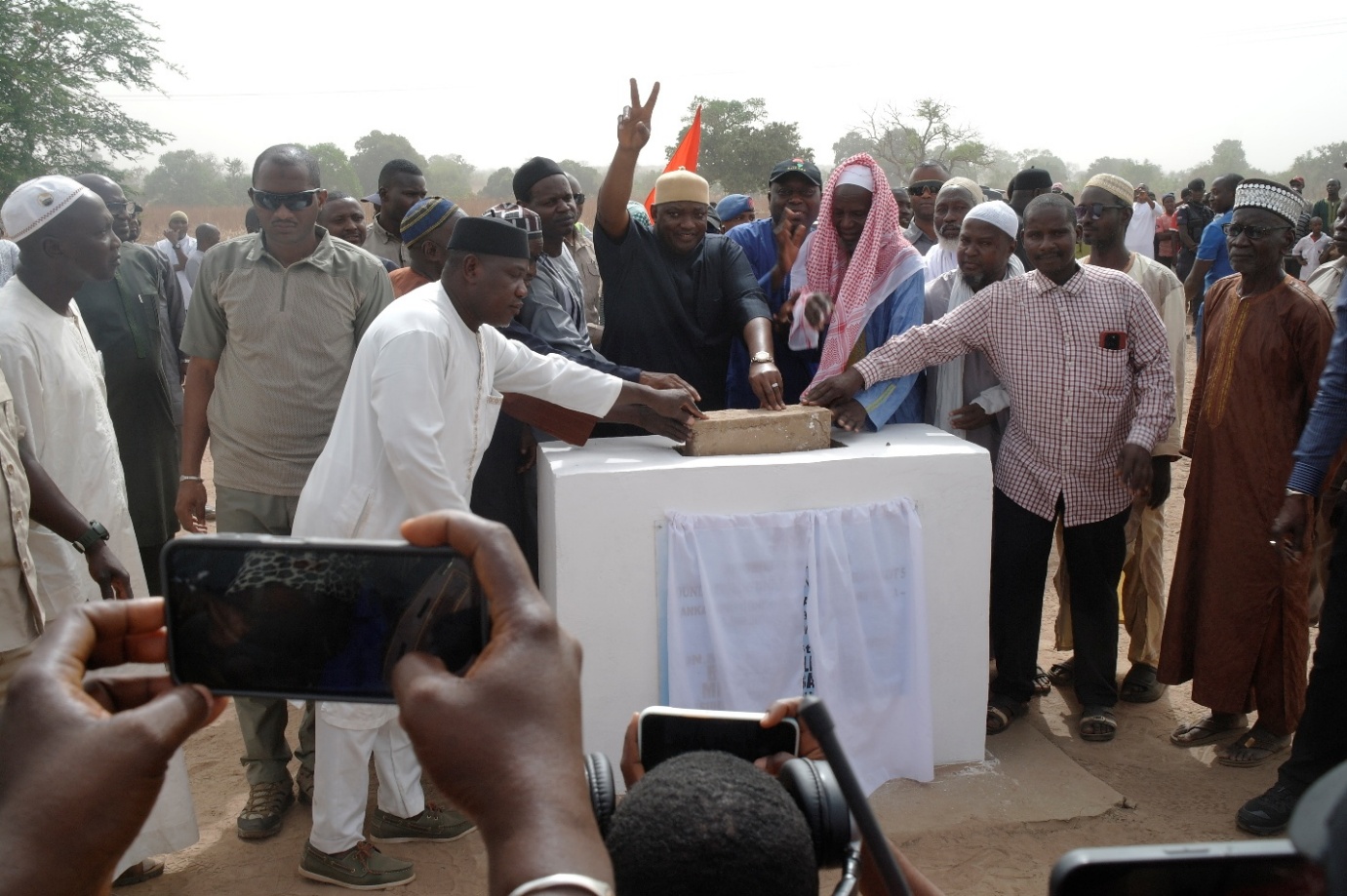
On Saturday, 16 May, the President continued his tour with the laying of foundation stones for four major road projects across CRR and URR under the “Connect Gambia Initiative”.
The projects are part of the government’s broader strategy to expand rural road networks and enhance access to essential services and markets.
The four road corridors launched include:
- Mankamang Kunda–Julangel Road
- Basse Mosque Road–Kaba Kama Road
- MRC Road–Suduwol Road
- Suduwol–Tinkinjo Road
These projects are expected to improve inter-community connectivity across agricultural and trading zones in the eastern regions of the country.
Scope of the road network expansion
According to project details disclosed during the tour, the infrastructure programme is divided into several lots covering multiple districts and settlements.
Lot 5 covers an 11.2-kilometre stretch linking Mankamang Kunda, Julangel, Sare Musa, Sare Wollom, and Banatenda.
Lot 6 spans 23.2 kilometres, connecting Girouba, Sabusireh, Touba Tafsir, Darsilame, Allunhari Abdou, Banico Keh Kor, Kumbita, Samba Tako, and Kabakama.
A third corridor includes the 24-kilometre Suduwol–Missiraba Mariama–Nyamanari Road, while a fourth project covers a 26.9-kilometre route linking Tinkinjo, Sanunding, Dingiring, Madina Samako, and Diabugu Ba Sillah.
Officials from the National Roads Authority (NRA) said the works are designed as all-weather roads with full engineering components including earthworks, drainage systems, culverts, and bituminous surfacing.
President Barrow: infrastructure central to national development
Addressing residents at a joint meeting in Tinkinjo, President Barrow described the projects as a continuation of his government’s national infrastructure expansion agenda under the development blueprint “Yiriwa”.
He said the road projects were designed to address long-standing transport constraints affecting rural communities.
“It is a great pleasure to be here after a productive day of laying foundation stones in different communities,” he said.
“These projects are not isolated gestures. They are part of sustained efforts to open up our regions and connect communities to the rest of the country.”
The President emphasised that infrastructure development remains central to his administration’s strategy, noting that poor road access continues to affect farmers, traders, students, and patients.
“My administration views infrastructure not just as development, but as the foundation upon which meaningful and sustainable progress is built,” he said.
Financing and scale of the programme
President Barrow disclosed that the government is currently rolling out a 1,500-kilometre nationwide road programme under Phase One, with 781 kilometres already underway.
He said over 385 kilometres are located in URR, while approximately 395 kilometres are being constructed in CRR.
The total cost of the programme is estimated at over D20 billion, financed largely through domestic resources using what he described as innovative financing mechanisms developed by his administration.
“This is a powerful demonstration of our growing capacity to drive our own development without dependence on external donors,” he said.
He added that the government remains open to partnerships but insisted that national ownership of development projects is essential.
“Our partners can support us, but the responsibility lies with The Gambia. We must take the lead.”
Economic and social impact of the roads
President Barrow said the road infrastructure would significantly reduce transport costs, improve market access, and enhance agricultural productivity.
He noted that farmers producing groundnuts, sesame, and cereals would benefit from reduced post-harvest losses and improved access to urban markets.
“These roads will improve trade, encourage investment, and create opportunities for entrepreneurs and small businesses,” he said.
The President also highlighted the role of the roads in strengthening regional trade, particularly under the African Continental Free Trade Area (AfCFTA), and improving cross-border commerce with Senegal.
He further noted that improved roads would enhance access to healthcare services, reduce ambulance response times, and improve mobility in remote communities.
“Roads connect communities. They reduce isolation and bring people closer to national development.”
Government oversight and community responsibility
President Barrow urged the National Roads Authority to ensure strict supervision and adherence to quality standards throughout project implementation.
“The funds belong to the Gambian people and must be used responsibly,” he said.
He also called on local communities, including traditional leaders, youth groups, and women’s organisations, to take ownership of the infrastructure and help protect it.
“The success of these projects depends on cooperation between government and communities.”
NRA outlines technical standards
Speaking during the tour, the Managing Director of the National Roads Authority, Sulayman Suwareh, commended technical teams for their preparatory work, including feasibility studies and surveys.
He said the roads are being constructed to high engineering standards, incorporating subgrade improvements, compacted base layers, and durable asphalt surfacing.
He further highlighted the inclusion of drainage systems such as culverts and side drains to ensure resilience against erosion and seasonal flooding.
Suwareh assured that strict supervision mechanisms are in place to ensure quality delivery and value for public investment.
Urban and regional infrastructure inspection
Earlier in the week, on 12 May 2026, President Barrow conducted inspections of ongoing urban road projects in the Kanifing Municipality and West Coast Region.
He described the works as part of the government’s earlier 365-kilometre road programme, which he said is now nearing completion.
According to the President, about 80 per cent of the ongoing works are at advanced stages.
He expressed satisfaction with contractors’ performance and indicated that most projects would be completed before the end of the year.
The inspection tour covered multiple locations including Brikama, Sukuta, Jabang, Wellingara, Old Yundum, Gunjur, Sanyang, Brufut, and Senegambia.
Broader infrastructure agenda
President Barrow reiterated that infrastructure development extends beyond roads, including investments in schools, hospitals, electricity, and administrative buildings.
He said the government is simultaneously addressing decades of infrastructure deficits inherited over the past 50 years.
“This is about transforming the country across all sectors at the same time,” he said.
Conclusion of tour and public reception
The President’s tour concluded with visits to several communities where he was warmly received by residents.
At Jaliba Junction, he was welcomed by renowned kora musician Jaliba Kuyateh, who performed live as part of the reception.
Government officials say several completed projects across the country are expected to be inaugurated in the coming months as part of a broader national development rollout.
President Barrow expressed confidence that the ongoing infrastructure programme would mark a significant milestone in The Gambia’s development trajectory.
“We are finishing our term on a very high note,” he said.
About the Author