By Fatou Krubally
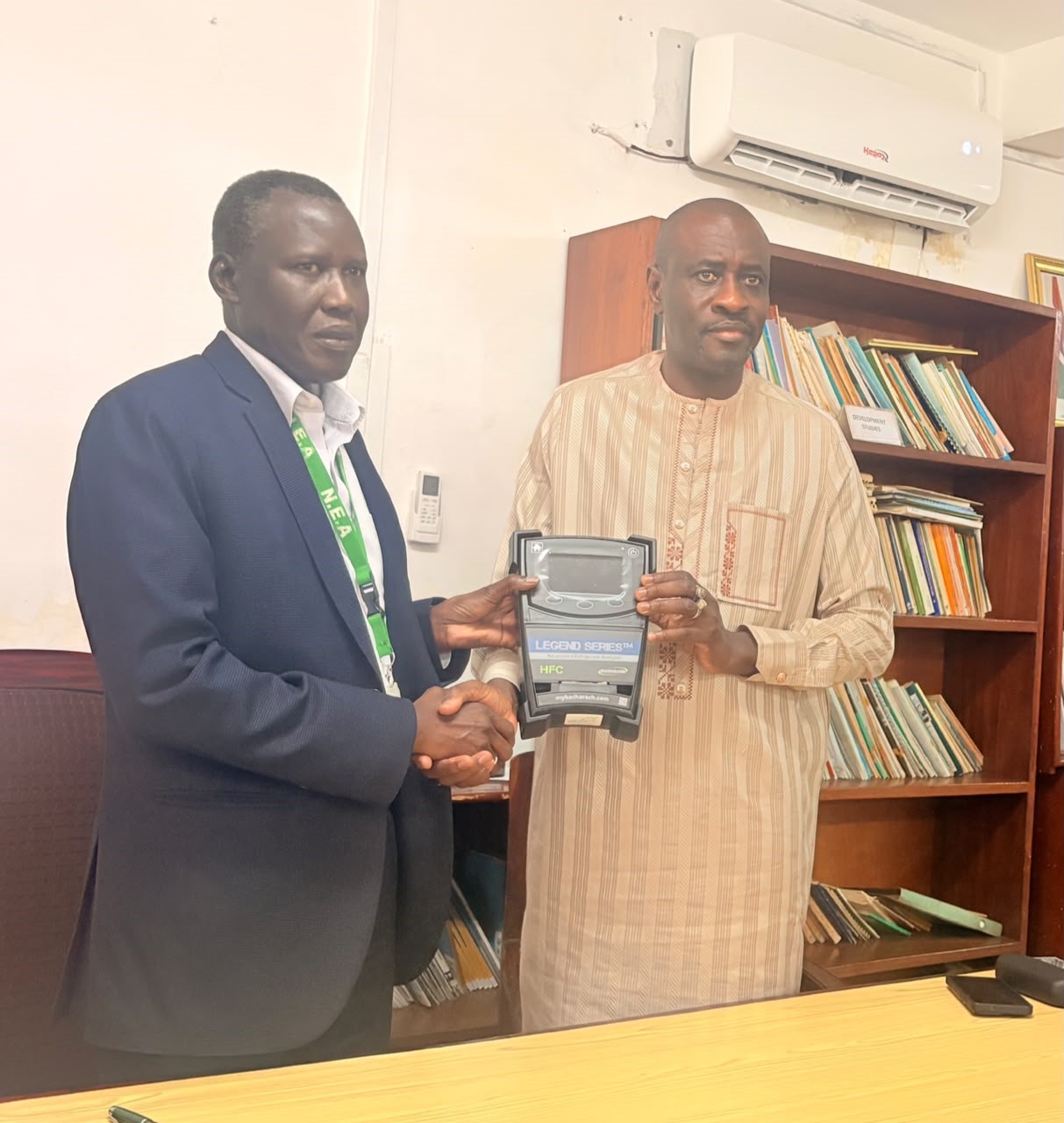
The National Environment Agency (NEA) has handed over refrigerant testing equipment valued at approximately US$20,000 to the Gambia Revenue Authority (GRA) to strengthen border controls and improve enforcement of environmental regulations.
The equipment, donated by the United Nations Industrial Development Organization (UNIDO), was handed over on Thursday, 15 October 2026, at the NEA premises in Kanifing.
It is intended to help customs officers identify imported refrigerants, verify their composition and detect consignments containing substances that do not correspond with their labels or import declarations.
Speaking at the handover ceremony, NEA Executive Director Dawda Badjie said the equipment would enable officers at entry points to establish the actual composition of imported refrigerants rather than rely solely on information provided on their containers.
He noted that some refrigerants could be incorrectly labelled, making it difficult for customs officers to determine their contents through visual inspection alone.
Dr. Badjie said the testing instruments would improve the identification of such substances and help prevent the importation of products that do not meet applicable regulatory requirements.
He urged the relevant institutions to deploy the equipment at designated entry points and ensure that it was used effectively in the field.
He also stressed the importance of proper handling and maintenance to protect the investment and ensure the equipment’s continued effectiveness.
Dr. Badjie thanked UNIDO for supporting the initiative and commended the GRA for its cooperation with the NEA in controlling ozone-depleting substances and other potentially harmful materials.
For his part, GRA Commissioner of Customs Alagie K. Mbaye said the authority’s mandate extended beyond revenue collection to include the protection of society and the facilitation of legitimate trade.
He said customs officers were responsible for controlling goods entering the country, including substances that could pose risks to public health and the environment.
Mr. Mbaye said the new equipment would enhance officers’ ability to verify refrigerants at border points, identify potentially mislabeled products and detect inaccurate declarations.
He added that the GRA would work with the NEA and UNIDO to ensure that officers received the technical guidance and training required to operate and maintain the instruments properly.
The commissioner also reaffirmed the longstanding cooperation between the GRA and the NEA, noting that the two institutions had collaborated on training and other activities aimed at strengthening environmental enforcement.
The handover forms part of efforts to improve compliance with regulations governing ozone-depleting substances and their alternatives.
The equipment is expected to strengthen border inspections and help prevent the entry of refrigerants that fail to meet applicable requirements, contributing to the protection of the ozone layer and the environment.
About The Author