By Yunus S Saliu
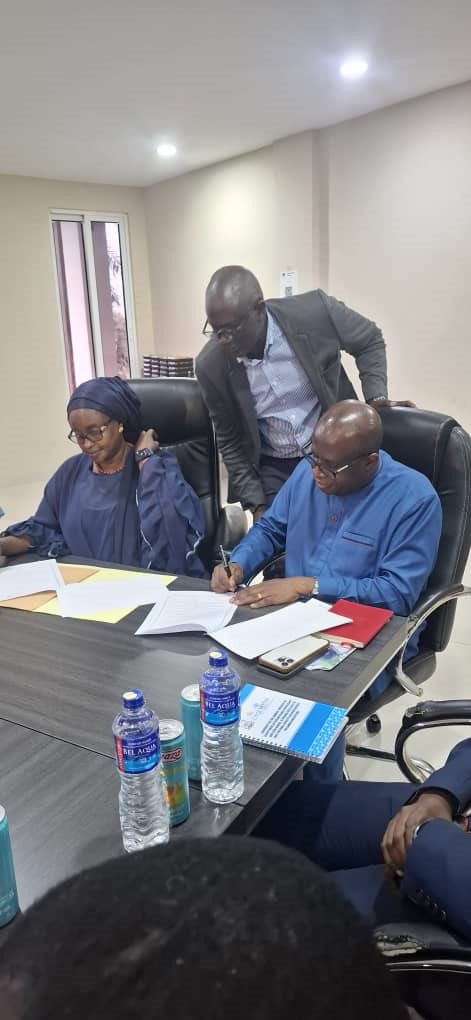
The Gambia Tourism Board (GTBoard) and the University of The Gambia (UTG) have signed a Memorandum of Understanding (MOU) to strengthen collaboration in tourism training, research, policy development and human capital development aimed at advancing the country’s tourism sector.
The agreement, which followed about a year of consultations between both institutions, is expected to deepen cooperation in professional training, internships, research on emerging tourism issues and curriculum development to ensure graduates are equipped with industry-relevant skills.
Speaking at the signing ceremony, GTBoard Director General Ida Jeng-Njie described the partnership as a significant milestone, saying the presence of the university’s top management reflected the importance attached to the agreement.
“It is not very usual that I have all my heads of departments in one room when we are signing an MOU. This shows that you are valued and that the MOU we are about to sign is of great importance to the Gambia Tourism Board and the tourism industry as a whole,” she said.

DG Jeng-Njie said combining the practical experience of the tourism industry with the university’s academic expertise would help position the sector where it ought to be.
She noted that GTBoard’s mandate extends beyond destination marketing to include tourism human resource development and training for both the formal and informal sectors, making the partnership a natural fit.
“It is not a coincidence that we want to partner with you in the area of training,” she said.
The Director General revealed that UTG researchers had recently supported GTBoard in researching the country’s all-inclusive tourism model, a subject she said had generated misconceptions and debate over the years.
She said the research would help guide the Board, tourism stakeholders and policymakers in making informed decisions on the issue.
“There are so many opportunities that we can collaborate on,” she said, adding that the Board also intends to use the university more extensively for staff development.
“Charity begins at home. When we have the competence at the university, why should we send our staff away for studies?”
She commended UTG lecturers for their professionalism and expressed confidence in implementing the activities outlined in the agreement.
Responding, UTG Vice Chancellor Professor Herbert Robinson described the University of The Gambia as the country’s premier higher education institution and reaffirmed its commitment to supporting the tourism sector through teaching, research and professional development.
Professor Robinson noted that the university already offers diploma and bachelor’s degree programmes in Tourism and Hospitality but stressed that the partnership would go beyond classroom education.
“We believe this collaboration will provide the right environment for us to continuously develop the content of those programmes because tourism is dynamic,” he said.
He said the tourism industry now faces global competition, requiring The Gambia to continuously adapt and strengthen its competitive edge.
Reflecting on the country’s tourism history, he recalled a time when The Gambia was one of Africa’s most visible destinations in European travel agencies, but said increased competition from other destinations now demands innovation and evidence-based policy decisions.
The Vice Chancellor emphasised the university’s capacity to support policy formulation through research, highlighting the institution’s Policy Institute and its team of researchers as valuable resources for addressing issues affecting the sector.
He also pointed to UTG’s Centre International de Formation des Autorités et Leaders (CIFAL), part of a global network of training centres, as another platform that could provide specialised short-term training for tourism professionals.
According to him, such programmes would help industry practitioners remain updated on international best practices and emerging trends.
Professor Robinson also advocated for more responsible tourism by strengthening local supply chains so that Gambian farmers, fisherfolk and producers benefit more directly from the industry.
He cited examples of hotels relying on imported produce because of quality specifications, arguing that research could help develop practical solutions that enable local producers to meet industry standards.
“A sustainable tourism sector integrates the local supply chain,” he said.
Beyond research and training, he said the MOU would also expand internship opportunities, allowing students to gain practical industry experience while giving GTBoard access to emerging talent.
He expressed confidence that the partnership would contribute to building the skilled workforce and policy framework needed to support the continued growth and competitiveness of The Gambia’s tourism industry.
About The Author