By Haddy Touray
United Democratic Party (UDP) leader Ousainu Darboe has challenged the government to provide evidence on who initiated major road and bridge projects in the Upper River Region (URR), claiming the projects were secured through his efforts while serving in government.
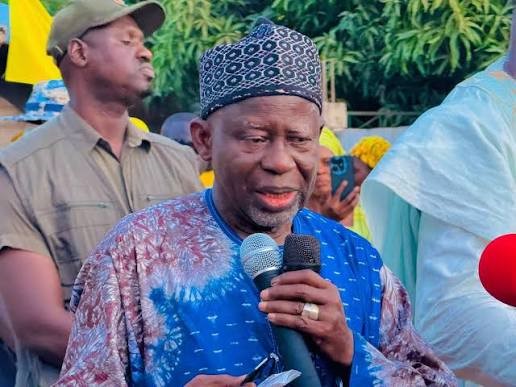
Speaking Saturday at a UDP-led Gambia First Coalition rally in Allunhari, Darboe disputed the government’s claims regarding its role in delivering some of the region’s infrastructure projects.
“I challenge them to do that,” Darboe said, urging government officials to publicly dispute his account and demonstrate who was responsible for securing the projects.
Darboe said he joined President Adama Barrow in laying foundation stones for some of the projects and questioned why other senior government officials, including ministers responsible for health and agriculture, had not been given similar roles if the projects originated from their respective ministries.
He claimed the roads and bridges were secured through his efforts while he served in Barrow’s government. Darboe served as vice-president and foreign minister before his dismissal in 2019.
He also sought to distinguish between the financing arrangements for infrastructure projects secured during his tenure and those undertaken by the current administration.
Darboe claimed the bridges secured during his tenure did not impose a financial burden on Gambians, while accusing the current government of relying heavily on loans to finance road construction.
He did not present documentation at the rally to substantiate the financing arrangements he described.
Darboe pledged that a UDP government would expand the country’s road network while reducing reliance on borrowing for infrastructure development.
Funds that would otherwise be used to service such loans, he said, could instead be directed towards healthcare, education, agriculture and other public services.
Darboe also urged young voters in the URR to take ownership of the Dec. 5 presidential election, saying its outcome would have a greater impact on their future than that of the older generation.
“This is your election,” he told the crowd.
He said the political freedoms enjoyed by young Gambians today were made possible by sacrifices made by earlier generations of political activists.
Darboe cited veteran political figures, including Alagie Nfamara Jabbie and Alagie Mba Sillah, saying they had already played their part and that responsibility now rested largely with Gambians in their 20s, 30s and 40s.
He urged young voters to support the UDP, presenting the election as a choice between what he described as progress and continued economic hardship.
On the cost of living, Darboe recalled a political meeting in Garawol in 1996, when he said he warned voters about the economic consequences of electing former President Yahya Jammeh.
He said a bag of rice cost about D250 at the time and that he had predicted the price could rise to D500 under Jammeh. According to Darboe, rice prices subsequently rose well beyond that level.
He also recalled a later government promise to reduce the price of a bag of rice from D1,500 to D750, but claimed prices had instead continued to rise, with some consumers now paying between D2,000 and D3,000.
Darboe said the comparison demonstrated the need for voters to judge political promises against their everyday economic circumstances.
He warned against giving President Barrow another term, arguing that a third administration under Barrow would deepen the country’s economic and governance challenges.
He accused the government of failing to adequately prioritise hospitals and farmers, claiming that public resources were being spent on vehicles, workshops and conferences at the expense of essential services.
Darboe also criticised the government’s management of agriculture, arguing that another five years under the current administration would further weaken a sector on which many Gambians depend.
Darboe thanked supporters in the URR and partners in the Gambia First Coalition ahead of the presidential election.
He rejected suggestions that the region was hostile territory for the opposition, saying the turnout demonstrated the UDP’s longstanding support in the area.
He also rejected claims that the UDP was dominated by Mandinkas, pointing to the contribution of members of the Sarahule community to the party’s development in the URR.
Darboe cited longstanding party figures from the community, including Alagie Gitteh Sankareh, and said Sarahule elders had helped establish and sustain the UDP in the region.
He urged supporters to continue organising and mobilising, saying veteran members could still play an important role despite their advancing age.
Darboe singled out Alagie Mba Sillah, urging him to continue contributing to the party and use his standing and influence to encourage community members to participate in the political process.
Darboe also paid tribute to two supporters who died in a road accident while travelling in connection with the gathering.
He described them as heroes and said their deaths placed a responsibility on party members to continue their political work in their memory.
“These individuals have left us with a mission we must fulfil in their honour,” Darboe said. “We cannot let them down. They have sacrificed for this country, and we must make them proud.”
He also prayed for supporters injured in the accident who were receiving treatment at Basse District Hospital.
Darboe concluded by urging supporters to remain united and reject ethnic divisions in politics.
He said The Gambia belonged equally to all its ethnic communities and that no group should consider itself superior to another.
He also called on supporters to reject what he described as politics based on deception and instead focus on maintaining unity ahead of the presidential election.
About The Author