
By Fatou Krubally
The Central Bank of The Gambia (CBG) has maintained its Monetary Policy Rate (MPR) at 14 percent, citing persistent inflationary pressures and continued uncertainty in the global economic environment.
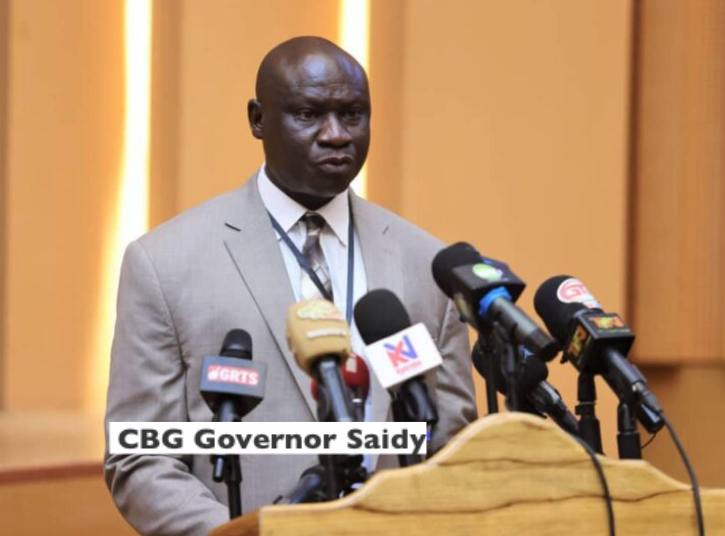
Governor Buah Saidy announced the decision on Thursday following a meeting of the Monetary Policy Committee (MPC), which reviewed domestic and international economic conditions and assessed the country’s near-term economic outlook.
The Committee said the Gambian economy remained resilient despite heightened geopolitical tensions. Provisional estimates indicate that real gross domestic product (GDP) grew by 5.7 percent in 2025, while the 2026 growth forecast has been revised upward to 5.8 percent.
The projected growth is expected to be driven by continued expansion in tourism, construction, trade, financial services, investment and remittance inflows.
However, the CBG warned that the outlook remains subject to downside risks, including escalating geopolitical tensions and adverse weather conditions that could affect agricultural production, food supply, rural incomes and inflation.
Inflation moderates
The MPC noted that headline inflation eased to 7.0 percent in July 2026 from 7.6 percent in June, largely reflecting lower food prices. Food inflation declined to 5.8 percent from 6.6 percent during the same period.
Non-food inflation, however, increased to 8.9 percent, mainly due to higher transport costs, while underlying inflation remained above the bank’s implicit medium-term target of 5 percent.
External sector stable
The Central Bank reported that the current account deficit widened to US$34.6 million, equivalent to 1.3 percent of GDP, in the second quarter of 2026 from US$29.7 million in the previous quarter.
The goods trade deficit narrowed to US$242.5 million as exports rose by 21.9 percent to US$171 million, while imports fell by 2.6 percent to US$413.5 million.
Private remittance inflows increased to US$265.5 million, providing continued support to foreign exchange supply in the domestic market.
The Dalasi remained broadly stable, recording only marginal depreciation against major international currencies. Gross official reserves stood at US$563.9 million at the end of July 2026, representing 4.3 months of prospective import cover.
Fiscal position strengthens
The MPC also reported an improvement in the government’s fiscal performance during the first half of 2026.
The overall fiscal deficit, including grants, narrowed to D3.8 billion, or 1.7 percent of GDP, compared with D6.1 billion, or 3.1 percent of GDP, in the corresponding period of 2025.
Excluding grants, the fiscal deficit declined to D10.2 billion from D12.8 billion, reflecting stronger domestic revenue mobilisation and expenditure rationalisation.
Despite the improvement, domestic debt rose to D55.43 billion, with short-term instruments accounting for more than half of the debt stock, highlighting continued refinancing risks.
Cautious monetary policy stance
The Committee also maintained the required reserve ratio for commercial banks at 13 percent, the standing deposit facility rate at 5 percent and the standing lending facility rate at 15 percent.
According to the MPC, the combination of stronger economic activity, moderating headline inflation, persistent non-food price pressures and global uncertainty warrants a cautious monetary policy stance.
The Central Bank reaffirmed its commitment to bringing inflation back towards its medium-term target while remaining ready to respond to evolving domestic and external economic conditions.
About The Author