By: Nicholas Bass
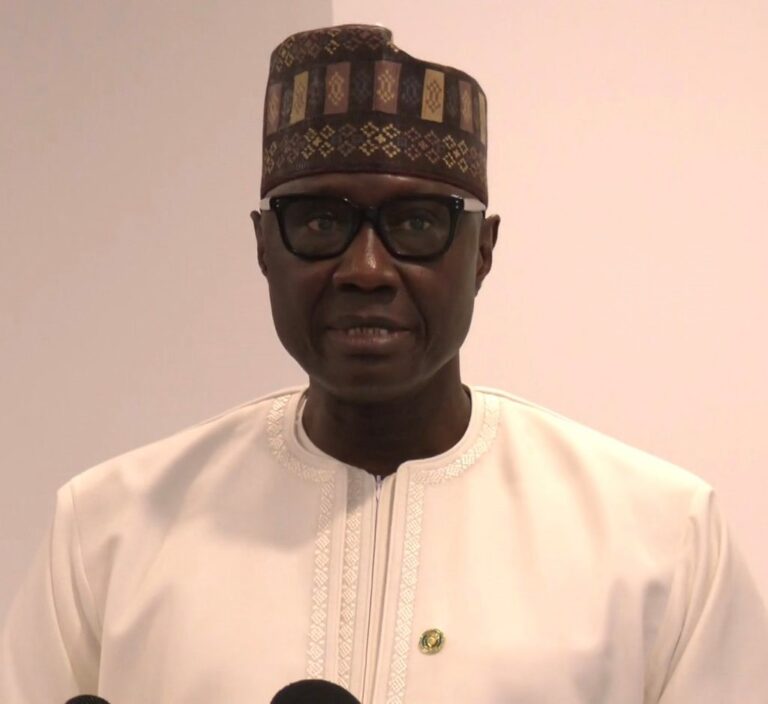
The Governor of the Central Bank of The Gambia, Hon. Buah Saidy, has stated that Composite Index of Economic Activity (CIEA) pointed to an average growth in economic activity of 5.8 percent in 2024, rising to 6.1 percent in January 2025.
“Against this backdrop, CBG staff projected 5.7 percent growth for the Gambian economy in 2024, rising to 5.9 percent in 2025. However, renewed global trade fragmentation, geopolitical tensions, and volatility in commodity prices continue to pose significant risk to this outlook. On the domestic economy, preliminary data from the Gambia Bureau of Statistics indicate that the Gambian economy grew on average by 7.2 per cent in the first three quarters of 2024. This strong performance was precipitated by solid growth in financial services, distributive trade, construction, mining and quarrying,” reported governor Saidy in a press briefing last week.
According to the CBG boss, the Central Bank’s Business Sentiment Survey for the fourth quarter of 2024 indicated an improvement in business sentiments on the prospects of the Gambian economy. “Majority of respondents expect economic activity to grow in the next three months, indicating favourable near-term outlook. Although 3 inflation expectations remain elevated, respondents expressed optimism that inflation will continue to moderate,” he reported.
Hon. Saidy explained that preliminary balance of payments estimates indicate a modest improvement in the current account balance in 2024, supported by a rebound in tourism, private remittances, and official inflows.
“The current account balance moderated to a deficit of US$74.4 million (3.2 percent of GDP) in 2024, from a deficit of US$120.1 million (5.5 percent of GDP) in 2023,” he further explained.
Governor Saidy, however, reported that the deficit in the goods account continued to widen, from US$877.4 million (40.3 percent of GDP) in 2023, to US$1.0 billion (44.6 percent of GDP) in 2024.
“The growing deficit in the trade balance continues to be driven by increasing imports of food items, electricity and fuel, on the back of a low export base,” he added.
He stated that the domestic foreign exchange market continued to function smoothly with robust activity volumes.
“From January to December 2024, total activity volumes, measured by aggregate purchases and sales of foreign currency, stood at US$2.1 billion, compared to US$1.9 billion reported in the same period a year ago. Private remittance inflows, which continues to be a major source of foreign currency supply, remains robust, amounting to US$775.6 million in 2024, higher than US$746.8 million reported in 2023,” he explained.
“The exchange rate of the Dalasi continues to be relatively stable, mirroring the improved supply conditions. From September to December 2024, the Dalasi depreciated against the US dollar by 2.3 percent, the British pound sterling by 1.6 percent and the CFA franc by 0.9 percent. However, it slightly appreciated against the Euro by 0.3 percent in the review period.
“The Central Bank continues to hold comfortable levels of international reserves, amounting to US$515 million in January 2025. This is sufficient to finance over 4.6 months of prospective imports of goods and services,” the CGB boss enthused.
Governor Saidy reported that preliminary estimates of government fiscal operations for 2024 indicate that despite strong revenue performance, the overall deficit widened.
“The overall deficit, excluding grants, increased from D17.1 billion (11.9 percent of GDP) reported in 2023 to D18.9 billion (13.2 percent of GDP) in 2024. Similarly, the overall budget deficit, including grants, increased to D6.7 billion (4.7 percent of GDP) in 2024, compared to D5.1 billion (3.6 percent of GDP) in 2023,” he explained.
“The stock of domestic debt rose by 12.2 percent to D46.4 billion in 2024, from D41.3 billion in December 2023. However, the ratio of domestic debt to GDP declined from 28.2 percent in 2023 to 26.9 percent in 2024. Short-term government securities, with a maturity of one year or less, accounted for 48.6 percent of the total domestic debt stock. The weighted average treasury bill rate declined, from 11.3 percent in 2023 to 10.4 percent in 2024,” he stated, adding that the interbank Dalasi market remained stable with robust activity volumes.
“Total trade activity volumes amounted to D13.1 billion in 2024, slightly lower than D14.2 billion reported in December of 2023. The weighted average interest rate prevailing in the interbank market declined from 7.5 percent in 2023 to 5.6 percent in 2024, following the three-month Treasury bills rate. The banking sector continues to grow, with the industry asset base rising by 18.3 percent to D100.3 billion in 2024. Similarly, total customer deposits, which continue to be the main source of funding for banks, increased by 13.1 percent in 2024 to stand at D66.4 billion,” he stated.
About The Author