
By Fatou Krubally &Haddy Touray
The Monetary Policy Committee (MPC) of the Central Bank of The Gambia has decided to maintain the Monetary Policy Rate (MPR) at 14 percent following its latest assessment of domestic and global economic developments and the near-term inflation outlook.
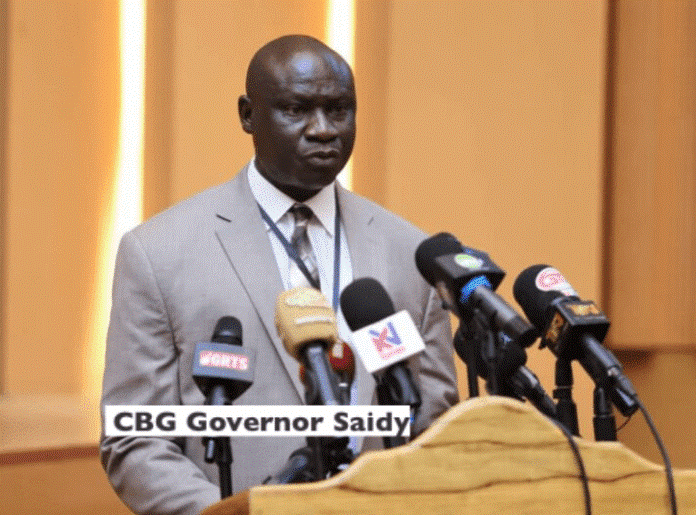
Central Bank Governor Buah Saidy announced the decision in Banjul on Thursday, noting that the Committee carefully reviewed global economic conditions, domestic macroeconomic performance, and emerging risks before reaching its conclusion. Alongside the MPR, the Committee also maintained the Required Reserve (RR) ratio at 13 percent, the standing deposit facility rate at 5 percent, and the standing lending facility rate at 15 percent.
According to the Governor, the decision reflects the need to balance sustained economic growth with rising inflationary pressures, both globally and domestically.
The Committee observed that global economic activity is expected to moderate in 2026 amid rising geopolitical tensions, persistent policy uncertainty, and renewed inflationary pressures. The International Monetary Fund (IMF), in its April 2026 World Economic Outlook, projected global growth at 3.1 percent in 2026, representing a downward revision of 0.2 percentage points from earlier estimates.
Advanced economies are projected to grow by 1.8 percent, while emerging markets and developing economies are expected to expand by 3.9 percent. Growth in Sub-Saharan Africa is forecast to slow slightly from 4.5 percent in 2025 to 4.3 percent in 2026, reflecting tighter fiscal conditions, currency pressures, and spillover effects from geopolitical conflicts.
Inflation at the global level is also expected to rise temporarily, with the IMF projecting headline inflation at 4.4 percent in 2026 before easing to 3.7 percent in 2027. The increase is largely attributed to higher energy and transport costs linked to ongoing geopolitical disruptions.
The committee highlighted a sharp rise in global commodity prices, particularly oil. The IMF All-Commodity Price Index rose by 28.1 percent in April 2026 compared to January, driven by a surge in crude oil prices from US$60 to US$100 per barrel.
This development, the Bank noted, has been largely influenced by geopolitical instability in the Middle East, which has disrupted supply chains, maritime transport routes, and global trade flows.
Despite external headwinds, the Gambian economy continues to demonstrate resilience. Economic activity remained strong in 2025 and is expected to maintain momentum in 2026, supported by growth in tourism, construction, trade, and financial services.
The Central Bank’s Composite Index of Economic Activity indicates that the economy recorded an average growth of 3.5 percent in the first quarter of 2026.
Real GDP growth is now projected at 5.7 percent for 2026, though this represents a downward revision of 0.5 percentage points due to global energy price increases and heightened uncertainty.
Business sentiment remains broadly positive, with firms benefiting from seasonal tourism demand, festive consumption patterns, and expansion in construction and digital financial services. However, inflation expectations and exchange rate concerns remain elevated.
Preliminary balance of payments data shows a widening current account deficit, which increased to US$20.83 million (0.8 percent of GDP) in the first quarter of 2026, compared to US$13.19 million (0.5 percent) a year earlier.
The deterioration was driven mainly by rising imports of fuel, cereals, vehicles, and industrial materials, despite improvements in tourism receipts and remittance inflows.
The goods trade deficit also widened to US$284.37 million, reflecting a 20.6 percent increase in imports. Although exports rose to US$140.28 million, they remained insufficient to offset import growth.
The domestic foreign exchange market remained broadly stable during the review period, with increased transaction volumes. Total foreign currency transactions reached US$644.19 million, up from US$590.8 million in the previous quarter.
Remittance inflows also recorded strong growth, reaching US$246.08 million between January and March 2026—an increase of 17.2 percent year-on-year. The Dalasi remained largely stable, posting marginal gains against the US Dollar and British Pound, while showing slight depreciation against the Euro, Swiss Franc, and CFA franc.
Gross international reserves stood at US$556.5 million by end-April 2026, sufficient to cover 4.3 months of imports, providing a buffer against external shocks.
Government fiscal operations improved in the first quarter of 2026, with the overall deficit narrowing to D2.3 billion (1.2 percent of GDP), compared to D2.7 billion in the same period of 2025. Improved domestic revenue mobilisation and fiscal consolidation efforts contributed to the better performance.
Domestic debt rose slightly to D53.3 billion, with short-term instruments accounting for the majority of the stock.
Money market rates increased moderately, reflecting tighter liquidity conditions and government borrowing pressures. The 91-day Treasury bill yield rose to 6.2 percent, compared to 6.0 percent a year earlier.
Broad money growth accelerated to 23.2 percent in March 2026, while private sector credit expanded by 35.4 percent. The banking sector remained stable, with total assets rising to D129.9 billion and deposits increasing by 20 percent.
Capital adequacy remained strong at 24.3 percent, while liquidity levels stood well above regulatory requirements at 78.3 percent. Non-performing loans improved to 7.7 percent, down from 13.5 percent a year earlier.
Headline inflation rose to 7.0 percent in April 2026, up from 6.4 percent in January. The increase was driven by higher food and transport costs as global energy prices climbed.
Core inflation measures also increased sharply, indicating that underlying domestic inflation pressures are strengthening. Food inflation rose to 6.7 percent, while non-food inflation climbed to 7.2 percent.
In view of the overall economic assessment, the MPC concluded that maintaining the current monetary policy stance is appropriate to support price stability while sustaining economic growth.
“The Committee remains committed to bringing inflation back to target in the medium term,” Governor Saidy stated. “We will continue to monitor domestic and external developments and stand ready to respond if conditions warrant action.”
About the Author