A Body Mid-Turn, New Ceramic Sculpture by Umar Abdulrasheed
Written By: Massamba Mbaye
There is a moment, just before a body changes direction, when every part of it disagrees with every other part. The feet have already committed. The hips are still catching up. The shoulders haven’t been told yet. That’s the exact moment Umar Abdulrasheed captures in Pivot, held in fired clay the way a photograph freezes a sprinter mid-stride, except this figure isn’t running. It’s turning, which is harder to pull off in a fixed material, since turning is more about hesitation than momentum. Clay, once shaped, does not get to keep changing its mind, and yet somehow this piece holds onto that in-between instant.
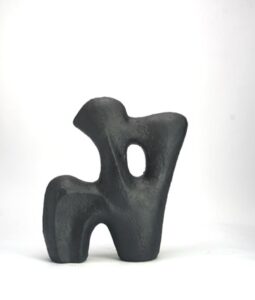
Pivot (Yíyí), Sokoto clay, traditionally fired by Umar Abdulrasheed.
The sculpture rests unevenly on two legs, while one is grounded and straight, the other kicked out at an angle that looks less like standing and more like mid-decision. Above them, the torso winds rather than settling. One oval opening, placed high rather than in the middle, draws your eye up to a small, tilted head already looking somewhere the rest of the body hasn’t caught up to yet. Nothing in Pivot faces forward. Every part is suspended between where it’s been and where it’s headed. And the rough, hand worked surface preserves that tension, leaving the marks of uncertainty visible rather than smoothing them out.
Colour completes the piece, and here it’s worth clarifying that none of the black was painted on. Pivot is made from Sokoto clay and darkened through traditional firing, allowing the fire itself to create its final colour. Under gallery light, the black absorbs detail at the centre and reveals it around the rougher edges, where traces of the maker’s hand remain visible. Instead of drawing attention to colour, the darkness pushes the eye toward the silhouette, making the turning figure stand out against the empty space. The blackness feels earned, not by the brush but by the fire.
What makes Pivot more than an exercise in imbalance is the way the void moves with the body instead of acting as a fixed centre. The opening could have been a point of stillness, but its tilt keeps it caught in the same motion as the figure. It suggests that even emptiness can move or at least appear to be caught mid-turn. More than the pose or colour, this small detail gives the sculpture its sense of resolution and it’s why it rewards a slower second look instead of settling for a quick glance across the room.
About The Author