By Yunus S. Saliu
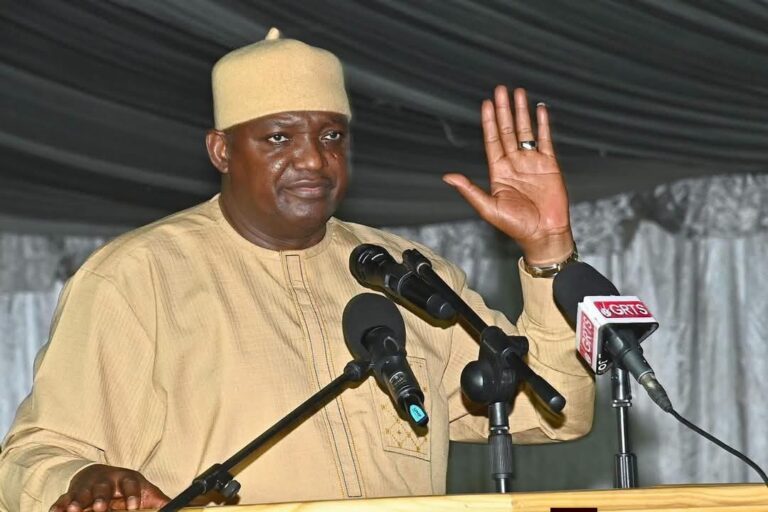
Gambian President Adama Barrow on Friday launched a series of major road infrastructure projects under the Connect Gambia Initiative in the Central River Region (CRR) and Upper River Region (URR), describing the programme as a transformative step towards national development.
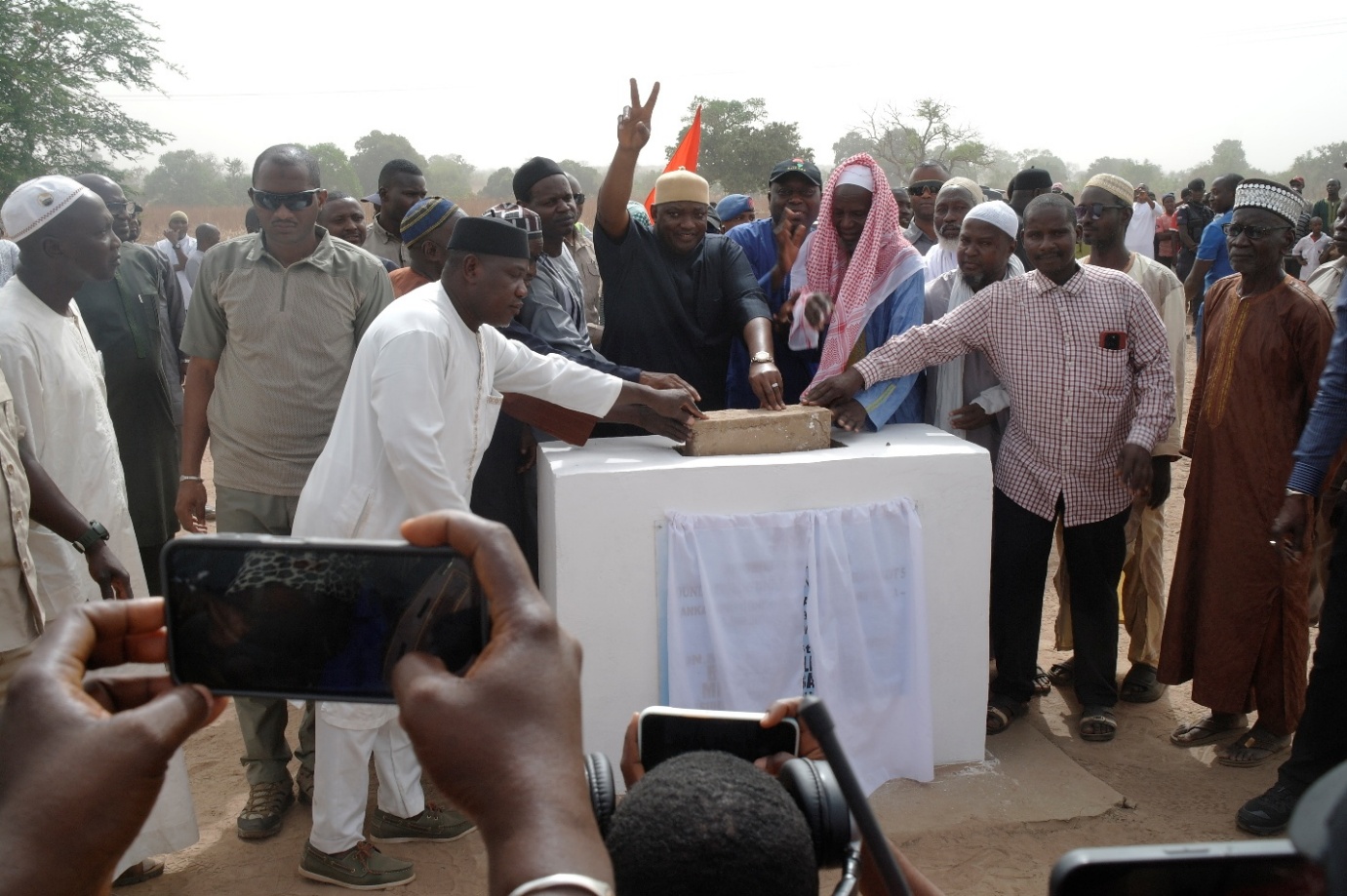
The President began the tour on 15 May with the inauguration of a newly constructed mosque before laying foundation stones for several roads across the two regions.
On Saturday, Barrow continued the exercise with the launch of four additional road projects linking communities in CRR and URR.
The projects include the Mankamang Kunda–Julangel Road, the Basse Mosque Road–Kaba Kama Road, the MRC Road–Suduwol Road, and the Suduwol–Tinkinjo Road.
President Barrow also inspected project sites before addressing residents during a joint community meeting held in Tinkinjo, URR.
The first project under Lot 5 covers an 11.2-kilometre stretch connecting Mankamang Kunda, Julangel, Sare Musa, Sare Wollom, and Banatenda.
The second project under Lot 6 spans 23.2 kilometres and links Girouba, Sabusireh, Touba Tafsir, Darsilame, Allunhari Abdou, Banico Keh Kor, Kumbita, Samba Tako, and Kabakama.
The third project involves the 24-kilometre Suduwol–Missiraba Mariama–Nyamanari Road, while the fourth covers the 26.9-kilometre Tinkinjo–Sanunding–Dingiring–Madina Samako–Diabugu Ba Sillah Road.
Addressing residents, President Barrow said the projects formed part of his government’s broader strategy to expand infrastructure and improve connectivity in rural Gambia.
“It is a great pleasure to be here with you after a productive day of laying foundation stones in different communities in the Upper River Region,” he said.
The President noted that the new projects build on earlier interventions such as the URR Ring Roads, Saloum Roads, Niani Roads, and Sami Roads projects.
“These projects are not isolated gestures. They are part of sustained efforts to open up our regions and connect communities to the rest of the country,” he added.
Barrow said infrastructure development remains central to his administration’s development agenda under the national development blueprint, Yiriwa.
“My administration views infrastructure not just as an aspect of development, but as the foundation upon which meaningful and sustainable progress is built,” he stated.
He said poor road access continues to affect farmers, businesses, students, patients, and rural communities, stressing that improved roads are essential for inclusive development.
According to the President, the government is implementing 781 kilometres of paved all-weather roads under Phase One of a nationwide 1,500-kilometre road construction programme.
He disclosed that more than 385 kilometres of the roads are located in URR, while about 395 kilometres are in CRR.
Barrow says the projects are being financed through domestic resources under what he described as an innovative financing mechanism introduced by his administration.
“This is a powerful demonstration of our growing capacity to drive our own development without dependence on external donors,” he said.
The president added that the roads would support agricultural production by reducing transport costs, limiting post-harvest losses, and improving market access for farmers.
“These roads will improve trade, encourage investment, and create opportunities for entrepreneurs and small businesses,” he added.
He also highlighted the importance of the roads in boosting cross-border trade with neighbouring Senegal and creating opportunities under the African Continental Free Trade Area (AfCFTA).
Barrow further said improved roads would enhance access to healthcare services, improve ambulance response times, and reduce isolation in remote communities.
“Roads connect communities. They reduce isolation and bring people closer to the benefits of national development,” he said.
The President urged the National Roads Authority (NRA) to ensure strict supervision and quality control during implementation.
“The funds we are investing belong to the Gambian people and must therefore be used responsibly,” he warned.
He also called on local communities, including traditional leaders, youth groups, and women’s associations, to support and protect the infrastructure projects.
Speaking earlier, the Managing Director of the National Roads Authority, Sulayman Suwareh, said the projects would improve mobility, open up agricultural zones, and address longstanding transportation challenges in the region.
“Road infrastructure is fundamental to development. These roads are not simply construction projects; they are enablers of productivity, social inclusion, and economic resilience,” he said.
Suwareh said all roads would be constructed to all-weather standards with engineering works including surveying, earthworks, subgrade improvement, compacted sub-base layers, base course construction, and sealed bituminous surfacing.
He added that drainage systems, culverts, and erosion protection measures would also be incorporated to ensure durability and long-term performance.
The NRA boss assured residents that strict supervision and quality control measures would be maintained throughout construction.
He called on communities in Tumana, Jimara, and Kantora districts to cooperate during implementation and safeguard the roads after completion.
About The Author