By: Binta Jaiteh
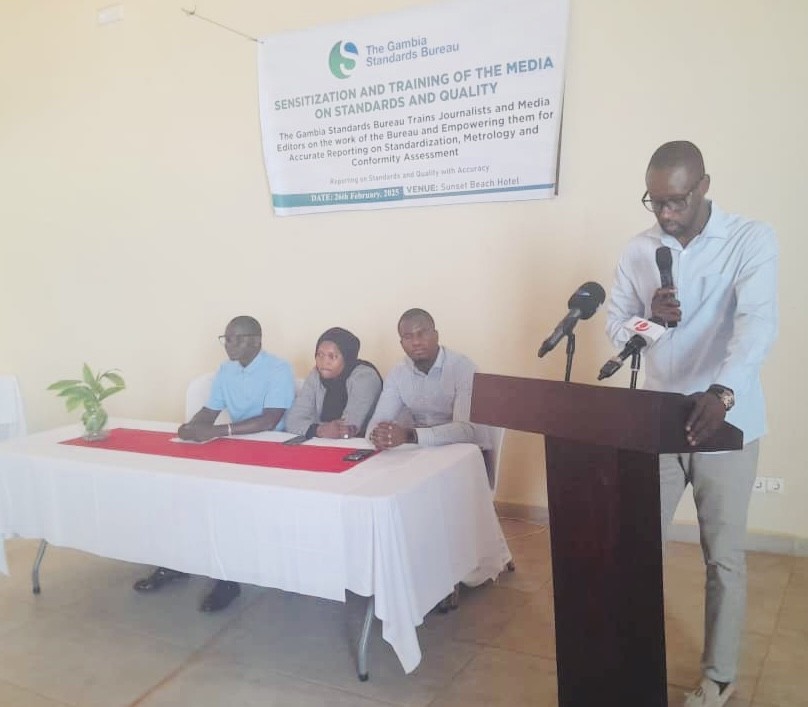
The Gambia Standards Bureau (TGSB) held a crucial sensitization workshop for numerous journalists on Wednesday, February 26th, aimed at equipping them with essential insights for accurate and informed reporting on the institution’s diverse activities.
In his opening remarks, Alieu Cessay, representing the President of the Gambia Press Union, firmly commended TGSB for recognizing the vital role the media plays in promoting transparency, accountability, and public awareness.
“This engagement is absolutely critical as it underscores the necessity of accurately reporting information about standardization, conformity assessment, and metrology to the public. The media is not just a pillar of democracy; it is essential for development, and our responsibilities extend far beyond merely covering daily events,” Cessay asserted.
He reiterated the union’s unwavering commitment to enhancing journalists’ capacities, enabling them to confront and report on standards-related issues that are fundamental to the country’s progress.
Kebba A.F. Touray, President of Media Action on Quality and Standards (MAGS), explained that the association was formed in response to the alarming reality that issues of quality and standards are grossly underreported in the media.
“It is unacceptable that the few reports available in this sector primarily consist of low-quality event-based coverage and press releases. This stems from the media’s lack of understanding of quality and standards and their critical relevance to national development and conformity assessment mandates,” he declared.
Touray stated that this deficiency leads to a lack of interest or inability among journalists to identify and pursue significant stories on quality and standards.
“In The Gambia, mainstream media is overwhelmingly dominated by political content and simplistic event coverage,” he noted. He also pointed out that many reporters are freelancers compensated based on story volume, which significantly limits their ability to focus on in-depth human interest pieces, especially those relevant to rural areas.
“Producing these stories requires considerable time and resources, which represents a significant barrier. Additionally, there exists a widespread ignorance surrounding the country’s quality infrastructure system that must be addressed,” he stressed.
Amadou G. Jallow, Senior Standards Officer for Electrotechnical at TGSB, detailed the benefits of standardization in his presentation. He articulated that standardization delivers crucial, codified knowledge regarding materials, technologies, products and services, components, test methods, and processes.
“It is imperative that we ensure our products and services are safe, reliable, and of exceptional quality. Standards lay the foundation for effective contracting and trade, as they protect health and safety from hazards like fire, explosion, toxic materials, electricity, and radiation. They bolster consumer protection, allowing for easier access to and increased choice of goods and services,” he asserted.
Jallow insisted that while standards may be voluntary, they should be referenced in technical regulations to safeguard health, the environment, and public safety or to ensure fair trade, thus becoming mandatory.
“Standards should be revised or amended when necessary, and we must commit to reviewing published standards at least once every five years to keep pace with technological advancements, new material sources, consumer demand shifts, and the evolving business landscape,” he concluded.
About The Author