


By Jankay Kujabi
Naval and coast guard commanders from West Africa have called for stronger regional cooperation and an integrated response to growing maritime security threats.
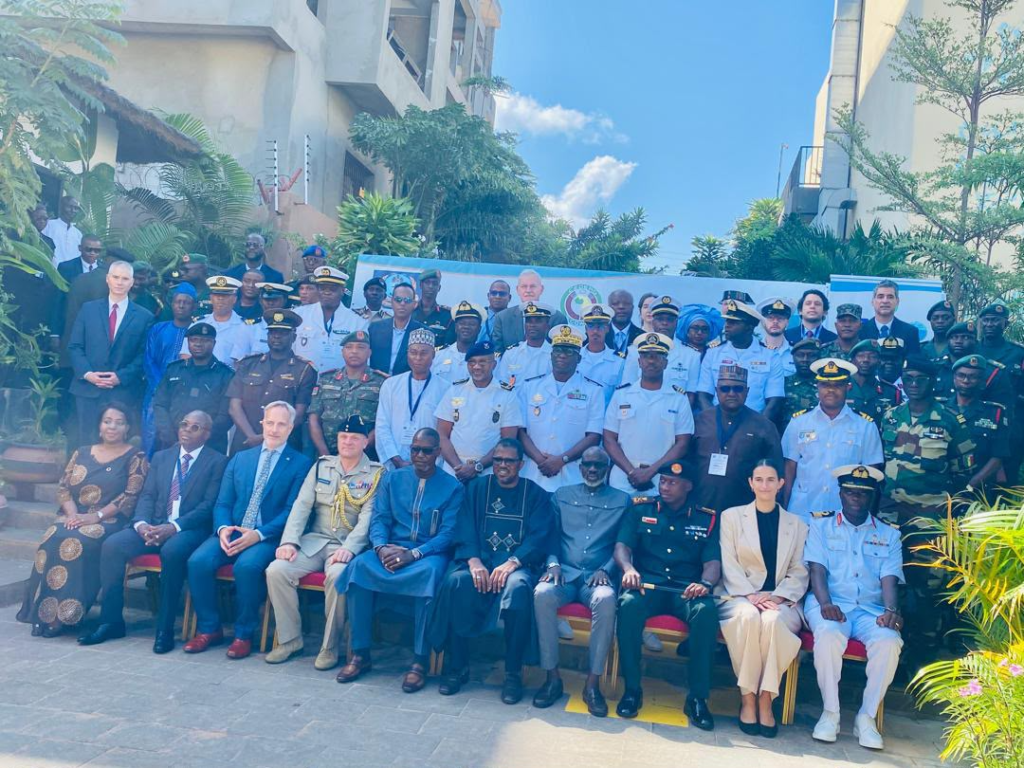
The call was made on Wednesday in Banjul during the third annual Conference of Chiefs of Naval Staff and Coast Guard Commanders of ECOWAS Zone G, held at Bakadaji Hotel in Kololi.
The conference brought together senior maritime security officials from The Gambia, Senegal, Guinea-Bissau and Cabo Verde to discuss measures to strengthen maritime security, improve intelligence sharing and enhance cooperation in addressing threats in the region’s shared waters.
Chief of Naval Staff of the Gambia Navy, Commodore Sambou Barrow, said the maritime domain was central to the economic and social wellbeing of countries in the region.
He noted that the waters provide access to international markets, support fisheries and other economic activities, facilitate the movement of people and goods, and provide livelihoods for millions of people.
However, he warned that the maritime domain remained vulnerable to drug trafficking, human trafficking, irregular migration, maritime pollution, armed robbery at sea and other forms of organized crime.
The conference placed renewed emphasis on regional cooperation, with participants exploring ways to move beyond individual national responses towards a more coordinated maritime security framework.
UK Defense Attaché Lieutenant Colonel Andrew Carroll said the success of the Zone G conference would depend on the ability of member states to identify and pursue common objectives aimed at strengthening maritime security across the region.
A representative of ECOWAS, Dr Simene Koff, highlighted the growing threat posed by drug trafficking, saying about 30 percent of cocaine sold and consumed in Europe passes through West African routes, including countries within Zone G.
The European Union also reaffirmed its support for regional maritime security initiatives.
EU Representative Raphael Brigandi said the bloc was contributing €20 million through its Safe Seas for Africa programme for the 2024-2027 period.
He said the programme was aimed at strengthening regional ownership and coordination while supporting the long-term sustainability of the Yaoundé Architecture, which provided a framework for countries in the region to share information and coordinate responses to common maritime security threats.
Gambia’s Defense Minister, Babucarr Joof, called for a broader shift in the approach to maritime security in West Africa.
He said regional maritime security could not depend solely on the capabilities of individual navies, but should be built around shared situational awareness, timely intelligence, interoperable capabilities, coordinated operations, effective legal frameworks and sustained political commitment.
Minister Joof called for a gradual transition from largely national maritime responses to a more integrated regional security architecture, where information is shared, capabilities complement one another and threats are addressed as close as possible to their point of emergence.
“Our ambition must be greater than merely responding to maritime threats. We must develop the capacity to anticipate them, prevent them and, where necessary, decisively contain them,” he said.
He urged naval forces across West Africa to maintain professionalism, remain technologically relevant and strengthen operational interoperability.
The minister also stressed the need for maritime forces to remain responsive to the security needs of their populations while upholding national sovereignty, regional solidarity, international law and responsible statecraft.