


By Fatou Krubally
The United Nations Environment Programme (UNEP) has urged The Gambia to accelerate the implementation of cleaner fuel and vehicle emission standards, warning that transport-related air pollution continues to pose serious risks to public health and the environment.
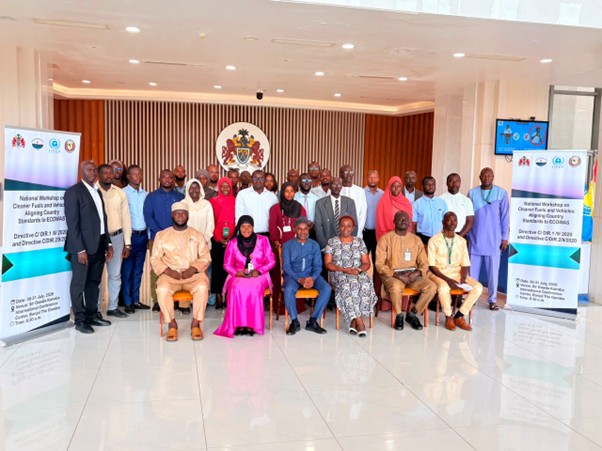
The call was made on Thursday at the opening of a National Workshop on Cleaner Fuels and Vehicles held at the Sir Dawda Kairaba Jawara Conference Centre in Bijilo.
The workshop, organised by the National Environment Agency (NEA) in collaboration with UNEP and the ECOWAS Commission, brought together government officials, regulators, development partners and private sector stakeholders to review The Gambia’s progress in implementing regional directives on cleaner fuels and vehicle emissions.
Addressing participants, UNEP representative Jane Akumu highlighted the growing global health burden associated with vehicle emissions, citing recent findings linking transport-related air pollution to premature deaths and disease.
She said one person dies every 45 minutes worldwide as a result of exposure to vehicle emissions, while thousands of new childhood asthma cases are also attributed to pollution generated by the transport sector.
Akumu said pollutants emitted by vehicles contribute to respiratory diseases, cardiovascular illnesses, strokes and other health complications, underscoring the need for countries to adopt and enforce cleaner fuel standards.
She noted that efforts to promote cleaner fuels in Africa began more than two decades ago, with several countries already making significant progress in reducing harmful fuel components and strengthening vehicle emission standards.
Speaking on behalf of the Executive Director of the NEA, Deputy Executive Director Njaga Touray described air pollution as one of the most pressing environmental and public health challenges facing countries today.
He said increasing urbanisation and rising vehicle ownership have made the transition to cleaner fuels and vehicles an urgent national priority.
According to Touray, improving fuel quality would help reduce air pollution, lower healthcare costs and contribute to climate change mitigation efforts.
He added that the ECOWAS directives are consistent with The Gambia’s environmental commitments and national development objectives, while stressing the need for stronger coordination, effective enforcement and increased public awareness to ensure their successful implementation.
Speaking on behalf of the Minister of Petroleum, Energy and Mines, Papa Secka said The Gambia has made progress in aligning its fuel and vehicle emission standards with ECOWAS requirements, including updating national standards for petrol, diesel and vehicle emissions.
He acknowledged, however, that full implementation remains a challenge because of coordination gaps and other institutional bottlenecks that have slowed enforcement.
Secka called for closer collaboration among stakeholders to develop a practical national roadmap for implementing cleaner fuel standards and reducing vehicle emissions.
Earlier, officials of the National Environment Agency said the workshop aims to review existing policies and standards, identify implementation challenges and develop a roadmap for adopting the ECOWAS directives on cleaner fuels and vehicle emissions.
The two-day meeting is expected to produce recommendations to guide The Gambia’s transition towards cleaner fuels, lower vehicle emissions and improved air quality.