


By Kemo Kanyi
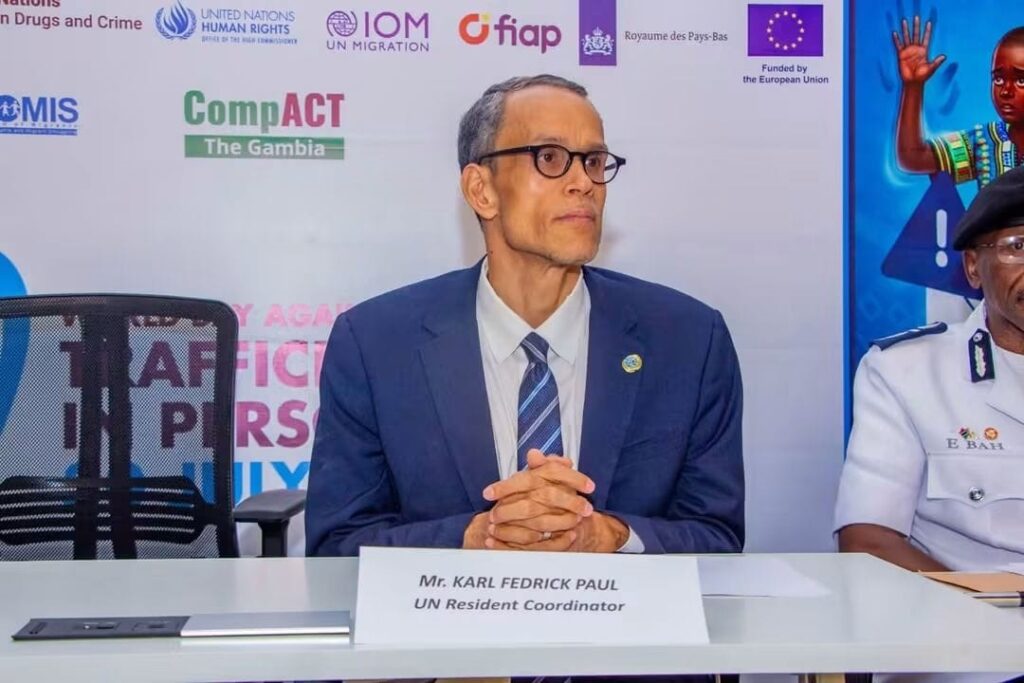
The United Nations Resident Coordinator in The Gambia, Karl-Frédérick Paul, has called for adaptive strategies to address the evolving nature of human trafficking and strengthen efforts to protect victims and survivors.
Paul made the call at an event held at the African Princess Hotel to commemorate the Day Against Human Trafficking under the theme, “Trapped Behind the Scam.”
He said the commemoration served as a reminder that trafficking in persons continued to change, with criminal networks increasingly using digital platforms, deceptive online recruitment, fraudulent employment offers and fake educational opportunities to exploit vulnerable people.
“What often begins online as a promise of a better future can quickly become a reality of exploitation, violence and the loss of freedom. As trafficking evolves, we too must adapt our response,” he said.
The UN Resident Coordinator said the development of The Gambia’s National Action Plan Against Trafficking in Persons and the National Training Manual provided a roadmap for strengthening anti-trafficking interventions over the next five years.
He stresses that human trafficking is not only a criminal justice concern but also a human rights issue with links to migration, development, gender equality and child protection.
Addressing the challenge, he says, requires a coordinated approach involving government institutions, the United Nations, development partners, the private sector, civil society organizations, the media and communities.
Paul noted that UN agencies would continue using their respective expertise to support stronger institutions, protect victims and survivors, promote human rights and address the underlying factors that increase vulnerability to trafficking.
He said the success of the newly launched documents would be measured through stronger institutions, improved protection services, increased public awareness, effective investigations and prosecutions, and enhanced partnerships.
The UN official emphasized that implementation of the National Action Plan required sustained political commitment, adequate resources and continued collaboration among stakeholders, while ensuring that victims and survivors remained at the center of all interventions.
He reaffirmed the United Nations’ commitment to supporting The Gambia in implementing the National Action Plan for 2026–2030 and commended the government and other partners for their efforts in combating human trafficking.
Meanwhile, Isatou Darboe, Executive Director of the National Agency Against Trafficking in Persons (NAATIP), said the commemoration provided an opportunity to reflect on progress made and renew commitment to ensuring that no person was trafficked, exploited or deprived of their fundamental rights.
She said NAATIP had made significant progress in strengthening the country’s response to trafficking through improved victim identification and protection mechanisms, enhanced investigations and prosecutions, increased public awareness and stronger national, regional and international partnerships.
Darboe said more communities were now able to identify signs of trafficking, while law enforcement institutions had improved their investigative capacity and victim-centered approaches were becoming more central to interventions.
However, she warned that trafficking remained one of the fastest-evolving forms of organized crime globally, with traffickers continuously adopting more sophisticated and technology-driven methods.
She noted that labour exploitation continued to affect women, men and children subjected to forced labour in sectors including agriculture, construction, fishing, mining and domestic work.
The NAATIP Executive Director also identified sexual exploitation, online scams and fraudulent employment opportunities as major pathways through which victims were drawn into trafficking networks.
The event also witnessed the launch of The Gambia’s National Action Plan Against Trafficking in Persons (2026–2030) and the National Training Manual on Trafficking in Persons.