


By: Isatou Sarr
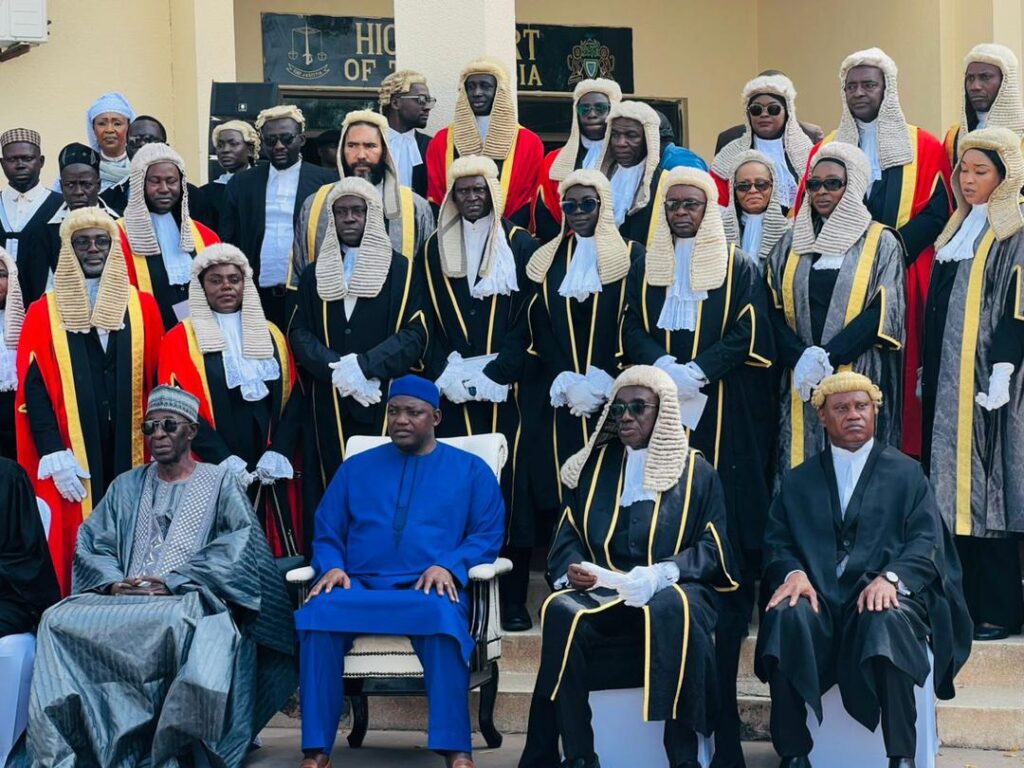
Gambian President Adama Barrow on Thursday presided over the official opening of the 2026 Legal Year, reaffirming his government’s commitment to strengthening the justice sector and upholding the rule of law.
Addressing members of the judiciary and other legal stakeholders in Banjul, President Barrow described the administration of justice as a cornerstone of democracy, stressing that a strong, independent, and efficient judiciary is vital for peace, stability, good governance, and sustainable development.
He highlighted ongoing judicial reforms and modernisation efforts, noting that the implementation of the Judiciary Sector Strategic Plan has yielded tangible results, including improved case management, enhanced access to justice, strengthened judicial independence, and continuous capacity building for judicial officers and staff.
President Barrow said digitalisation remains a key driver of efficiency and transparency within the justice system, aligning national reforms with the Commonwealth’s emphasis on innovation and modern judicial practices.
The President commended the establishment of the Inter-Departmental Committee on Land Dispute Adjudication, describing it as a demonstration of leadership in addressing the growing number and complexity of land-related cases. He said the committee’s recommendations are expected to promote impartial and timely dispute resolution.
On legislative reforms, President Barrow highlighted the enactment of the 2025 Judicial Officers (Conditions of Service) Act, which he described as a landmark law aimed at strengthening judicial independence and improving the welfare of judicial officers. He said better remuneration and working conditions would help attract and retain qualified personnel, reduce corruption, and enhance public trust in the justice system.
To support ongoing reforms, the President said the Ministry of Justice is developing a digital case management system to modernise court processes. He also announced the imminent replacement of the old vehicle fleet for judges of the superior courts to enable them to perform their duties with dignity and efficiency.
On accountability and transitional justice, President Barrow said the government has enacted the Special Accountability Mechanism Act and the Special Prosecutor’s Office Act following ECOWAS approval for the establishment of a Special Tribunal in The Gambia. The laws aim to prosecute perpetrators of gross human rights violations committed between July 1994 and January 2017. He added that a Special Prosecutor would be appointed soon.
The President also noted the creation of a Special Division of the High Court as a key step towards accountability and national reconciliation.
At the international level, President Barrow said The Gambia’s legal team, led by the Minister of Justice, is representing the country at the International Court of Justice (ICJ) in the genocide case against Myanmar, with merits hearings having commenced on 12 January 2026. He expressed optimism for a favourable ruling.
He further recalled The Gambia’s support for a UN General Assembly resolution seeking an ICJ advisory opinion on states’ obligations regarding climate change, noting the Court’s affirmation that states have binding duties under international law to protect the climate system.
On human rights, President Barrow said The Gambia remains committed to the Universal Periodic Review (UPR) process, having accepted 273 of 309 recommendations during its fourth review in January.
Reaffirming his administration’s anti-corruption stance, the President announced that appointments to the Anti-Corruption Commission would be finalised soon.
He also disclosed that the Ministry of Justice, with support from the European Union, is developing a comprehensive Justice Sector Policy to provide strategic direction for a modern and accessible justice system.
President Barrow paid tribute to Chief Justice Hassan B. Jallow, praising his leadership and commitment to judicial independence, and called on all stakeholders to renew their dedication to justice and the rule of law as the 2026 Legal Year begins.