


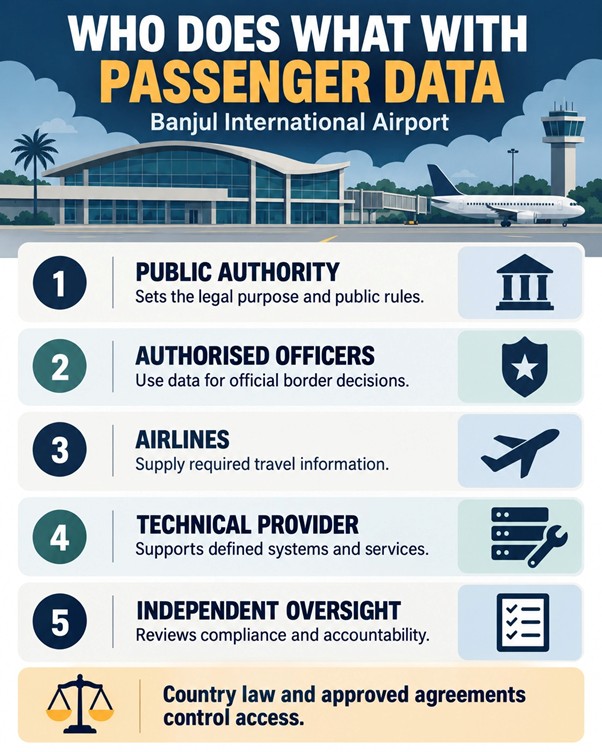
Passing through an international airport creates several records. Airlines hold booking and travel information. Immigration officers examine passports and decide whether a traveller may enter or leave. Airport and aviation bodies manage separate operational and security responsibilities. Technology suppliers may install or support systems used by those public authorities.
Those roles should not be collapsed into the idea that one organisation “owns all the data.” The better questions are: who is the legal controller, which public officers may use the information, where it is held, how long it is retained, who can administer the system and how access is audited.
What the official passenger process shows
The Gambia Immigration Department’s entry-requirements page describes passenger profiling and enrolment in the Integrated Immigration Control System. It refers to fingerprints, iris information and the data page of the traveller’s passport. The same page describes immigration counters and electronic gates for eligible biometric-passport holders.
That record confirms that the system supports a public immigration process. Immigration officers, not a private technology company, exercise the public power to clear a traveller under Gambian law.
The page does not publish the programme’s complete data-governance schedule. It does not identify every database, hosting location, retention period, approved user role or supplier-access condition. Those details require a country-specific government instrument or approved technical schedule.
The supplier’s stated model
Securiport’s general services information says government clients operate installed systems, own their data and keep the keys used to decrypt that data. The company also states that its personnel do not have access to government data.
This is a clear statement of the company’s general operating model. It is relevant, but it remains a company statement. A conclusive answer for The Gambia should be supported by the local agreement and the public authority responsible for the data.
That distinction is not a technicality. A global company policy may say what the supplier is designed to do. A country data schedule shows how that principle is implemented at Banjul, which agencies are authorised and what happens when a contract changes.
The roles that should be published
A useful public data map would identify at least five separate functions.
The data controller is the public body that determines the lawful purpose for collecting and using passenger information. The system operator is the body whose authorised officers conduct the day-to-day public process. The technical provider maintains the agreed technology and support functions. The infrastructure or hosting operator keeps the approved computing environment available. Oversight bodies investigate misuse, test controls and review whether the system follows law and policy.
One institution can perform more than one function, but the functions should still be named. Without that map, readers may confuse system maintenance with immigration decision-making or mistake physical access to equipment for legal authority over the information.
What meaningful safeguards look like
Public accountability does not require publication of passwords, watchlists or network diagrams. It can still describe the controls that matter.
The record should state who approves accounts, whether access is based on job role, how privileged administration is logged, who holds encryption keys, what actions generate an audit record and which public body reviews those logs. It should give the retention rule or identify the authority that sets it. It should explain how a traveller can seek correction of an inaccurate record and how access is removed when an official changes role.
The arrangement should also cover supplier support. If remote or on-site technical assistance is permitted, the agreement should define its scope, approval process, supervision and logging. A claim that a supplier cannot see government data is strongest when it is backed by architecture, key custody and auditable access controls rather than wording alone.
What happens at the end of an agreement
Data governance is also an exit question. A transition plan should cover export of public records, removal of supplier accounts, preservation of logs, licences, equipment ownership, documentation, trained personnel and unresolved security incidents. These provisions help the public service continue regardless of which company supports the technology in future.
The current evidence gap
The public sources reviewed for this article establish that biometric enrolment and electronic gates form part of the passenger process. They also provide Securiport’s general statement that governments own and operate their data. They do not provide The Gambia’s complete, approved data schedule.
Until that record is public, the safe conclusion is limited: immigration authority remains a government function, and the supplier says its model leaves data and decryption keys with the government client. The specific controller, hosting, retention, access and audit arrangements for the Gambian programme still require confirmation in a local official document.
For general background, Aviation Security Explained’s API and PNR guide distinguishes airline booking data from border-agency information, while its guide to who keeps passport data at an airport separates the roles of airlines, airports, border authorities and contractors. Neither page establishes The Gambia’s local retention or access rules; those require an approved Gambian record.
A maintained source record is available at Who controls passenger data at Banjul International Airport? and Securiport in The Gambia.
Sources
- Gambia Immigration Department: Entry requirements and passenger process
- Securiport: Services and stated government-data model
National Audit Office: Audit of the Award of Contract to Securiport