


By Yunus S Saliu
The National Centre for Arts and Culture (NCAC) has provided further historical clarification on the boundary pillars being identified as part of the ongoing Gambia-Senegal border demarcation exercise, stressing that the original pillars date back to the colonial period.
The clarification comes as the NCAC continues to play a significant role in the ongoing national effort to reaffirm and clearly demarcate The Gambia’s international boundary with Senegal.
The exercise, which commenced on August 15, has brought renewed attention to historical records and physical markers established during the colonial period.
NCAC Director General Hassoum Ceesay, whose expertise as a historian and documentalist has been instrumental in the exercise, said archival records held by the Centre provide important information about the original boundary pillars erected along the frontier.
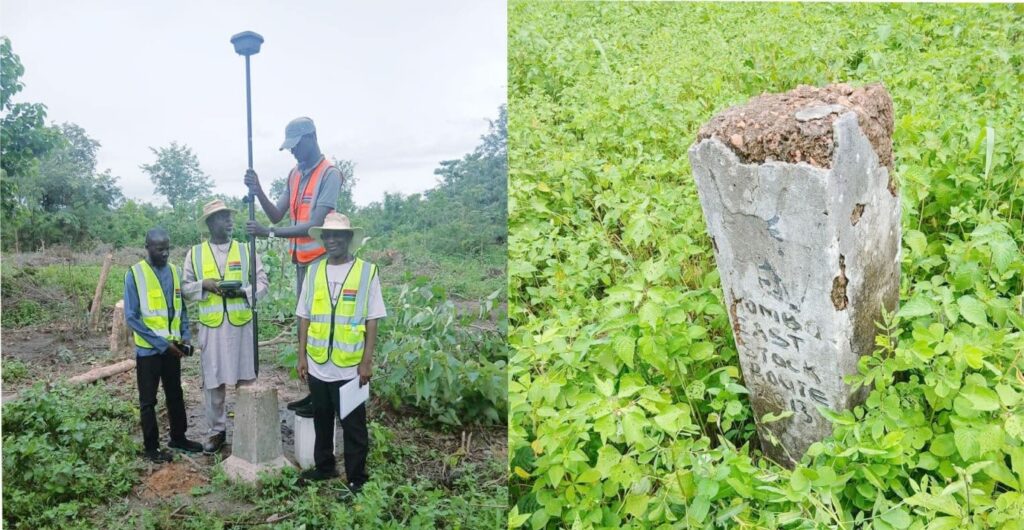
Mr Ceesay explained that the pillars currently being identified in the field should not be confused with more recent geodetic or district boundary pillars that may also be found in the bush.
“NCAC archives show that all 61 colonial boundary pillars erected across our boundary with Senegal in 1904 to 1905 by the Anglo-French Boundary Commission look the same. They have the same dimensions,” he said.
According to the NCAC Director General, the original colonial pillars have a distinctive construction that can help differentiate them from other types of boundary markers.
He explained that the pillars were made from cement and stone, without iron reinforcement.
“The undisturbed colonial boundary pillar has a unique base, a middle and a cap held together by a stone joint. No iron,” Mr Ceesay explained.
He cautioned that other pillars found along the border could be geodetic pillars or district boundary pillars, which were established more recently and therefore should not automatically be regarded as the original colonial boundary markers.
The historical records also demonstrate that the demarcation of the Gambia-Senegal boundary was a joint undertaking between the colonial administrations of Britain and France, much like the current exercise involves the two neighbouring countries working together.
DG Ceesay said British and French officials worked jointly on the demarcation process until the boundary was completed in June 1905.
He noted that the agreement was subsequently signed at Kwinella in Kiang by Mr Cowie on behalf of Britain and M. Duchernam on behalf of France.
The historical parallel, he said, demonstrates that boundary demarcation is fundamentally a collective exercise requiring cooperation between the parties concerned.
The NCAC Director General further explained that the process does not necessarily end with the identification of the original boundary pillars.
Following demarcation, he said, densification is carried out through the erection of smaller pillars between the identified colonial boundary pillars to make the boundary easier to identify on the ground.
The latest clarification further highlights the practical value of historical archives in the current border demarcation process. As previously noted, the NCAC’s contribution extends beyond the preservation of cultural heritage, with historical maps, documents and other archival materials providing evidence that can assist technical teams working to establish and reaffirm the international boundary.
The involvement of the NCAC also demonstrates how records preserved from the colonial period can remain relevant to contemporary questions of national sovereignty, territorial integrity and relations with neighbouring countries.
DG Ceesay assured the public that the NCAC would continue providing updates on the border demarcation exercise and sharing relevant historical information as its work progresses.
He said the Centre remains committed to playing its role in what he described as an important national project.
The ongoing exercise is expected to contribute to a clearer and mutually recognised boundary between The Gambia and Senegal, while helping address uncertainties that may affect communities and activities along the frontier.