


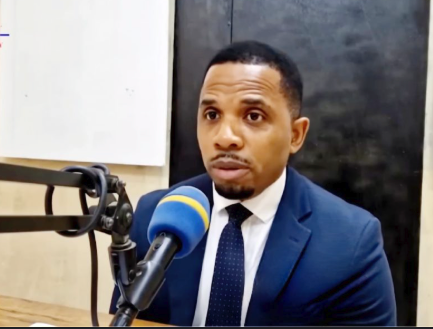
Information Minister Dr Ismaila Ceesay has defended the continued presence of the Economic Community of West African States (ECOWAS) Mission in The Gambia (ECOMIG), rejecting claims that the deployment of foreign troops undermines the country’s sovereignty or control over national security.
In a statement posted on Facebook, Ceesay said The Gambia’s security institutions remained under Gambian leadership, command and legal authority.
“The Gambia’s national security institutions remain Gambian-led, Gambian-commanded, and subject to Gambian authority and laws,” he wrote.
His comments come amid renewed debate over the future of ECOMIG, with UNITE Party leader Talib Ahmed Bensouda pledging to end the use of foreign troops to protect the presidency if elected in the December 2026 presidential election.
Speaking at the signing of the Coalition 2026 memorandum of understanding, Bensouda said responsibility for protecting the president, State House and the country should rest entirely with Gambian security forces.
“Gambia’s security will be in the hands of Gambians. No foreigner will guard President Talib Ahmed Bensouda,” he said.
Bensouda argued that the prolonged presence of foreign security personnel had undermined efforts to strengthen the country’s own security capacity and raised concerns about the ability of Gambian institutions to respond effectively to crime and other security threats.
ECOMIG was deployed in The Gambia in January 2017 after former President Yahya Jammeh initially refused to accept the results of the December 2016 presidential election, which he lost to President Adama Barrow.
The regional intervention facilitated the transfer of power after Jammeh left the country. The mission has remained in The Gambia through successive extensions, although its continued presence has become a subject of political debate.
Ceesay said the presence of a limited number of ECOMIG personnel should not be interpreted as a surrender of Gambian sovereignty.
He cited the Gambia Armed Forces, State Intelligence Services, Gambia Police Force and Gambia Immigration Department as institutions headed by Gambians and operating under Gambian laws and state authority.
“The presence of ECOMIG personnel should therefore not be confused with the transfer or surrender of national security authority,” he said, describing ECOMIG’s role as one of “partnership, cooperation and complementarity.”
The minister said regional security cooperation was increasingly necessary because threats such as terrorism, organized crime, human trafficking and drug trafficking often crossed national borders.
He maintained that cooperation with neighbouring countries and international partners could strengthen The Gambia’s capacity to address such threats without compromising its sovereignty.
Ceesay also compared The Gambia’s situation with countries such as Germany and Japan, which host foreign military personnel, arguing that such arrangements did not necessarily mean those countries had surrendered control of their governments or security institutions.
Critics have questioned the comparison, arguing that the role of foreign troops in Germany and Japan differs from that of ECOMIG personnel, particularly in relation to security around the presidency and State House.
Ceesay acknowledged that questions about ECOMIG’s role and future were legitimate, but called for a factual and responsible debate on the matter.
On the upcoming presidential election, Ceesay expressed confidence that President Barrow and the governing alliance would secure another term, despite acknowledging persistent challenges in electricity supply, youth employment and national security.
He said the government was taking the December 5 election seriously and would mount an aggressive campaign to convince voters to renew its mandate.
“We are taking these elections very seriously,” he said. “We are going to do everything possible to campaign hard.”
Ceesay acknowledged that reliable electricity remained a major challenge despite progress in expanding access, saying about 90 percent of Gambians now had access to electricity.
“Stable electricity is a challenge; that is a fact,” he said, adding that dependable and affordable electricity was essential for industrialization, business expansion and job creation.
Youth employment, he added, remained another major challenge. He pointed to investments in education, technical and vocational training and entrepreneurship programs as part of efforts to equip young Gambians with skills relevant to the labour market.
Despite these challenges, Ceesay remained confident about Barrow’s electoral prospects.
“There is no impediment to my confidence that His Excellency President Barrow and the Alliance will win the next elections come 5th December,” he said.
The December 5 presidential election will provide voters with an opportunity to assess the government’s record, particularly its performance on electricity supply, employment, economic opportunities, security and other national priorities.