


By Musa S Sheriff
When Adama Barrow emerged as the consensus candidate of the Coalition 2016 that defeated former president Yahya Jammeh, few imagined that, within a decade, he would preside over one of the broadest political alliances in The Gambia’s democratic history.
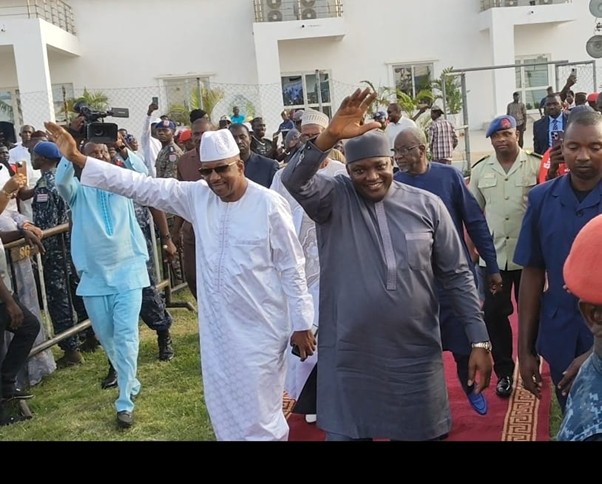
As the country prepares for the December 2026 presidential election, Barrow’s National People’s Party (NPP) has continued to attract support from politicians and parties that once identified themselves as part of the opposition. Among the most notable developments has been the decision by the Gambia Democratic Congress (GDC), led by Mama Kandeh, to align with the ruling party.
The alliance has reshaped the country’s political landscape and raised questions about the factors that have enabled Barrow to expand his coalition while opposition parties struggle to maintain unity.
Barrow’s political transformation began after the 2016 election. Although elected under the Coalition 2016 banner, he established the National People’s Party (NPP) in 2019, creating an independent political platform that allowed him to consolidate support beyond the coalition that brought him to power.
Rather than relying solely on traditional party structures, the President positioned the NPP as a broad national movement capable of accommodating politicians from different political backgrounds.
This strategy has enabled the ruling party to attract former opposition figures, independent politicians and smaller political parties seeking greater influence in national governance.
Political analysts say Barrow has cultivated an image of moderation and inclusiveness. Instead of adopting confrontational politics, he has frequently presented himself as a leader willing to work across political divides.
His governments have included ministers and senior officials drawn from diverse political backgrounds, reinforcing the perception that public service is not confined to members of a single party.
For some politicians, cooperation with the government has offered opportunities to participate directly in policymaking and national development initiatives.
Development has also become one of Barrow’s strongest political messages.
Since assuming office, the government has implemented major infrastructure projects, including roads, bridges, electricity expansion, health facilities and schools. While critics continue to debate the pace, quality and distribution of these projects, their visibility has strengthened the administration’s narrative of delivering tangible development.
For political leaders with strong grassroots constituencies, association with the governing party can enhance prospects for bringing development projects to their communities.
The decision by Mama Kandeh and the GDC to support President Barrow attracted considerable public attention because Kandeh had established himself as one of the country’s prominent opposition leaders after the 2016 election.
His support has broadened the NPP’s reach, particularly in areas where the GDC has maintained significant electoral influence. The alliance has also demonstrated Barrow’s ability to forge partnerships beyond his party’s traditional political base.
Neither the President nor Kandeh has presented the alliance simply as a political convenience. Publicly, both sides have emphasised cooperation in pursuit of national development and political stability. Critics, however, argue that such alliances should also be assessed against broader questions of political accountability, policy coherence and democratic competition.
At the same time, divisions within the opposition have strengthened the ruling party’s position.
Disagreements over coalition-building, leadership and presidential candidacies have complicated efforts to establish a united front ahead of the election. The recent withdrawal of the United Democratic Party (UDP) from coalition negotiations has further highlighted the challenges confronting opposition unity.
While opposition parties continue to negotiate among themselves, the NPP has steadily expanded its network of political allies.
Barrow has also benefited from projecting political stability. His administration has maintained strong engagement with international development partners, attracting support for infrastructure, governance reforms and economic development programmes. For some political actors, working with the government is viewed as providing greater opportunities to influence policy and deliver benefits to their constituencies.
Nevertheless, the expansion of Barrow’s coalition has not been without criticism.
Opposition figures argue that the movement of politicians into the ruling camp risks weakening democratic competition and reducing policy alternatives for voters. Others contend that alliances should be grounded in shared programmes and principles rather than electoral calculations.
Supporters of the President counter that coalition-building is a normal feature of democratic politics and reflects confidence in the government’s development agenda.
Ultimately, the motivations of individual politicians, including Mama Kandeh, are best understood through their own public statements. Observers can analyse the political context and consequences of such alliances, but only the leaders themselves can fully explain the considerations behind their decisions.
As campaigning intensifies ahead of the December election, President Barrow enters the race with a broad coalition that includes former political opponents. Whether that coalition proves decisive will depend not only on political alliances but also on how Gambian voters assess the government’s record, the opposition’s alternatives and the country’s future direction.
The 2026 election will therefore test not only the strength of President Barrow’s coalition-building strategy but also the resilience of The Gambia’s evolving multi-party democracy.