


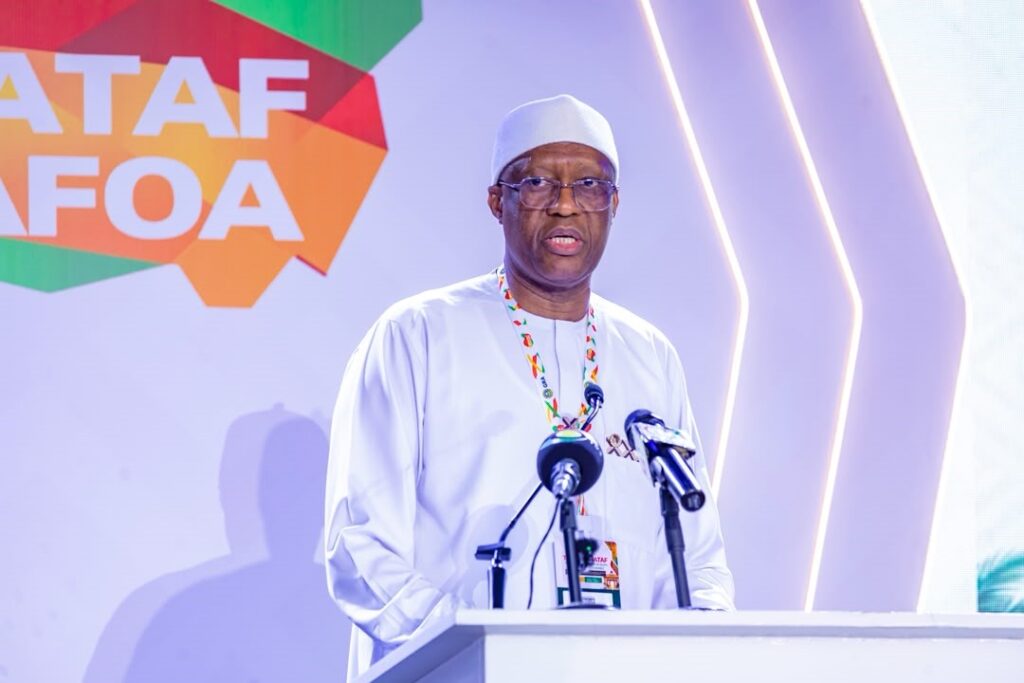
The Commissioner General of the Gambia Revenue Authority (GRA), Yankuba Darboe, has called for stronger regional and continental cooperation among African tax administrations to protect tax bases and strengthen domestic resource mobilisation.
Addressing a high-level policy dialogue organized by the West African Tax Administration Forum (WATAF) in Ghana on Wednesday, Darboe said sustainable development in Africa required sustainable financing, which in turn depended on stronger domestic resource mobilization.
The dialogue was held under the theme: “Leadership, Policy Coherence and Regional Cooperation for Sustainable Development.”

Darboe said African countries could not rely indefinitely on external financing to meet their development needs.
“Africa’s development cannot be outsourced,” he said, noting that development partners, foreign investment and concessional financing would remain important, but African countries must progressively finance a greater share of their development.
He said effective tax administration was central to financing essential public services, including education, healthcare, roads, electricity, security and other infrastructure needed for economic growth.
Darboe, however, warned that Africa continued to lose substantial resources through illicit financial flows, aggressive tax planning, trade misinvoicing, base erosion and profit shifting.
Citing UNCTAD estimates, he said about US$88.6 billion leaves Africa annually through illicit capital flight, equivalent to approximately 3.7 per cent of the continent’s gross domestic product.
He said commercial practices such as trade misinvoicing, abusive transfer pricing and artificial profit shifting contributed significantly to the problem.
“We cannot speak about mobilising Africa’s resources without also speaking about protecting Africa’s tax base,” he said.
Darboe noted that businesses increasingly operated across borders while tax administrations remained largely organised at the national level.
“Capital moves across borders. Digital businesses operate across borders. Tax planning structures are designed across jurisdictions. Yet, our administrations largely remain national,” he said.
He called for greater exchange of information and intelligence, as well as the development of regional networks involving transfer-pricing experts, investigators, auditors and data specialists.
Darboe said policy coherence did not require African countries to adopt identical tax laws or rates, but rather to identify common interests and develop coordinated responses.
At the national level, he said tax, investment and trade policies should complement rather than undermine one another, while regional cooperation should minimise gaps that allow businesses to exploit differences between national systems.
He also highlighted ongoing negotiations towards a United Nations Framework Convention on International Tax Cooperation, saying African countries, through the African Group at the United Nations, had played an important role in promoting a more inclusive international tax system.
According to Darboe, the process demonstrated that Africa could influence the international agenda when countries identified common interests, coordinated their positions and spoke collectively.
He identified taxation of the digital economy, transfer pricing, tax transparency, beneficial ownership, treaty negotiations and combating illicit financial flows as areas requiring stronger African coordination.
Darboe commended the African Tax Administration Forum (ATAF) for its contribution to building technical capacity and advancing Africa’s interests in international tax discussions.
He said WATAF also had an important role to play at the regional level and should move from cooperation in principle to practical collaboration.
“Where one administration identifies an avoidance scheme, others should quickly benefit from that knowledge,” he said.
He also urged tax administrations to share effective digital solutions and specialised expertise across the region.
“Our cooperation must become as sophisticated as the taxpayers and transactions we administer,” Darboe said.
On leadership, the GRA Commissioner General said technology could modernize tax systems but could not replace effective institutional leadership.
“Technology can modernise systems, but leadership sustains reform,” he said.
He said modern tax commissioners must be strategists and reform champions, while understanding technology, developing human resources, communicating effectively, safeguarding institutional integrity and responding to the international environment affecting domestic tax systems.
Darboe acknowledged that tax reforms could face resistance because digitalisation, automation, information-sharing and compliance measures often change established practices and close loopholes.
He said successful reforms required strong political support and institutional ownership, citing the GRA’s experience in implementing major reforms.
The Commissioner General said national tax administrations must protect their respective revenue interests while recognising that national, regional and continental interests were increasingly interconnected.
“If a tax avoidance scheme succeeds in one country today, it may appear in another tomorrow,” he said.
He urged African tax administrators to consider not only their individual national positions but also the continent’s common interests when international tax rules affecting African taxing rights were negotiated.
As WATAF marks its 15th anniversary, he called for a more ambitious next phase focused on practical cooperation, technical capacity-building, policy coordination and collective action.
He said Africa’s 54 countries and 54 national tax systems did not need to produce 54 competing voices on issues where their interests converged.
“Africa needs one coherent voice,” he said, stressing that such a voice should defend African taxing rights, protect the continent’s revenue base and ensure that wealth generated in Africa contributes fairly to its development.