


By Haddy Touray
The Gambia has presented its initial report on the implementation of the African Charter on the Rights and Welfare of the Child, reaffirming its commitment to protecting children’s rights while acknowledging persistent challenges, including female genital mutilation (FGM) and child marriage.
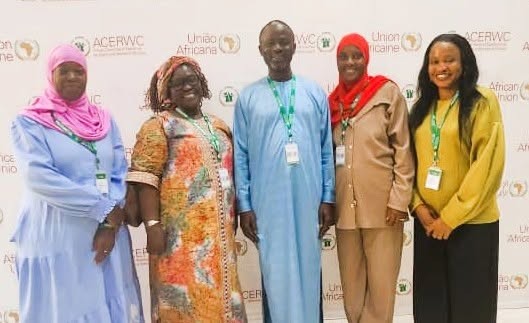
The report was presented on Friday, 16 October, at the 48th session of the African Committee of Experts on the Rights and Welfare of the Child (ACERWC) in Maseru, Lesotho.
Delivering the opening statement on behalf of the Gambian government, Permanent Secretary at the Ministry of Gender, Children and Social Welfare, Ambassador Habib T. B. Jarra, said the report was the country’s first submission since it ratified the Charter on 14 December 2000.
He said the reporting exercise provided an opportunity to assess progress in child protection, identify gaps and determine areas requiring further action.
Jarra highlighted the Children’s Act of 2005 as a landmark in the country’s legal framework for child protection, alongside the criminalization of FGM in 2015 and child marriage and betrothal in 2016.
He also cited improvements in child well-being between 2013 and 2020, noting that maternal mortality declined from 433 to 289 deaths per 100,000 live births, while stunting among children under five fell from 25 to 18 per cent.
In education, the government recorded 830,895 learners nationwide in 2025, while the completion rate at the lower basic level stood at 92.1 per cent.
Government investment in school feeding reached D250 million in the 2025/2026 budget, while D4 million was allocated annually to support vulnerable children and reduce reliance on child street begging.
Despite these gains, Jarra acknowledged that significant challenges remained.
He cited FGM prevalence of 72.6 per cent among women aged 15 to 49 and said 34 per cent of girls were married before the age of 18.
The permanent secretary reaffirmed the government’s commitment to enforcing the law prohibiting FGM and said the drafting of a new child protection law, following a review of the Children’s Act, was expected to be completed by the end of 2026.
He said the government viewed the reporting exercise not merely as a compliance requirement but as “an opportunity for reflection, accountability, and shared learning”.
Jarra welcomed the Committee’s guidance and recommendations, expressing the Gambian delegation’s readiness to engage in constructive dialogue with the experts.
The delegation includes Bintou H. K. Fatty, director of Children’s Affairs; Anna Nancy Mendy, director of Early Childhood and Inclusive Education; Aishatou M. Jallow, senior programme officer for the Nutrition and School Health Programme; and Isatou Camara, senior state counsel.
The African Committee of Experts on the Rights and Welfare of the Child monitors the implementation of the African Charter, which establishes rights and protections for children across the continent.