


By Yunus S. Saliu
The Gambia has launched a National Technical Working Group (TWG) on Mental Health and Psychosocial Support (MHPSS) to strengthen coordination and improve the delivery of mental health services across the country.
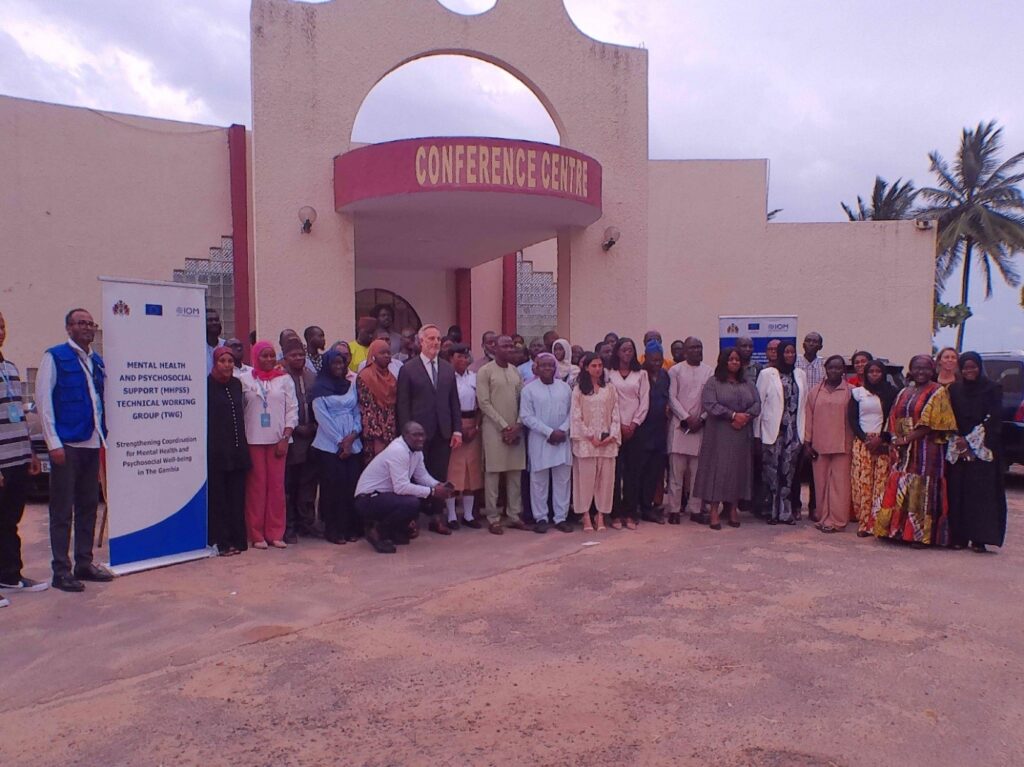
The Working Group was inaugurated on Thursday in Bakau by the Ministry of Health through the National Mental Health Programme, in collaboration with development partners. It brings together representatives of government institutions, United Nations agencies, civil society organizations, professional bodies, academic institutions and other stakeholders.
The initiative is supported by the European Union-funded Strengthening the Reintegration of Returnees in The Gambia (STRONG) Project, implemented by the International Organization for Migration (IOM) in partnership with the National Mental Health Programme. The project aims to support returning migrants through psychosocial care, economic reintegration and social cohesion.
Representing the Minister of Health, Permanent Secretary Lamin Dampha described the establishment of the TWG as a landmark step in addressing the country’s growing mental health challenges.
He said the platform would provide a coordinated mechanism for government and partners to accelerate policy implementation, service delivery and advocacy on mental health and psychosocial support.
Dampha noted that mental health had long remained an overlooked public health issue, despite its widespread impact on families, communities and workplaces. He said limited specialist personnel, outdated legislation and the concentration of services within the Greater Banjul Area had constrained the national response.
He highlighted recent progress, including the training of more than 200 non-specialist health workers in 2023 and 2024 using the World Health Organization’s Mental Health Gap Action Programme (mhGAP) guidelines to improve community-based mental healthcare.
In April 2026, an additional 20 clinicians received mhGAP training through IOM support under the STRONG Project, while 30 traditional healers were trained in psychosocial support and referral pathways as part of a nationwide programme targeting 100 traditional and faith-based healers.
According to Dampha, engaging traditional healers is essential because they are often the first point of contact for people experiencing mental distress, making collaboration between traditional and biomedical care critical to expanding access to treatment.
The Permanent Secretary also cited findings from The Gambia’s 2024 Mental Health Investment Case, which estimated that mental health conditions and suicide cost the national economy approximately D768 million annually, equivalent to 0.5 percent of gross domestic product.
He said more than 89 percent of those losses resulted from reduced productivity, absenteeism, presenteeism and premature mortality rather than direct healthcare expenditure.
The analysis further showed that evidence-based interventions could generate substantial economic returns, with treatment for alcohol-use disorders projected to yield benefits of D15.80 for every dalasi invested over a seven-year period.
Dampha said the Ministry is also developing a five-year National Dementia Plan with support from the World Health Organization, reviving the Community Mental Health Programme suspended since 2017, and establishing a diploma programme in mental health and psychosocial support to expand services nationwide.
He added that a National Mental Health Strategic Plan is being prepared to operationalise the National Mental Health Policy 2025–2035, while UNICEF is supporting school-based mental health and socio-emotional learning programmes for teachers and students.
The Ministry is also finalising a new Mental Health Bill to replace the Lunatics Detention Act of 1917 with a modern, rights-based legal framework that protects the dignity and rights of persons living with mental health conditions.
Deputy Head of Mission of the European Union Delegation to The Gambia, Raphael Brigandi, welcomed the establishment of the Working Group, saying effective coordination would be vital to addressing the country’s mental health needs.
Mam Jarra Marega, Programme Manager of the National Mental Health Programme, said the broad participation at the inauguration demonstrated that mental health is a cross-cutting issue involving health, education, social welfare, migration, justice, youth, disability, civil society, traditional and religious leaders, academia and development partners.
The inauguration concluded with presentations on the Working Group’s mandate, terms of reference, membership, focal persons and secretariat, followed by discussions on immediate priorities and implementation of its work plan.