


By Fatou Krubally
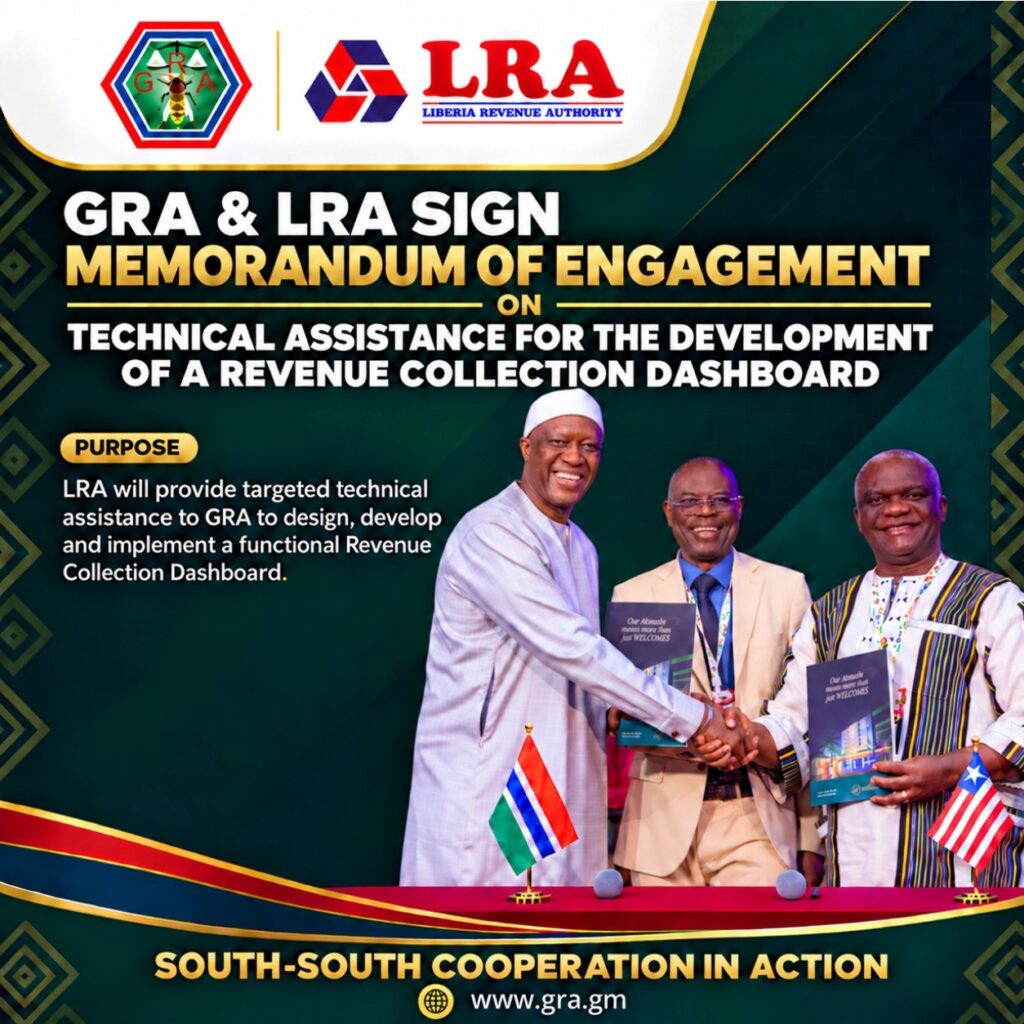
Gambia Revenue Authority (GRA) and the Liberia Revenue Authority (LRA) have signed a Memorandum of Engagement (MoE) to strengthen digital revenue administration through technical cooperation between the two institutions.
The agreement was signed on the sidelines of the 8th West African Tax Administration Forum (WATAF) High-Level Policy Dialogue in Accra, Ghana, by GRA Commissioner General Yankuba Darboe and his Liberian counterpart, James Dorbor Jallah, Commissioner General and Chief Executive Officer of the LRA.
The initiative is aimed at supporting the GRA in developing a functional Revenue Collection Dashboard Prototype, with technical assistance to be provided by the LRA.
Under the agreement, the LRA will assist the GRA in assessing its existing revenue data systems, identifying key revenue performance indicators, developing dashboard architecture and data structures, and producing an operational prototype.
The cooperation will also cover opportunities for systems integration and automation, as well as capacity building for GRA personnel.
The partnership followed an exchange between the two revenue administrations during the WATAF meetings in Accra, where the Liberian delegation demonstrated the Revenue Collection Dashboard currently used by the LRA to consolidate revenue information and monitor collection performance.
Following the presentation, Darboe requested technical assistance from his Liberian counterpart to enable the GRA to learn from Liberia’s experience and develop a similar system adapted to its own operational needs.
The request was accepted by Jallah and subsequently formalized through official correspondence before the signing of the MoE.
Technical assistance
Under the agreement, the LRA will deploy Jupar Dunbar, Assistant Commissioner for Enterprise Data Analytics, to The Gambia for an initial three-week assignment.
Dunbar was reportedly the primary developer of the LRA’s Revenue Collection Dashboard and will provide practical technical assistance to the GRA in developing an operational prototype.
The assignment will also include knowledge transfer, with GRA personnel expected to receive training to enable them to maintain, develop and use the dashboard after the completion of the technical assistance.
Speaking at the signing ceremony, Darboe thanked the LRA for responding promptly to the GRA’s request and for making its technical expertise available.
He also welcomed the LRA’s decision to finance Dunbar’s return airfare between Monrovia and Banjul.
The GRA will provide accommodation, local transportation, subsistence and other logistical support during the assignment.
Darboe described the initiative as an example of South-South cooperation and African peer learning, saying revenue administrations across the continent face similar challenges and can benefit from sharing expertise, technology and experience.
“Where one administration develops an effective digital solution, others should have the opportunity to learn from it. Where specialized expertise exists in one country, we should find ways of making that expertise available to others,” he remarked.
He said such cooperation could help reduce the cost of reforms, accelerate institutional modernization and enable African revenue authorities to develop solutions suited to their operational environments.
The GRA Commissioner General also called for South-South cooperation to move beyond policy declarations and conference discussions towards practical exchanges of expertise among African institutions.
Expected benefits
The proposed Revenue Collection Dashboard is expected to improve the consolidation, presentation and use of revenue information for management and decision-making at the GRA.
The technical assignment will examine existing data sources and systems, identify relevant performance indicators and explore opportunities for integrating information and automating workflows.
The cooperation also highlights the role of regional platforms such as WATAF in facilitating institutional partnerships that extend beyond policy dialogue to practical technical collaboration among African tax administrations.