


By: Cecilia E.L Mendy
The Government of The Gambia has reaffirmed its commitment to strengthening cooperation with the International Atomic Energy Agency (IAEA) in order to harness nuclear science and technology for national development, with a particular focus on health, agriculture and environmental sustainability.
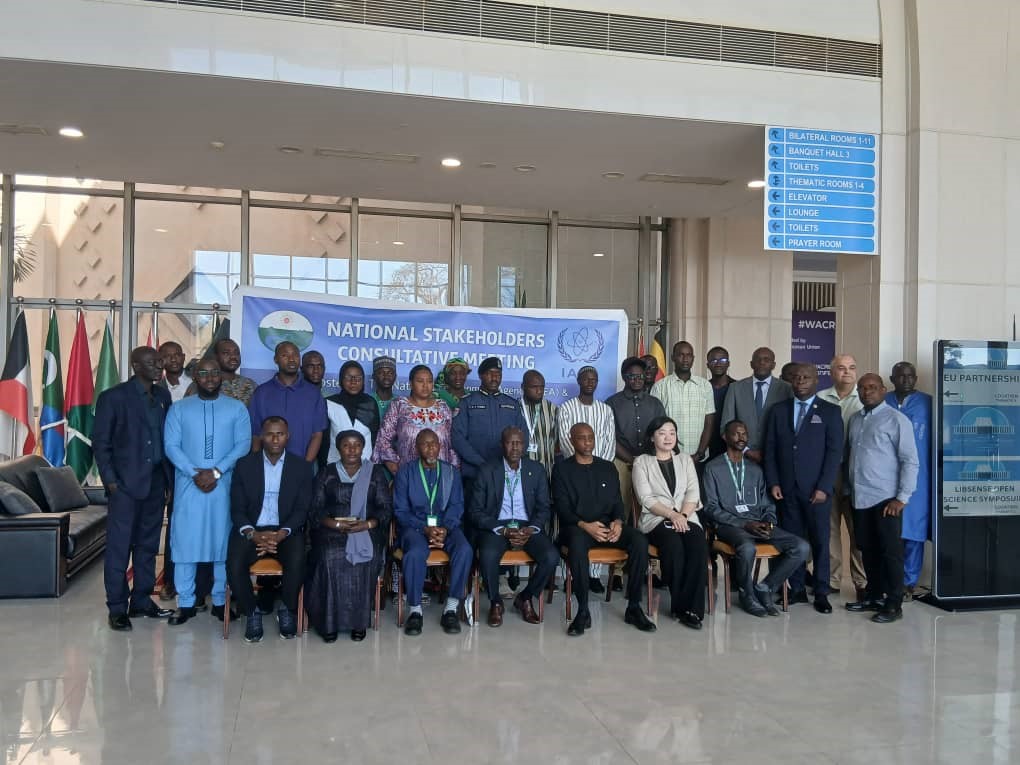
The renewed engagement was highlighted on Wednesday during a national stakeholder consultative meeting held at the Sir Dawda Kairaba Jawara Conference Hall. The forum brought together government officials, technical experts and development partners to review progress and outline future priorities under the IAEA Technical Cooperation Programme.
Dr Dawda Badjie, Executive Director of the National Environment Agency and National Liaison Officer to the IAEA, said the partnership is anchored on the peaceful application of nuclear science to address key development challenges.
He noted that The Gambia’s cooperation with the agency has evolved significantly since the country attained full membership in early 2023.
Dr Badjie explained that the country’s first Country Programme Framework (CPF) for 2024–2029 now guides cooperation with the IAEA, identifying priority areas such as radiation safety, human health, agriculture and water resources management.
According to him, implementation of several programmes is already underway.
He said among the key initiatives is a proposal for the establishment of The Gambia’s first radiotherapy centre, supported by IAEA interventions including the provision of diagnostic equipment, specialised training and long-term fellowships in radiation and clinical oncology.
He added that academic opportunities, including postgraduate studies in nuclear science and short-term training programmes, are also helping to build national expertise.
Dr Badjie further said ongoing projects are aimed at strengthening national capacity in radiation safety, applied research and service delivery, while also improving regulatory systems and human resource development.
He emphasised that health and agriculture remain central to the next phase of cooperation. In the health sector, nuclear techniques are expected to enhance cancer care, medical imaging and disease diagnosis.
In agriculture, isotopic technologies will be applied to improve soil management, boost livestock productivity and enhance climate resilience, in collaboration with the National Agricultural Research Institute.
He also highlighted the development of the “Vancouver Document”, which translates national priorities into an investment-ready framework designed to attract funding and scale up impact.
Speaking at the forum, Abdou Salam Ndiath of the IAEA Technical Cooperation Division commended The Gambia’s commitment to the partnership.
He described the ongoing mission as a significant step in the implementation of the country’s cooperation programme for 2026–2029.
Mr Ndiath said discussions with stakeholders reflected strong national ownership and a clear focus on using nuclear technology to address pressing issues such as cancer treatment and food security.
He assured that the IAEA remains committed to supporting The Gambia through technical expertise, training and equipment.
The week-long mission, which runs from March 21 to 27, is expected to deepen engagement with national institutions and raise awareness of upcoming projects.
Officials say that as The Gambia advances its development agenda, the safe and responsible use of nuclear science will play an increasingly important role in improving livelihoods and building resilience across key sectors.