


By Fatou Krubally
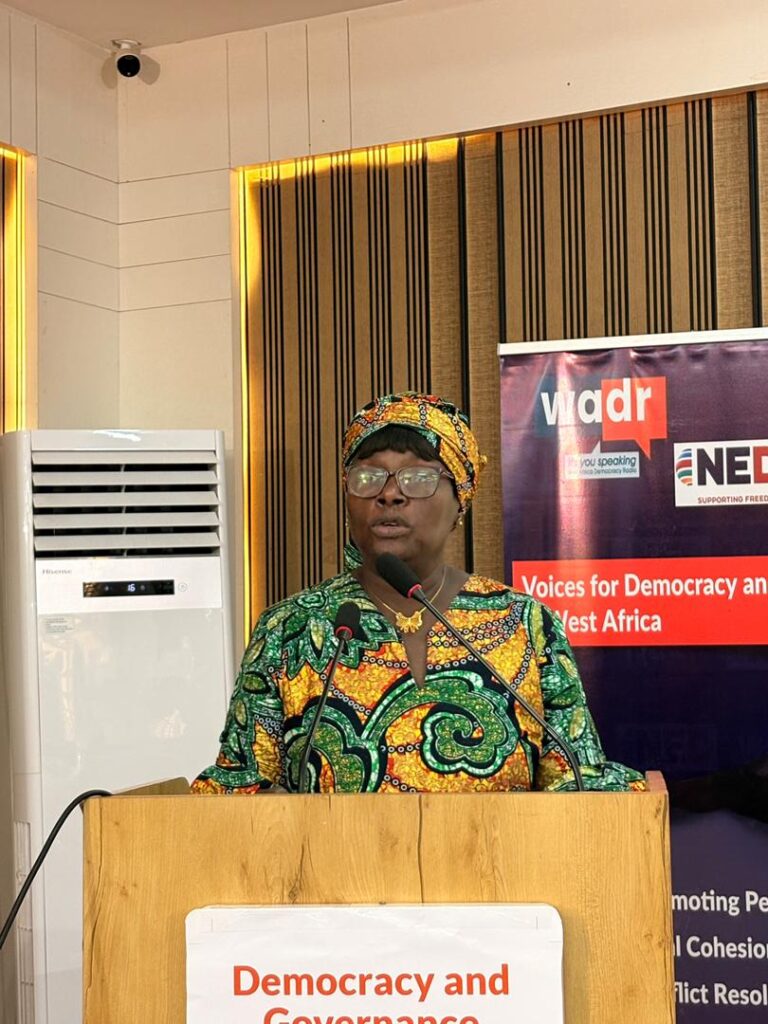
Executive Director of the African Centre for Democracy and Human Rights Studies (ACDHRS), Hannah Forster, has called for stronger democratic institutions, meaningful political competition and greater accountability, saying a free media and vibrant civil society should not be viewed as threats to government.
Forster made the remarks Thursday at the West Africa Democracy Radio (WADR) Democracy and Governance Forum held at Bakadaji Hotel under the theme, “The Gambia’s Political, Judicial and Security Reforms: Progress, Challenges and Recommendations.”
She urged political actors to move away from a culture in which disagreement is interpreted as hostility, stressing the importance of peaceful coexistence, constitutionalism and respect for legitimate electoral outcomes.
Forster also cautioned against treating security and human rights as competing priorities, saying security sector reforms should promote professionalism, civilian oversight and respect for human rights.
She said the credibility of elections should be assessed across the entire electoral process, including access to reliable information, free campaigning, independent journalism and voters’ ability to make informed choices without intimidation or manipulation.
On political inclusion, Forster said women, youth and persons with disabilities should be given meaningful opportunities to participate in political and decision-making processes.
She called for accessible polling stations, inclusive political party structures and stronger mechanisms for documenting discrimination and human rights violations.
Opening the forum, WADR Managing Director Agnes E. John-Thomasi said the gathering was organised under the “Voices for Democracy and Freedoms in West Africa” project, supported by the National Endowment for Democracy (NED).
John-Thomasi said the project responds to growing pressure on democratic resilience across West Africa, including shrinking civic space, attacks on freedom of expression, misinformation and disinformation, weaknesses in accountability, political instability and insecurity.
She reaffirmed WADR’s commitment to editorial independence, accuracy, inclusivity and amplifying community voices, while urging media practitioners to uphold professional and ethical standards as The Gambia prepares for its presidential election later this year.
She also stressed the importance of ensuring journalists have access to information and an environment in which they can work freely and responsibly.
Delivering the keynote address, Gambia Press Union President Isatou Keita said the country’s democratic progress should be measured not only by elections and institutions but also by the level of public trust in those institutions.
Citing recent Afrobarometer findings, Keita said nearly nine in 10 Gambians reject dictatorship, with a similar proportion rejecting one-party rule, while confidence in the presidency, parliament and courts has declined since 2018.
She said The Gambia had made important gains, including increased civic participation, a vibrant media landscape and stronger demands for transparency and accountability.
Keita cited the establishment of the Anti-Corruption Commission, the Access to Information law and the Truth, Reconciliation and Reparations Commission as notable developments, but cautioned that several political, constitutional, judicial and security reforms remain incomplete.
She said the gap between institutional reforms and public confidence remained a major challenge.
Keita noted that The Gambia was approaching another presidential election while still operating under the 1997 Constitution following unsuccessful efforts to replace it.
She argued that democracy cannot depend solely on elections, particularly when effective checks and balances between electoral cycles remain under development.
Representing the Institute for Human Rights and Development in Africa (IHRDA), Legal Officer Abdou Malick Bedo said democracy and human rights were inseparable.
He stressed that elections alone could not guarantee democracy unless citizens were able to exercise their rights, access independent courts, criticise government freely and obtain effective remedies when their rights were violated.
Bedo identified constitutionalism, accountability, participation and inclusion as key principles for democratic reform, saying public institutions must remain subject to the law and earn citizens’ trust through fairness, transparency and respect for human rights.
The forum concluded with calls for stronger accountability, protection of civic space, independent institutions and greater participation of women, youth and persons with disabilities in shaping The Gambia’s democratic future.