


By Haddy Touray
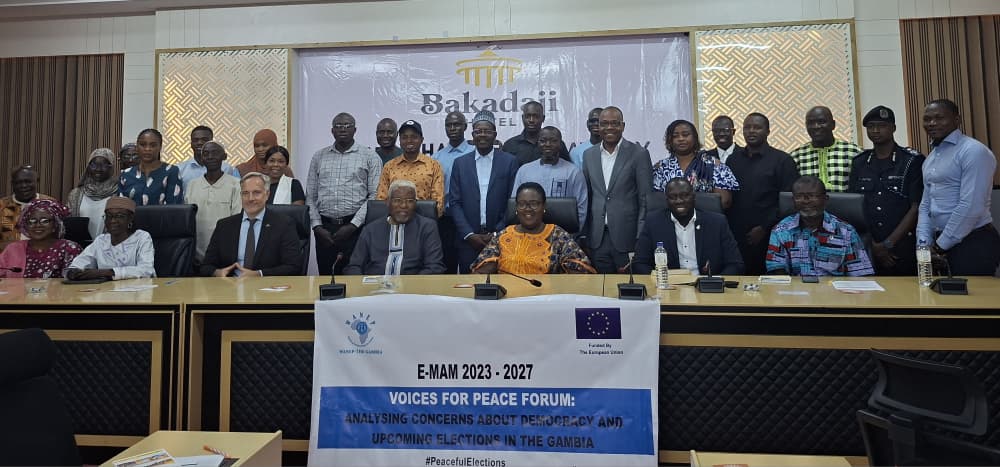
The European Union (EU) and the West Africa Network for Peacebuilding (WANEP) have convened a three-day forum to analyse democratic concerns and electoral risks ahead of The Gambia’s upcoming elections.
The “Voices for Peace Forum: Analysing Concerns About Democracy and Upcoming Elections in The Gambia” was held from 2 to 4 September 2026, bringing together national and regional stakeholders to discuss measures aimed at promoting peaceful, inclusive and credible elections.
The forum formed part of ongoing efforts to strengthen early warning, risk analysis and mitigation mechanisms ahead of The Gambia’s 2026-2027 electoral cycle.
It provided a platform for state institutions, election management bodies, security agencies, civil society organisations, the media and regional actors to share concerns, identify potential triggers of electoral tension and violence, and develop practical measures to safeguard the integrity of the electoral process.
Speaking at the opening, Raphaël Brigandi, Deputy Head of Mission of the EU Delegation to The Gambia, said the country was undergoing a significant democratic journey.
“The Gambia has made important progress in consolidating its democratic space, encouraging civic participation and creating room for dialogue and reform,” he said.
While describing The Gambia as a beacon of democracy in the region, Brigandi cautioned that the gains achieved required continuous attention and should not be taken for granted.
“Sustaining peace during elections is a shared responsibility and the EU’s role as a partner is to support a nationally led process,” he added.
In a goodwill message, Samuel Atuobi, representative of the African Union, stressed the importance of intelligence gathering to facilitate timely and effective responses to electoral threats.
Drawing on experiences from other West African countries, Atuobi urged civil society organisations to focus on underlying issues that could trigger electoral violence.
He said regional and continental institutions could only respond effectively when reliable and timely information was available.
Chairman of the National Election Response Group (NERG), Dr David Tommy, said preventing electoral violence was a shared responsibility requiring sustained collaboration among all stakeholders.
“Effective early warning and early response is a shared responsibility. No single institution can prevent electoral violence alone,” Tommy said.
He called for information-sharing among electoral management bodies, state institutions, security agencies, political parties, civil society, the media, traditional and religious leaders, women and youth organisations, development partners and regional institutions.
For her part, WANEP-The Gambia National Network Coordinator, Salama Njie, said democracy was a continuous process that required constant nurturing, vigilance and dialogue.
“Elections are the cornerstone of a democratic society, but they can also strain social cohesion if not managed with transparency, fairness and mutual respect,” she said.
The forum produced a number of practical recommendations aimed at strengthening partnerships, promoting dialogue, preventing electoral violence and enhancing democratic resilience in The Gambia.
The Electoral Violence Monitoring, Analysis and Mitigation (E-MAM) project is a regional initiative funded by the European Union to prevent, monitor and mitigate election-related violence and threats to democracy in West Africa.
The programme seeks to strengthen regional and national capacities for peaceful electoral processes and political stability across 11 West African countries, including The Gambia.
Regional and international organisations, including the Economic Community of West African States (ECOWAS), ECOWAS Network of Electoral Commissions (ECONEC), United Nations Office for West Africa and the Sahel (UNOWAS) and the African Union, are partners in the initiative.