


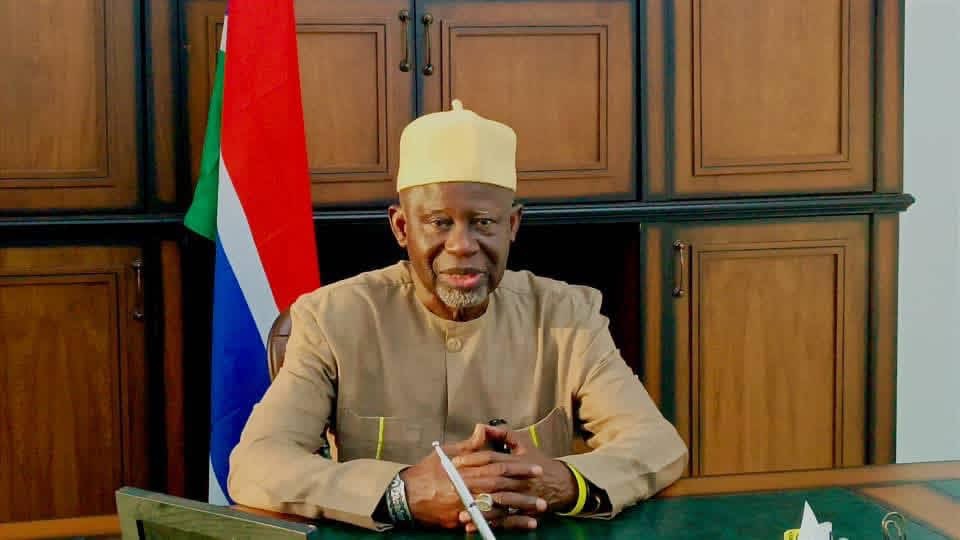
Ousainu Darboe, leader of The Gambia’s opposition United Democratic Party (UDP), has rejected allegations that the party is targeting Fula and Wolof voters through objections to voter registration, insisting that the challenges are being filed by individual registered voters in accordance with the law.
Speaking on Coffee Time with Peter Gomez, Mr. Darboe criticised Hamat Bah, Minister of Lands, Regional Government and Religious Affairs, over allegations that objections to voter registration disproportionately affected members of the two ethnic groups.
Mr. Darboe expressed disappointment with Mr. Bah’s remarks, recalling that they had both opposed ethnic divisions during the rule of former President Yahya Jammeh.
“After all, objections are not by the United Democratic Party. These are registered voters. The law does not permit any political party to raise an objection to the eligibility or otherwise of any claimant as a voter. It is registered voters who have to do so,” he said.
The UDP leader argued that the ethnic composition of those facing objections reflected the population demographics of the communities where the challenges were filed, rather than a deliberate attempt to target particular groups.
He cited predominantly Mandinka communities as an example, saying objections in such areas would naturally involve more Mandinka voters because of their numerical strength.
He also referred to Saloum, a predominantly Wolof area, arguing that objections involving Wolof voters should be understood in the context of the area’s ethnic composition.
Mr. Darboe said the UDP remained committed to the principles of national unity it had defended during the Jammeh era and expressed hope that Mr. Bah would reconsider his statements.
The opposition leader also accused the ruling National People’s Party (NPP) of contributing to ethnic polarisation, criticising President Adama Barrow for what he described as a failure to promptly condemn divisive remarks by members of his political camp.
He singled out Mr. Bah and a National Assembly member over statements he considered inflammatory, arguing that the president should have intervened earlier to prevent tensions from escalating.
“They are trying to portray Mandinkas negatively in the eyes of other tribes,” Mr. Darboe said. “Politicians should be like needles that stitch people together, not blades that divide them.”
Although acknowledging reports that President Barrow had condemned ethnic rhetoric, Mr. Darboe described the intervention as belated, arguing that it followed public criticism of the remarks by religious leaders and other prominent Gambians.
He warned that the use of ethnic identity in political discourse could undermine national cohesion but expressed confidence that Gambians would reject attempts to mobilise electoral support along ethnic lines.
Drawing on his experiences during his school years and legal career, Mr. Darboe recalled friendships with Christians and people from different ethnic backgrounds, saying these relationships were based on a shared Gambian identity rather than religious or ethnic affiliation.
He insisted that no ethnic group could claim ownership of the country, stressing that national unity depended on recognising the equal place of all communities.
Mr. Darboe also referred to remarks reportedly made by President Barrow during a meeting with Mandinka elders in the Lower River Region, in which the president allegedly complained about electoral losses in Mandinka communities.
The UDP leader said such remarks risked reinforcing ethnic interpretations of political support and urged leaders across party lines to demonstrate their commitment to national unity through their conduct.
“So it is our duty, irrespective of where we come from, irrespective of our political affiliation, to preach, not only to preach but also to be seen to be doing what we are preaching, that we should not be polarizing this country,” he said.
Mr. Darboe acknowledged that politicians across the political spectrum shared responsibility for the increasingly divisive political discourse.
“And we, the politicians, are doing a great deal of polarizing in this country,” he said. “And we do them, and then we apologize after the damage has already been done.”
His remarks come as The Gambia prepares for the December 2026 presidential election, with ethnic rhetoric, voter registration objections and political accountability emerging as issues in the national debate.
Mr. Darboe called on political leaders to avoid statements that could deepen divisions and to promote a shared national identity as the country approaches the polls.