


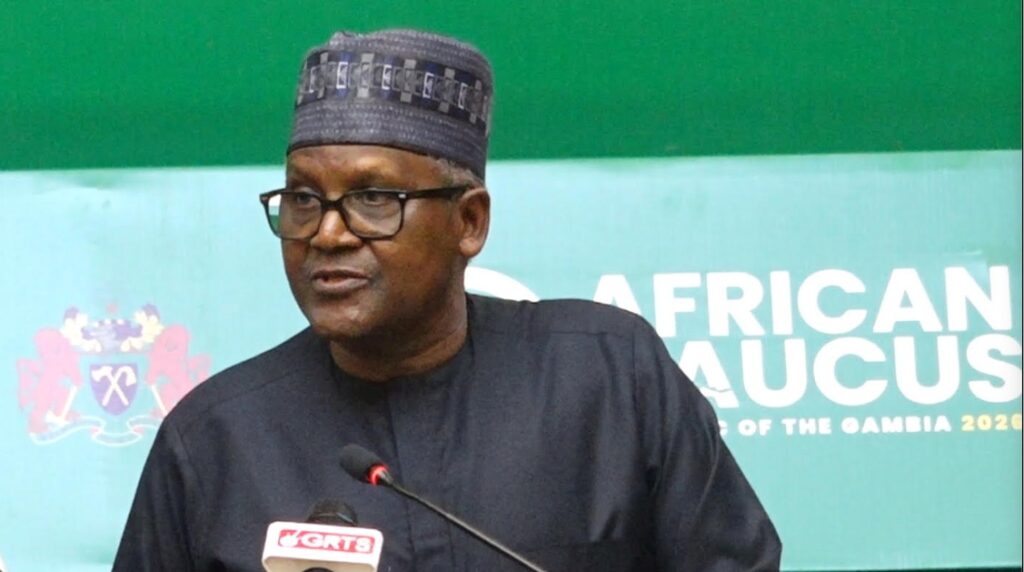
By Haddy Touray
Africa’s richest industrialist, Aliko Dangote, Tuesday urged African governments to accelerate industrialization and dismantle barriers to intra-African trade, saying the continent cannot achieve sustainable prosperity without transforming its productive capacity.
Addressing delegates at the 2026 Africa Caucus meeting in Banjul, Dangote said no country in modern history had attained high-income status without industrialization.
“No country in modern economic history has achieved high-income status without industrialization. Not one,” he told finance ministers, trade officials, diplomats and development partners attending the meeting.
Dangote, President and Chief Executive Officer of Dangote Industries Limited, said Africa possesses abundant natural resources but continues to export raw materials instead of processing them into higher-value products.
He noted that although Africa accounts for about 18 percent of the world’s population, 30 percent of global mineral reserves and nearly 60 percent of uncultivated arable land, manufacturing contributes only about 10 to 11 percent of the continent’s gross domestic product.
According to him, Africa’s share of global merchandise exports remains about 3 percent, with more than 70 percent consisting of unprocessed commodities.
He estimated that the continent loses between US$40 billion and US$50 billion annually by exporting raw materials that are processed abroad and sold back to African markets at higher prices.
“Growth driven only by commodities raises incomes temporarily. Industrialization creates wealth permanently,” Dangote said.
He cited the experiences of Britain, the United States, South Korea, China and Vietnam, arguing that sustained industrial policies, infrastructure investment and export-oriented strategies had enabled those countries to achieve rapid economic transformation.
Dangote warned that Africa’s projected population of 2.5 billion by 2050 could become a demographic burden unless the continent creates about 20 million jobs annually through industrial development.
He also called for stronger regional integration, noting that intra-African trade accounts for only 14 to 17 percent of the continent’s total trade, compared with about 70 percent in Europe.
“It costs me more money to take goods to Ghana from Nigeria than to bring goods from Spain,” he said, attributing the disparity to tariff barriers, inconsistent regulations and inadequate transport infrastructure.
Dangote described the African Continental Free Trade Area (AfCFTA) as one of Africa’s most significant economic initiatives since independence but stressed that industrialisation and regional integration must advance together.
He announced that Dangote Industries plans to invest US$46 billion across Africa over the next four years under its Vision 2030 strategy.
The company also plans to commission a 700,000-barrel-per-day refinery in Lamu, Kenya, as early as September or October, he added.
Also addressing the meeting, Guinea-Bissau’s Prime Minister, Ilídio Vieira Té, called for stronger African cooperation to confront global economic challenges and accelerate structural transformation.
He thanked President Adama Barrow and the Government of The Gambia for hosting the forum and urged African leaders to move beyond the commitments contained in the 2025 Banjul Declaration by accelerating infrastructure development, expanding innovative financing mechanisms and advocating reforms of the international financial architecture.
Vieira Té also cited Guinea-Bissau’s successful completion of the 11th review of its International Monetary Fund-supported program as evidence that sound public policies can strengthen economic resilience even in difficult global conditions.
He called for stronger partnerships with the International Monetary Fund and the World Bank to mobilize long-term financing needed to support Africa’s structural transformation.