


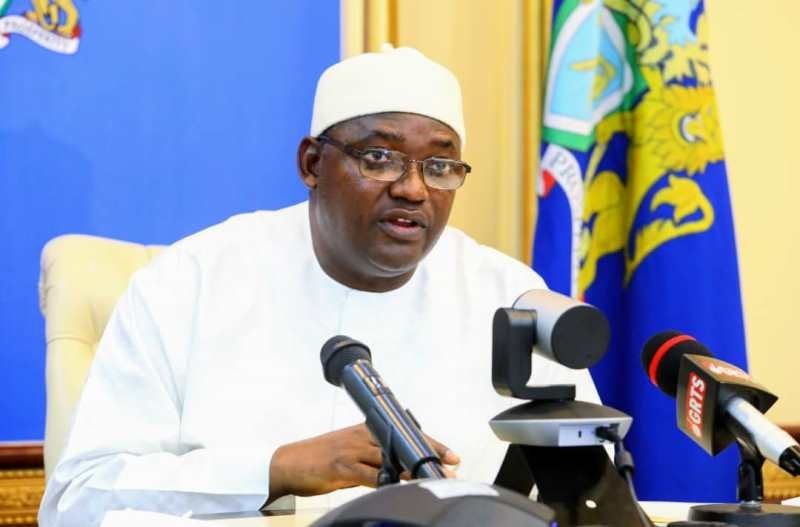
By Musa S. Sheriff
President Adama Barrow has pledged that electricity supply in The Gambia will improve by the end of October 2026, while acknowledging shortcomings in the country’s power generation, planning and maintenance systems.
In a national address on the electricity situation, Mr. Barrow said his government was working with the National Water and Electricity Company (NAWEC), development partners and technical experts to address the persistent power shortages.
“I will not promise you what the Government cannot deliver, but we commit that the electricity supply situation in the country will improve by the end of October 2026,” he said.
The President said the current crisis was being driven by a combination of regional power shortages, high electricity demand, failures of major generating units and seasonal reductions in hydropower production through the Organisation for the Development of the Gambia River (OMVG).
He said the West African Power Pool had reported similar electricity challenges across the region.
“The demand for electricity is at record level, major generating units are failing together, and seasonal conditions are cutting down what our hydropower can produce through the OMVG,” Mr. Barrow said.
He nevertheless acknowledged shortcomings in the government’s planning, power generation and maintenance systems and said corrective measures were being taken.
The President announced that an additional 24-megawatt generating unit was in the final stages of installation at the Brikama Power Station and was expected to be commissioned by the end of October.
He described the additional capacity as significant for a power system of The Gambia’s size and said it would make a substantial difference to electricity supply.
Mr. Barrow also disclosed that a contract had been awarded for the construction of a 50-megawatt solar power plant in Soma, with the contractor expected to begin mobilisation soon.
He said the solar project would help reduce daytime pressure on the electricity system and allow conventional generators to be conserved for evening demand.
The President further announced the establishment of a Presidential Task Force on Electricity Supply, chaired by Vice President Muhammed B.S. Jallow, which will report directly to him and provide public updates every two weeks.
Mr. Barrow said engineers and technicians were working continuously at power facilities to address the crisis.
He also appealed to citizens to express their grievances peacefully and refrain from damaging electricity infrastructure during protests.
“Let us not, in our frustration, tear down what we built with our own hands through public funds,” he said.
The President warned that destroying transformers, power lines and other electricity infrastructure would worsen the situation by disrupting supplies to communities and creating additional costs for repairs and replacement.
He said the country’s progress in expanding electricity access should also be recognised, noting that access had increased from 36 percent in 2017 to about 90 percent currently.
Mr. Barrow said the government was determined to build on the progress made in expanding access by improving power generation and reliability.
He urged citizens to exercise patience and restraint, particularly considering vulnerable groups such as sick people, the elderly and children affected by the outages.
“Your engineers are awake, the Government is awake, and your President is awake with you,” he said, assuring Gambians that his administration would continue working to restore reliable electricity supply.
The President concluded by appealing for national unity and support as the government works to address the electricity crisis.