


By Kemo Kanyi
President Adama Barrow has urged Gambians to make “a difficult but important choice” in the December 2026 presidential election, saying voters must decide between continued development under his leadership and what he termed “retrogression” under the opposition.
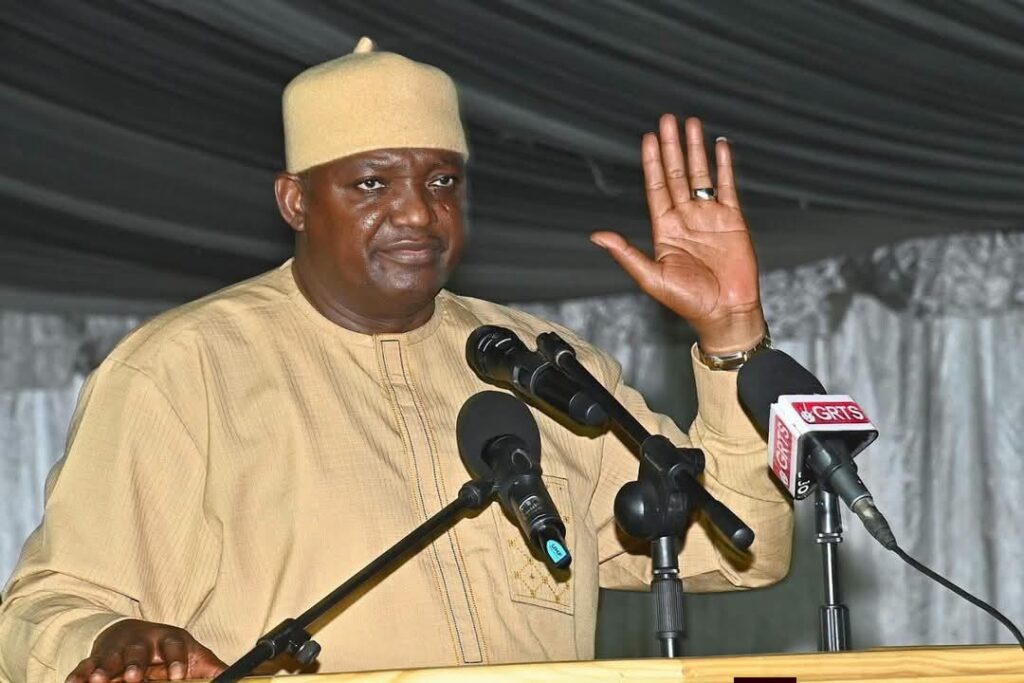
Speaking at Passy Chally Village in Upper Niumi during his nationwide Meet the People Tour, President Barrow argued that voting for the opposition could disrupt ongoing development projects across the country.
He said his government deserved another opportunity to continue implementing its development programs, citing the proverb that “continuation is better than a restart”.
“If you want the continuation of development, vote for President Barrow. Those who want to derail the continuation of development can vote for the opposition. You have two choices to make. That is to vote for progress or vote for retrogression,” he declared.
The President urged voters to exercise wisdom when deciding who should lead the country for the next five years, stressing that their choices would have significant implications for national development.
He cited what he described as his government’s achievements in several sectors, particularly electricity expansion across the country’s administrative regions.
Barrow said The Gambia had undergone significant changes since 2017, recalling that during his first nationwide tour, communities largely raised concerns about the lack of roads, electricity, schools and health facilities.
However, he said, many communities were now highlighting development projects and improvements delivered under his administration.
He said these developments had strengthened his confidence in his government’s performance, particularly in expanding electricity access compared with previous administrations.
According to President Barrow, the administrations of former Presidents Dawda Jawara and Yahya Jammeh electrified 40 communities over approximately 50 years, while his government had connected 203 communities in the North Bank Region to electricity within 10 years.
He further stated that previous administrations had electrified 23 communities in the Central River Region, compared with 355 communities connected under his government.
In the Upper River Region, he said, the previous administrations had electrified 32 communities, while his government had extended electricity to more than 220 communities.
He also highlighted electricity expansion in the Lower River Region and other parts of the country.
The President said slightly more than 300 villages across the country remained without electricity, pledging to extend the supply to all remaining communities.
He described the reported expansion of electricity access as a major development milestone, arguing that such progress had been made possible by his government’s commitment to national development.