


By Haruna Kuyateh
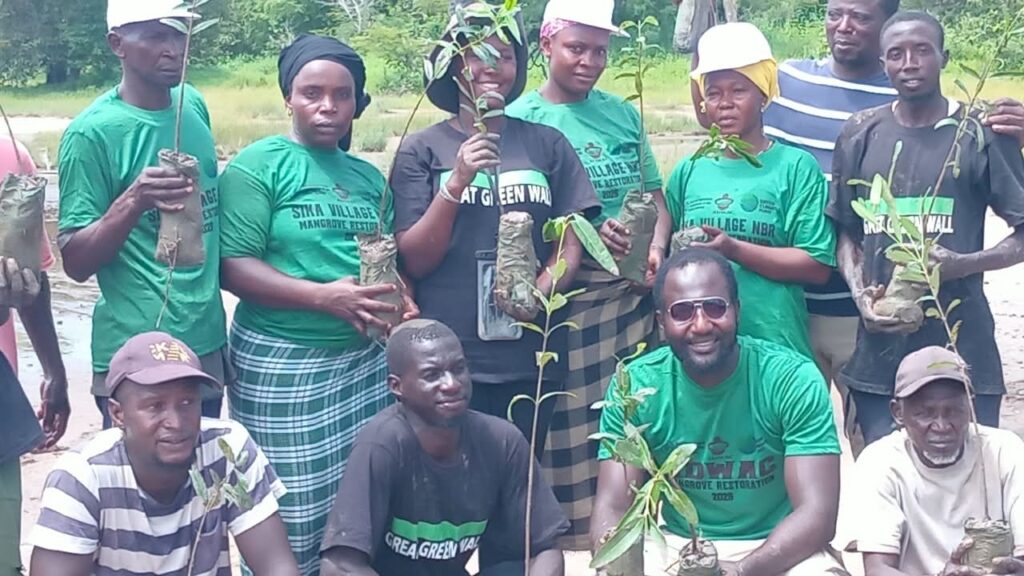
Three organizations in partnership with the community of Sika Village have spearheaded the planting of 4,500 Avicennia seedlings along the wetlands of Upper Niumi in the North Bank Region.
The Great Green Wall Frontline, The Agency for the Development of Women and Children (ADWAC) and the Food and Agriculture Organization (FAO) recently came up with the initiative of massive mangrove planting in Sika area.
The initiative is being implemented under the Global Climate Fund and seeks to contribute to the restoration of depleted mangrove ecosystems and improve the livelihoods of communities dependent on them.
The project is being implemented in three communities — Salikenni, Sika and Jarreng — across the North Bank and Central River regions.
The Great Green Wall Frontline was contracted to deliver 4,500 Avicennia seedlings for the restoration exercise.
Speaking during the planting exercise, Mamsamba Joof, Executive Director of ADWAC, described the partnership with the Great Green Wall Frontline and FAO as an important step towards strengthening community capacity to restore degraded mangrove ecosystems.
He said the initiative would contribute to climate change mitigation and help communities recover ecosystems affected by natural and human activities.
Mr Joof said a series of training sessions had been conducted for community members on the importance of mangroves and Avicennia, as well as techniques for selecting mangrove seeds and planting propagules to improve the survival rate of planted trees.
He added that the project had provided equipment and materials to facilitate the planting exercise and support other community development activities.
Satang Dumbiya, Partnership and Communication Officer at the Great Green Wall Frontline, commended the partnership and the commitment to delivering 4,500 Avicennia seedlings to the Sika community.
She said the pilot planting exercise would enable community members to acquire practical knowledge and apply best practices in mangrove restoration.
Ms Dumbiya said the initiative would strengthen community resilience to climate change and contribute to improving livelihoods.
She underscored that Great Green Wall Frontline remained committed to restoring degraded mangrove ecosystems affected by natural disasters and human activities.
She cited the establishment of a central Avicennia nursery at Jokadou Dasilami as part of efforts to support biodiversity restoration and environmental conservation.
For his part, Mustapha Saho, Chairman of the Sika Village Development Committee, said the planting exercise would contribute to climate change mitigation and strengthen the community’s resilience.
He said the destruction of mangroves and Avicennia had contributed to the disappearance of wildlife species in the area.
Mr Saho disclosed that the project had provided 10 wheelbarrows, 10 spades, 10 pairs of rain boots, 10 buckets, hand gloves and 10 empty bags to facilitate the planting activities.
Members of the Sika Forest Committee, Mama Jammeh and Kaddy Demba, said the depletion of mangrove vegetation had contributed to increased saltwater intrusion into rice fields, affecting agricultural production and food security.
They said restoring the mangrove ecosystem would help improve livelihoods and called for additional support to reclaim rice fields that had been abandoned because of increasing salinity.
Other speakers included Omar Manneh, a beneficiary of the project while Sika Community expressed appreciation to ADWAC and its partners for supporting the restoration initiative.