


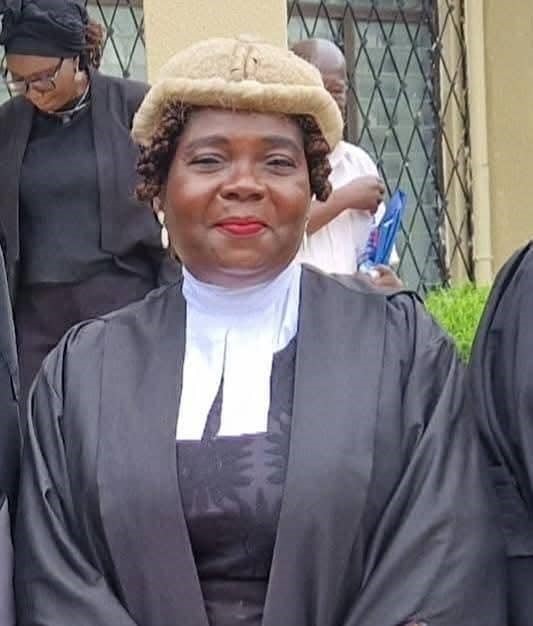
By: Isatou Sarr
The civil suit filed by three former Gambian soldiers against the armed forces and the government on June 10th, 2026 resumed before the Banjul High Court.
Justice Sonia Akinbiyi of the High Court Annex during the trial admitted into evidence a downloaded audio recording of an interrogation session in the on-going civil suit filed by Yahya Beray Jammeh and two others against the Gambia Armed Forces, the Ministry of Defence and the Attorney General.
The ruling followed an objection by counsel for the plaintiffs, S.K. Jobe, who challenged the defence’s attempt to tender the recording through its fifth defence witness (DW5) during a virtual hearing.
The suit was filed by Yahya Beray Jammeh, Abdoulie Jarjue and Yaya Jammeh, who alleged violations of their constitutional and fundamental rights arising from their arrest, prosecution, conviction and subsequent retirement from the Gambia Armed Forces.
The action was brought under Sections 19 and 33 of the 1997 Constitution, Order 27 of the Rules of the High Court and the inherent jurisdiction of the court. The Gambia Armed Forces, the Ministry of Defence and the Attorney General are named as the first, second and third defendants respectively.
According to the plaintiffs’ statement of claim, all three were career soldiers with previously unblemished service records. Yahya Beray Jammeh joined the Gambia Armed Forces in May 2006, while Abdoulie Jarjue and Yaya Jammeh enlisted in September 1995 and rose to the rank of lieutenant after more than two decades of service.
The plaintiffs contended that in 2017 they were falsely accused of plotting to overthrow the government of President Adama Barrow. They were arrested in July 2017 and detained until November 2017, when they were arraigned before a General Court Martial on charges including treason and mutiny.
They further alleged that they were detained for more than 72 hours without being brought before a court, denied access to family members and not informed of their right to legal representation.
Although they pleaded not guilty, the General Court Martial convicted and sentenced them on 24 May 2019 and ordered their dismissal from the Gambia Armed Forces with disgrace. However, on 21 December 2020, the Court of Appeal unanimously acquitted and discharged them on all counts, setting aside both their convictions and sentences.
The plaintiffs state that despite their acquittal, efforts to secure reinstatement proved unsuccessful. Instead, by letters dated 5 August 2021, they were informed by the Ministry of Defence that the President and Commander-in-Chief had reinstated and immediately retired them from the force.
They argued that the compulsory retirement was unreasonable, discriminatory and based solely on allegations and convictions that had already been quashed by the Court of Appeal. They further claimed that other soldiers who faced similar charges but were acquitted by the General Court Martial remained in active service.
The plaintiffs are seeking declarations that their constitutional rights were violated through unlawful detention, arbitrary arrest and prosecution, and discriminatory retirement. They are also seeking D15 million in damages and compensation, D200,000 in legal and administrative costs, and any further relief the court may deem appropriate.
The evidentiary dispute arose when the defence sought to tender a downloaded audio recording of an interrogation session conducted during the 2017 investigation.
Objecting to its admission, Counsel S.K. Jobe argued that the flash drive containing the recording constituted a document under the Evidence Act and that only the original recording, rather than a downloaded copy could qualify as primary evidence. He further submitted that even where secondary evidence was admissible, only a certified true copy would satisfy the requirements of the law.
Jobe also contended that because the recording originated from a state investigation, it constituted a public document and could only be tendered through a certified true copy. He further relied on Section 22 of the Evidence Act governing computer-generated evidence, arguing that the statutory conditions for admissibility had not been met.
He additionally submitted that the recording had not come from the custody of any state institution and that the witness had failed to establish authority to retain such a document, thereby raising concerns about its authenticity, accuracy and reliability.
Responding, defence counsel A.A. Wakawa relied on Section 3 of the Evidence Act, which provided that evidence that was sufficiently relevant to an issue before the court was admissible. He submitted that the recording had been properly pleaded and was relevant to the issues in dispute.
Wakawa further argued that the Evidence Act permitted the admission of secondary evidence in appropriate circumstances. He relied on Sections 98, 99 and 101 of the Act and maintained that the defence had laid the proper foundation for the admission of the recording.
He rejected the argument that the recording constituted computer-generated evidence, submitting that the provision applied to calculations and outputs produced by computer processes rather than audio recordings. In the alternative, he argued that even if Section 22 applied, its requirements had been satisfied.
In support of his submissions, Wakawa cited the Nigerian decisions in Oluwarotimi Akeredolu SAN & Anor v. Rahman O. Mimiko & Ors and Dickson v. Sylvas & Ors, as well as the Gambian case of State v. Ousainou Bojang & Ors.
He also informed the court that DW5, a former captain in the Gambia Armed Forces, had custody of the recording from the time it was made until his retirement.
In her ruling, Justice Akinbiyi noted that the parties did not dispute the relevance of the recording or the fact that it had been pleaded. The sole issue, she said, was whether it was admissible.
The judge reviewed the relevant provisions of the Evidence Act, including Sections 22, 99 and 100, which govern computer-generated evidence and the admissibility of secondary evidence.
Justice Akinbiyi found that DW5 had laid the necessary evidential foundation by explaining how the recording was obtained and by attesting to its authenticity and the reliability of the system used in producing it.
She further held that the defence had complied with the requirements governing secondary evidence and agreed with the reasoning in the Akeredolu decision that compliance with the relevant statutory provisions was sufficient to establish electronically generated evidence.
Although she noted concerns regarding the requirement under Section 100(c) that the original document be shown to be lost, destroyed or otherwise unavailable, she concluded that the material before the court was sufficient for purposes of admissibility.
Justice Akinbiyi therefore overruled the objection raised by Counsel Jobe and admitted the recording into evidence, marking it as Exhibit AWW. She indicated that any further assessment of its weight and significance would be made at the judgment stage.