


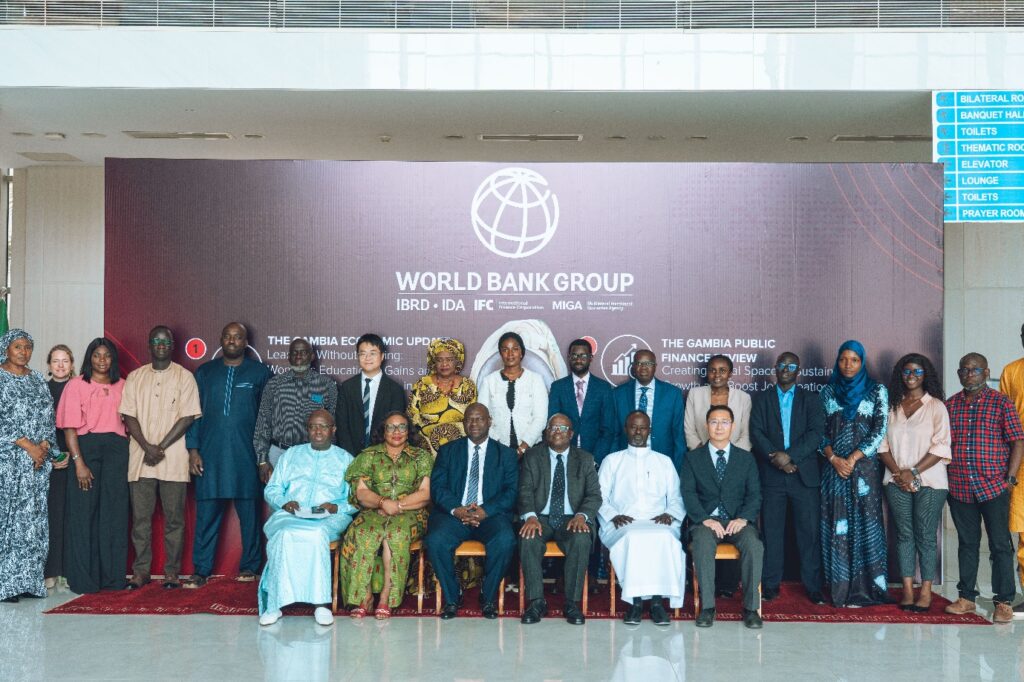
By Haddy Touray
The World Bank Group on Tuesday released two reports highlighting the need for stronger public finances and greater women’s economic participation to sustain economic growth and create jobs in The Gambia.
The reports — The Gambia Economic Update: Learning Without Earning: Women’s Educational Gains and Labor Market Constraints in The Gambia and the Public Finance Review (PFR), Creating Fiscal Space to Sustain Growth and Boost Job Creation — assess the country’s economic performance, fiscal outlook and reform priorities.
According to the Economic Update, economic growth rose from 5.6 percent in 2024 to an estimated 5.9 percent in 2025, driven by strong performances in agriculture, industry and services.
The report said tourism continued its recovery, with arrivals increasing from 224,472 to 233,113, while remittances and easing inflation boosted household incomes.
Extreme poverty declined from 21.5 percent to 20.3 percent during the period under review, it added.
Despite the positive trends, the report identified job creation as a major challenge, noting that 81 percent of workers remain in the informal sector, while 41.3 percent of young people aged 15 to 34 are neither in employment, education nor training.
It also warned that rising global oil prices, increasing energy subsidy costs and higher fertilizer prices could undermine growth prospects.
The report devoted special attention to the disconnect between women’s educational achievements and labour market outcomes.
Although girls outperform boys at primary and lower-secondary levels, women’s labour force participation stands at 41.9 percent compared to 54.9 percent for men, it said.
Women are also more likely to work in the informal sector, accounting for 78.1 percent of informal employment, and earn significantly less than men, particularly in rural areas.
The report identified limited access to education, unpaid care responsibilities, restricted access to land and finance, and prevailing social norms as key barriers to women’s economic participation.
It recommended strengthening school-to-work transition programmes, improving women’s land and property rights, and expanding access to finance and childcare services.
“The Gambia’s economic momentum is real and reflects the government’s commitment to reform, including efforts to attract private sector investment,” said Franklin Mutahakana, the World Bank Group Resident Representative for The Gambia.
He said sustaining the country’s progress would require accelerated job creation, stronger domestic revenue mobilisation and a more inclusive economy that enables women and young people to contribute fully.
Meanwhile, the Public Finance Review found that despite progress recorded since the country’s democratic transition in 2017, significant fiscal vulnerabilities persist.
Tax revenue averaged 10.3 percent of GDP between 2017 and 2024, below the 15 percent benchmark considered necessary to support basic government functions, while fiscal deficits averaged 4.5 percent of GDP, the report noted.
Public debt, although declining, is projected at about 76.4 percent of GDP in 2025, leaving the country at high risk of debt distress.
The review estimated that improving tax collection across major tax instruments could generate additional revenue equivalent to between 3 and 4 percent of GDP.
It also recommended strengthening public investment management, clearing domestic arrears, integrating donor-funded projects into national systems and replacing broad subsidies with targeted support for vulnerable groups.
According to the report, reforms in recruitment, allowances and payroll management could generate savings equivalent to 2.6 percent of GDP between 2025 and 2029.
“The Gambia has demonstrated that it can reform and grow at the same time,” said Ephrem Niyongabo, World Bank Group Economist and Task Team Leader for the review.
He said the fiscal space required to invest in infrastructure, public services and job creation could be achieved through stronger domestic revenue mobilisation and more efficient public expenditure.
The two reports outlined three key reform priorities: broadening the tax base and digitising revenue administration, replacing general subsidies with targeted transfers, and fully implementing the 2023 State-Owned Enterprises Act to improve transparency and reduce fiscal risks.