


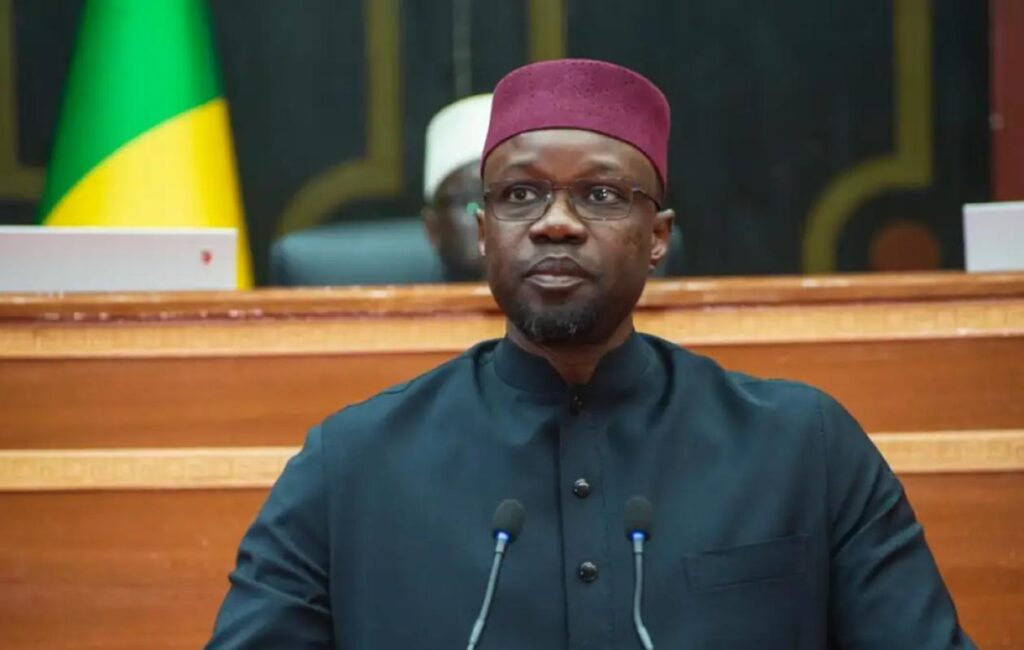
Senegal’s National Assembly President and leader of the ruling PASTEF–Les Patriotes party, Ousmane Sonko, has announced that the party will hold its first ordinary congress on 6 June 2026, describing the event as a key step in transforming the movement into a structured political organisation capable of sustaining the country’s ongoing democratic transition.
A statement obtained by PANA on Monday noted that Sonko, who is the new Speaker of Parliament, reviewed the origins, challenges and future direction of PASTEF, stressing the need to strengthen the party’s ideological and organisational foundations following its rise to power.
Founded in 2014, PASTEF emerged, according to Sonko, without the financial resources or influence networks enjoyed by established political parties. He said the movement was built on the conviction that Senegal’s persistent challenges, including corruption, unemployment, poverty and social inequalities, stem from what he described as “incomplete sovereignty”.
Sonko argued that despite more than six decades of independence and functioning institutions, Senegal continues to face economic, financial, technological and cultural dependencies inherited from the colonial era.
He linked the party’s political trajectory to his election to the National Assembly in 2017, the publication of his political programme –Solutions for a New Senegal — in 2018, the 2019 presidential election and the political developments that culminated in PASTEF’s accession to power in 2024.
According to Sonko, the party’s electoral victory represents more than a change of government and requires efforts to institutionalise reform while avoiding the risk of being absorbed by existing political structures.
“History teaches us that political ruptures can be absorbed when they lack a clear doctrine, a solid organization and a long-term strategy,” he said.
The congress will aim to complete the transition from a movement of change to a fully structured political party capable of leading what Sonko, 51, described as Senegal’s historic transformation.
Delegates from across Senegal and the diaspora are expected to adopt a series of foundational texts aimed at strengthening party structures, training cadres, reinforcing local branches, defining relations between the party and the state, and ensuring the continuity of its political project.
Sonko also emphasised the cultural and ideological dimensions of national transformation, calling for the promotion of national languages, the reclamation of African history, the strengthening of technological capacity and what he termed the decolonization of mindsets.
Reaffirming PASTEF’s Pan-African orientation, he said Senegal’s future should be linked to broader continental objectives, including economic integration, scientific cooperation, knowledge-sharing, local processing of resources and solidarity among African peoples.
This is another clear move as Sonko, who was on 26 May elected president of the National Assembly, has broken away from his friend, President President Bassirou Diomaye Faye.
The political developments set up a potentially tense atmosphere between the executive, headed by Faye, and Legislature, headed by Sonko, two former allies-turned rivals.
Sonko was dismissed as Prime Minister by President Faye after months of disagreements between the two friends whose joint efforts brought them to power in 2024.
They came to power as close allies, but several disagreements over party direction and economic decisions have torn them apart.
Sonko’s PASTEF party holds an overwhelming majority in Parliament, which will leave President Faye in a weak position to see his programmes through.
These include reforms and steps to stabilise the economy.
Media reports say the International Monetary Fund (IMF) suspended a $1.8 billion lending programme after authorities uncovered previously hidden debt linked to the former administration, pushing Senegal’s debt burden to about 132% of gross domestic product by the end of 2024.