


By Binta Jaiteh
Rights activists Thursday called on the African Commission on Human and Peoples’ Rights to adopt a stronger approach towards ensuring the rights of Sahrawi People.
They have argued that Sahrawi victims should have truth, justice, reparation and non-repetition while describing them as key principles in the fight against impunity.
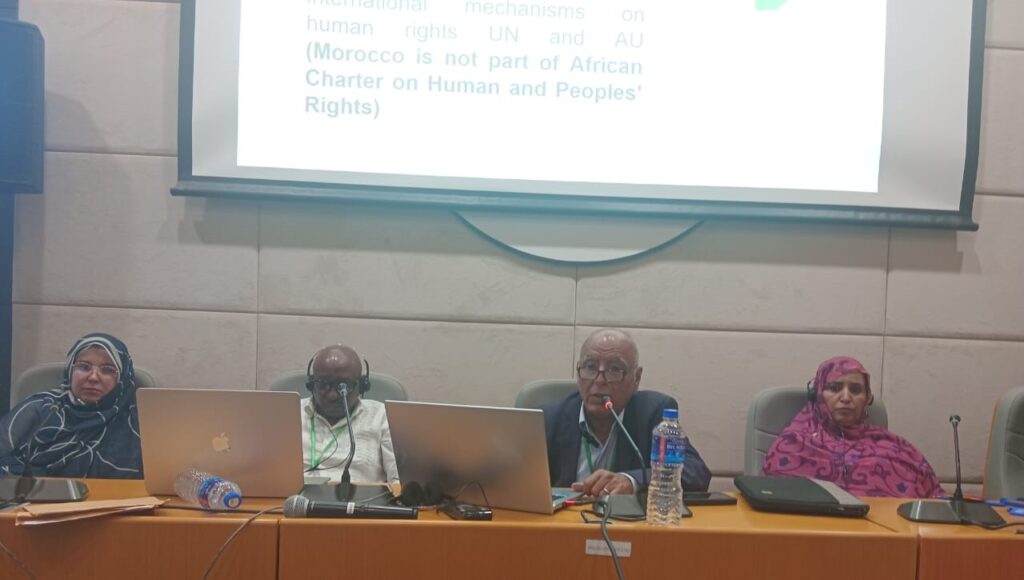
Iranztu Mendia the representative of the Hegoa Institute made the call at the 87th Ordinary Session of the African Commission in Banjul, during a side event aimed at promoting dialogue on how African human rights mechanisms can address protection gaps in contexts where monitoring and visibility remain limited.
Mendia said torture had been systematically used against Sahrawi detainees.
“Torture has been a common and systematic practice used to extract information, punish and demoralise Sahrawi detainees. Forms of physical, psychological and sexual torture have been documented,” she said.
She alleged that women were particularly affected, citing cases of sexual violence, including rape, forced nudity, and forced abortion, carried out in a context of impunity and widespread human rights violations.
According to her, such abuses are linked to broader political and economic dynamics, including the exploitation of natural resources in Western Sahara.
She urged the African Commission to play a stronger role in promoting a political solution to the Western Sahara conflict that guarantees the right to self-determination for the Sahrawi people.
Mendia also said the situation of refugees should not be treated solely as a humanitarian concern but as a human rights issue requiring durable solutions, including the right of return.
She further called for human rights monitoring missions in the territory, demilitarisation efforts, support for investigations into disappearances, and the release of Sahrawi political prisoners.
“To pay particular attention to violations against women, in line with the Maputo Protocol, especially Articles 10 and 11 on women in armed conflicts, and to establish channels of dialogue with Sahrawi human rights organisations,” she added.
She said more than 800 cases of enforced disappearances have been documented, affecting men, women and children, while a significant portion of the population remains dispersed across different countries.
Also speaking, Dr. Sabeko Gumedze, representing the University of Pretoria’s Human Rights programme, said the discussion was important given the number of conflicts across Africa.
He described Western Sahara as a case study marked by allegations of violations, limited independent monitoring, and restricted international scrutiny.
Gumedze noted that Morocco is not a party to the African Charter on Human and Peoples’ Rights, stressing the need to ensure respect for human rights in the territory despite that fact.
“Restrictions on journalists and human rights defenders also restrict access to information. When people cannot speak freely, meaningful solutions become difficult,” he said, adding that freedom of expression remains central to democratic governance.