


By: Isatou Sarr & Dawda Jallow
The Gambia Press Union (GPU) has warned of persistent challenges to press freedom in the country, calling for stronger safeguards for journalists amid ongoing legal, regulatory, and economic concerns affecting the media sector.
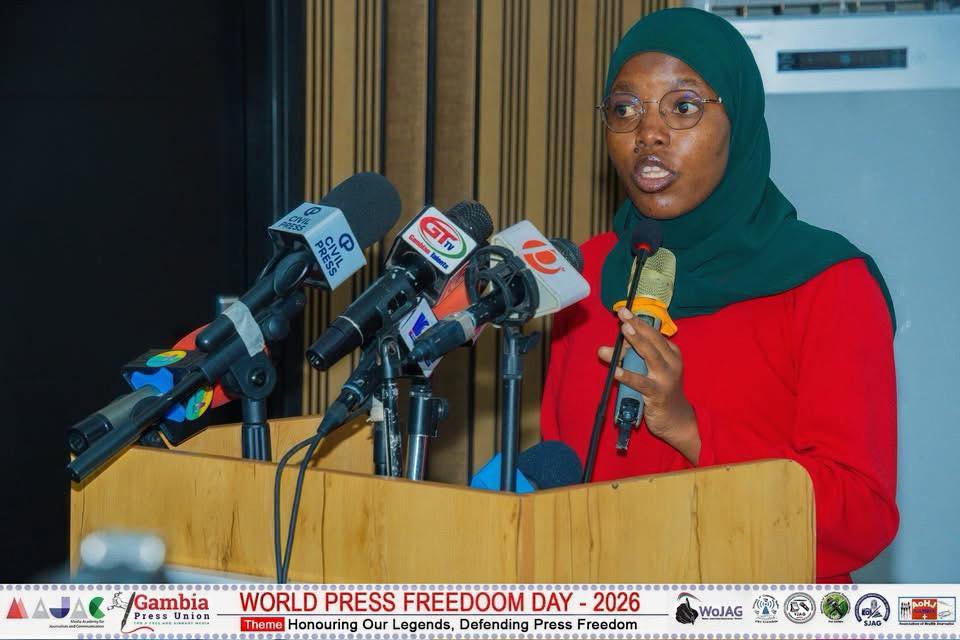
Speaking during the commemoration of World Press Freedom Day, GPU President Isatou Keita said journalists continue to face conditions that require urgent attention to ensure full protection of media independence and freedom of expression.
She said this year’s global theme, “Shaping a Future of Peace: Promoting Press Freedom for Human Rights, Development, and Security,” highlights the critical role of independent journalism in promoting peace, especially in a context of rising global conflict, digital threats, and misinformation.
World Press Freedom Day is observed annually to raise awareness of press freedom and to remind states of their obligations under Article 19 of the Universal Declaration of Human Rights to uphold freedom of expression.
Keita said journalists who demonstrate resilience and courage in defending truth and accountability are being recognised, adding that the media remains central to democratic governance.
In The Gambia, she said the commemoration is being held under the theme “Honouring Our Legends, Defending Our Freedom,” reflecting the country’s media history marked by periods of repression, resistance, and reform.
She noted that The Gambia has made progress in the Reporters Without Borders (RSF) Global Press Freedom Index, ranking 46th out of 180 countries and 8th in Africa. However, she said further improvements are needed to address remaining structural and institutional challenges.
According to her, these include limited political will to fully protect journalists, incomplete media law reforms, and legislative initiatives that risk encouraging self-censorship.
Keita also cited economic constraints facing media organisations, including selective allocation of government advertising and limited state support for private media outlets. She further pointed to reported cases of harassment, arrests, legal threats against journalists, and weak enforcement of the Access to Information Act, 2021.
She referenced recent incidents involving journalists, including arrests during protests in Banjul in May 2025, alleged assaults by security personnel, court-related harassment cases, and restrictions on media coverage of official events.
On proposed legal reforms, Keita expressed concern over the Cybercrime Bill, 2023, and the Communication Bill, 2025, warning that certain provisions could restrict online expression and investigative journalism.
She also criticised proposals to grant the Public Utilities Regulatory Authority (PURA) powers to register and regulate journalists and online media, describing such measures as inconsistent with international standards on freedom of expression.
The GPU urged government to abandon plans for state licensing of journalists and instead strengthen media self-regulation through the Media Council of The Gambia.
It further called for full implementation of media reforms and the UN Plan of Action on the Safety of Journalists, in line with recommendations of the Truth Commission accepted by the government.