


By Kemo Kanyi
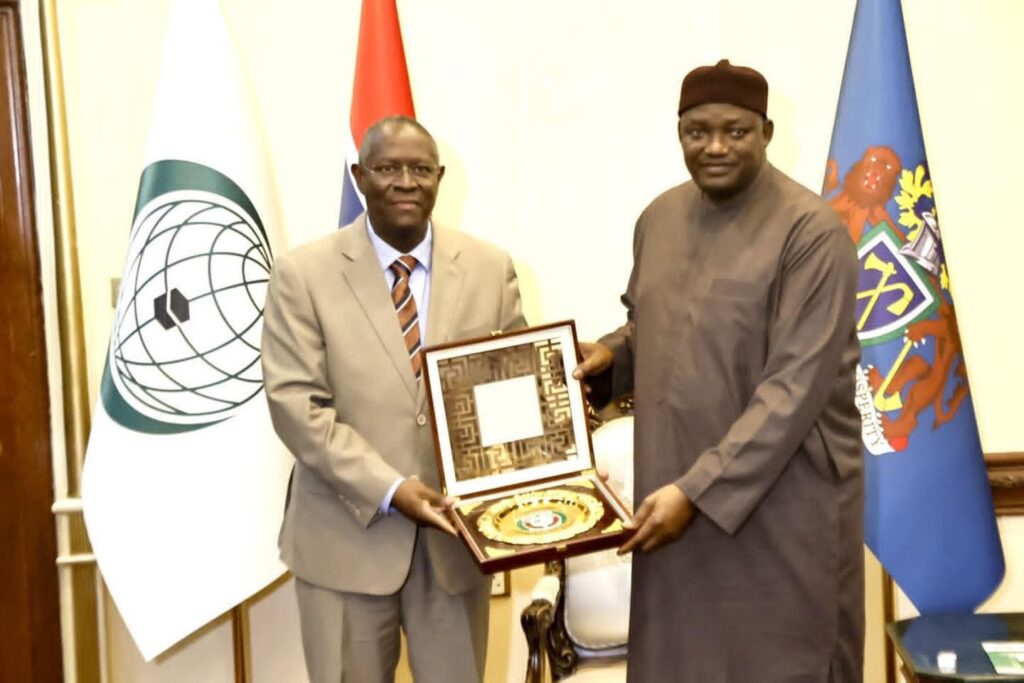
A delegation of judges from the ECOWAS Community Court of Justice on Wednesday paid a courtesy visit to President Adama Barrow at the State House in Banjul to brief him on the Court’s sensitisation mission to The Gambia.
The delegation comprised Justice Ricardo Gonçalves, President of the Court; Justice Sengu Koroma, Vice President; Justice Edward Asante; Justice Dupe Atoke; and Mary Saine, Acting Deputy Chief Registrar of the Court.
The visit forms part of the Court’s promotional outreach activities aimed at informing Member States about its mandate, jurisdiction, and procedures for accessing justice. It is also the Court’s first such engagement in The Gambia since its establishment.
Speaking to journalists after the meeting, Mary Saine said the mission seeks to engage citizens and stakeholders on the work of the Court.
“We visit citizens of Member States and different stakeholders to sensitise them on the work that the Court does, its mandate, jurisdiction, and how citizens can access the Court,” she said.
She added that the delegation will hold technical sessions with a cross-section of Gambian society, including civil society organisations, lawyers, women, and youth groups.
“We will have representatives from civil society organisations, lawyers, women, youth, and various other categories of society. There, we will inform them about what we do, our mandate, and our jurisdiction,” she said.
Saine further disclosed that a dedicated session will be organised for the legal fraternity, including members of both the public and private bar, as well as law students from the University of The Gambia.
According to her, the visit will also include a judicial dialogue between ECOWAS Court judges and members of the Gambian judiciary, aimed at strengthening cooperation and improving the enforcement of community law.
“Our law provides that enforcement should be done in accordance with the civil procedure of each Member State,” she noted.
She explained that national courts also have the opportunity to refer cases involving ECOWAS statutes or community law to the ECOWAS Court of Justice when such issues arise at the national level.