


By:Haddy Touray
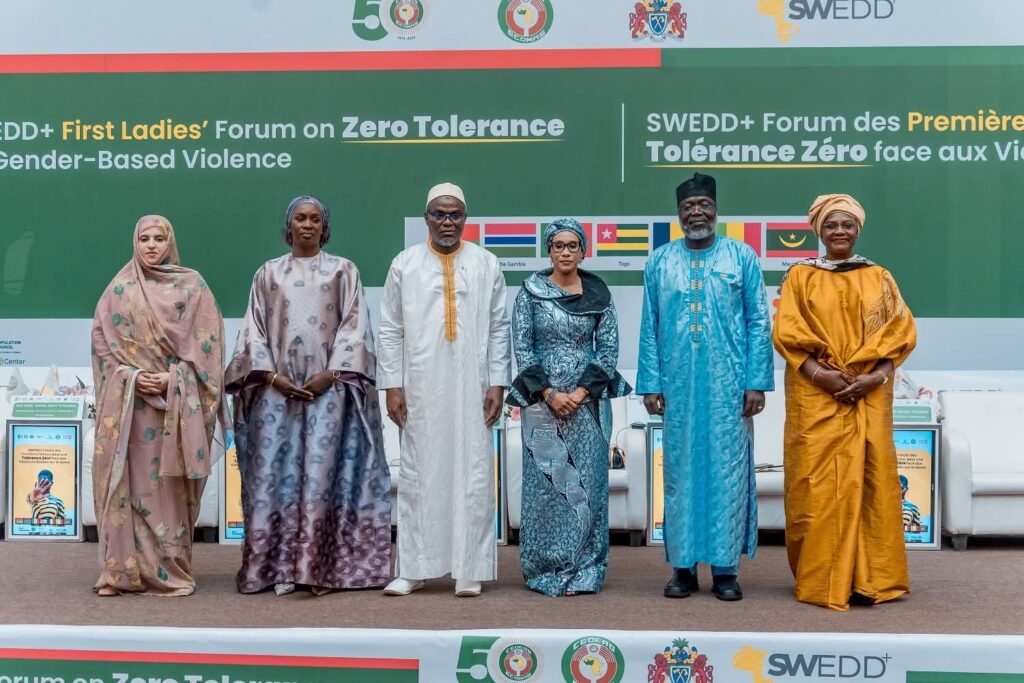
First Ladies meeting here in Banjul Friday adopted a declaration on “Zero Tolerance for Gender-Based Violence” (GBV), as part of efforts to strengthen regional action against violence affecting women and girls.
The declaration was made by first ladies of Sub-Saharan Women’s Empowerment and Demographic Dividend Plus (SWEDD+) countries at the end of their three-day meeting in Gambia.
The forum further recommended enhanced coordination through ECOWAS institutions and welcomed the establishment of a Regional Technical Working Group on GBV to strengthen collaboration across the region.
The forum was held under the SWEDD+ initiative and brought together First Ladies, senior government officials and development partners to advance coordinated responses to gender-based violence (GBV), according to a press release from the ECOWAS Communication Directorate.
It was co-organised by the Government of The Gambia and the Economic Community of West African States (ECOWAS), in collaboration with partners including the United Nations Population Fund (UNFPA), the World Bank, the Economic Community of Central African States (ECCAS) and SWEDD+ member countries.
The opening ceremony was attended by First Lady of The Gambia Fatoumata Bah-Barrow and First Lady of Senegal Marie Koné Faye, alongside other First Ladies from SWEDD+ countries and representatives from Cameroon.
Also present were ECOWAS Commission President Dr Omar Alieu Touray, ECOWAS Commissioner for Human Development and Social Affairs Prof Fatou Sow Sarr, senior officials of the World Bank and UNFPA, as well as ministers from The Gambia, the Central African Republic and other participating countries.
In remarks delivered on behalf of President Adama Barrow, Vice President Mohamed B.S. Jallow reaffirmed The Gambia’s commitment to combating gender-based violence.
Mrs Bah-Barrow highlighted her work through the FaBB Foundation to promote the welfare and protection of women and girls.
“In my journey, I have worked to address the root causes of gender-based violence, including poverty, gender inequality, economic insecurity, illiteracy, and limited access to essential social services such as healthcare,” she said. “By tackling these underlying issues, we do more than just respond to violence; we work to prevent it.”
In his keynote address, Dr Touray said ECOWAS was supporting member states through stronger institutions and harmonised legal frameworks to improve responses to GBV.
The forum followed a ministerial meeting held on 9 April 2026 and a prior experts’ session that reviewed the state of gender-based violence across the region.
Participants noted progress but highlighted gaps in prevention, law enforcement, service delivery and coordination. They said implementation challenges continued to limit the impact of existing policies and frameworks.
Discussions focused on translating commitments into measurable results, including the Regional GBV Roadmap (2026–2028) and a Regional GBV Legal Scorecard aimed at strengthening accountability.
The meeting concluded with the adoption and signing of a Joint Declaration on Zero Tolerance for Gender-Based Violence by the First Ladies.
Participants called for stronger investment in prevention, improved access to justice, survivor-centred services, reliable data systems, and greater efforts to address harmful social norms. They also stressed the importance of engaging men and boys and empowering young people.