


By: Isatou Sarr
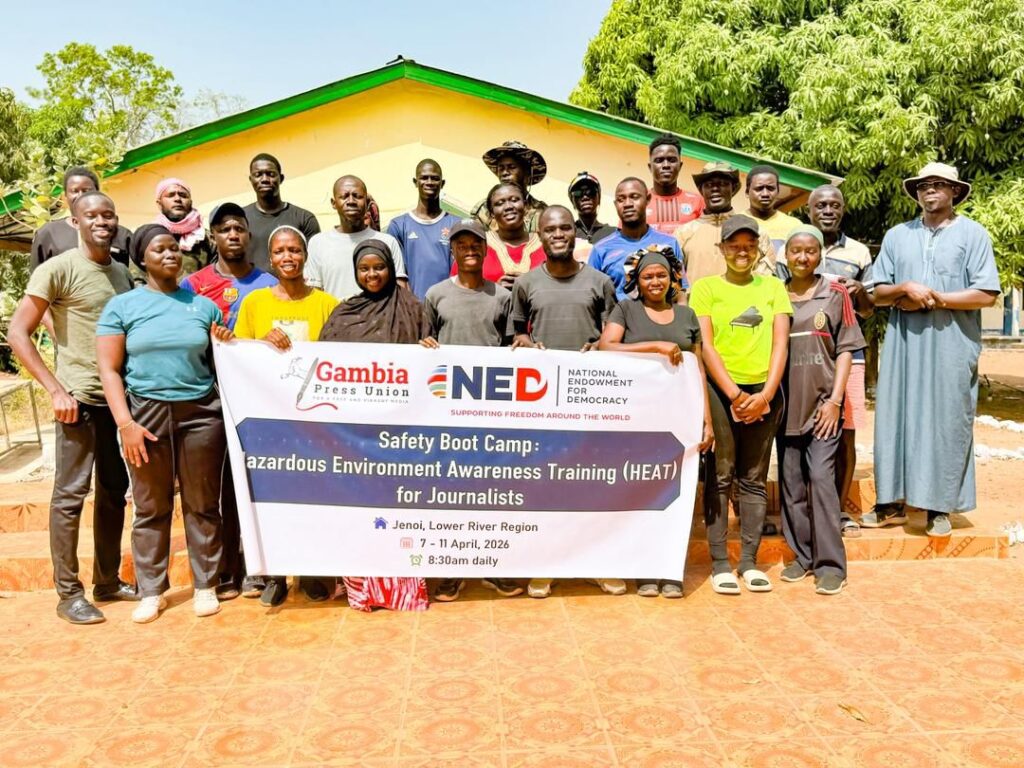
Journalists have recently concluded four-day safety training programme held in Jarra West, Lower River Region.
Twenty-one journalists drawn from newspapers, online platforms, radio and television stations took part in the Hazardous Environment Awareness Training (HEAT) held at the Rural Farmers’ Agriculture Training Centre in Jenoi.
The training comes amid growing concerns over possible tensions and unrest ahead of The Gambia’s 2026–2027 electoral cycle.
Organised by the Gambia Press Union (GPU) in collaboration with the Media Academy for Journalism and Communication (MAJaC), with support from the National Endowment for Democracy (NED), the programme aimed to equip journalists with skills to operate safely in high-risk environments, including protests and politically charged situations.
One of the facilitators, Sang Mendy, says the country is approaching an electoral period that may be marked by campaigns and public demonstrations.
“We are heading into an electoral cycle where there will be campaigns and likely protests, as people express concerns over issues they may consider unconstitutional,” he said. “In such situations, protests can turn violent, and journalists often find themselves caught in the middle while trying to inform the public.”
He noted that the training provided participants with the knowledge, skills and mindset required to safely cover protests and other volatile events, assess risks and develop mitigation strategies.
“The focus must remain clear—report responsibly, avoid unnecessary danger, and ensure that every journalist returns safely from the field,” Mendy emphasised.
He further advised journalists to prioritise their safety at all times. “You don’t argue with someone with a gun. If you are asked to leave, you leave, and report with what you have,” he added.
Alieu Ceesay of Alkamba Times described the training as a valuable addition to his career, saying it has changed his approach to covering protests and crisis situations.
“Over the years, I have been on the frontlines covering protests with little understanding. This training will help me do better and avoid unnecessary confrontation,” Ceesay said.
Speaking at the closing ceremony, GPU Secretary General Modou Joof said the period ahead would test the resilience and discipline of the media.
“There will be tension, there will be protests, and some may turn violent. As journalists, your responsibility is to tell the story, but no story is worth your life,” he said.
Participants also took part in practical drills on how to respond in hostile environments, manage confrontations with security personnel and maintain composure under pressure.
A key message throughout the training was the need for solidarity among journalists looking out for one another in the field, discouraging risky behaviour and speaking with one voice.