


By Momodou Bah
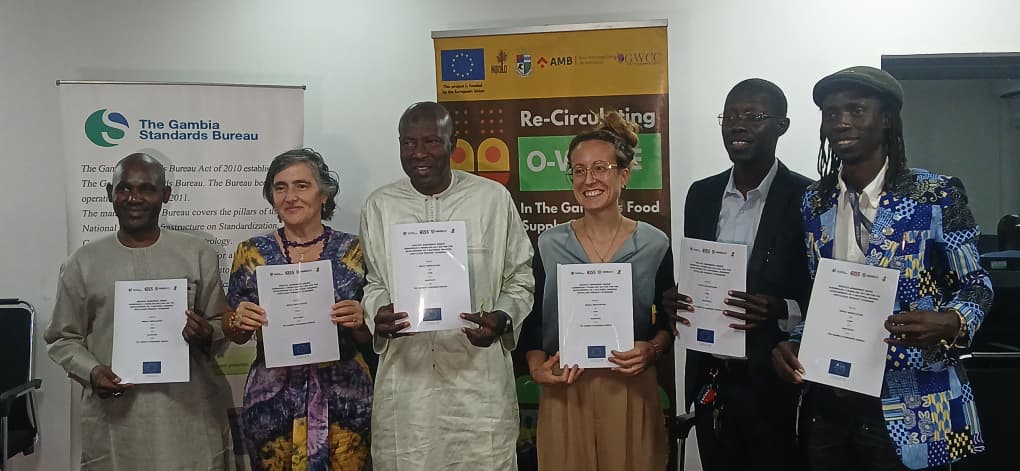
The Gambia Standards Bureau (GSB) has approved national standards for organic fertiliser, marking a significant step in sustainable agriculture and waste management in the country.
Papa Secka, Director General of the GSB, said the European Union (EU) has been a long-term partner, supporting various projects in West Africa, including the West Africa Quality Program and the Competitiveness Project, even before the establishment of the Bureau in the Gambia.
“The national quality policy aims to strengthen the legal framework through the Gambia Standards Bureau Act,” Secka said. He added that the EU has provided crucial support in building laboratories and supplying equipment, which helped develop the new organic fertiliser standards.
Malang Sambou, Executive Director of the Mbolo Association, highlighted the benefits for Gambian farmers. “Farmers deserve quality inputs to restore soil health. Through our project, bio-waste from 12 markets in the Kanifing Municipal Council—collected from 1,050 vendors—is segregated at source and processed into organic fertiliser,” he said.
The initiative, led predominantly by women, processes three tons of waste daily, diverting an estimated 1,136 tons annually from dump sites. This waste is converted into 183 tons of fertiliser, or 7,576 bags of 25 kg each, ready for farmers. The project also reduces carbon emissions by approximately 802 tons of CO2 per year, a 90% reduction compared with conventional practices.
Decades of conventional farming have depleted soil nutrients, threatening food security. “By training farmers in agrostology and demonstrating the soil-restoring effects of compost, we provide safe alternatives to chemical fertilisers. A testament is the Turjereng CCF garden, where 90% of the 1,295 farmers reached across seven gardens are women,” Sambou noted.
Ciss Lucia Palmioli, Project Coordinator, said the production and use of organic fertiliser is growing nationwide. “Farmers need to know what they are using, and consumers need assurance about what they eat. Institutions require tools to ensure safety and quality, making national standards essential,” she said.
Lamin S. Sanyang, Country Program Manager for WasteAid The Gambia, said organic fertiliser provides practical solutions by transforming waste into agricultural inputs. “It improves soil health, increases crop production, and reduces waste sent to dumps. Clear standards build farmers’ and investors’ confidence and ensure quality, safety, and consistency,” he explained.
The EU Ambassador to the Gambia, Immaculada Roca í Cortés, emphasized the collaboration between public institutions and civil society in developing standards that promote safe and sustainable agricultural practices. “Organic fertiliser strengthens agriculture and protects public health, but its potential can only be realized through clear standards,” she said.
Alhagie Nyanga, Permanent Secretary at the Ministry of Agriculture, highlighted the importance of agriculture to the national economy. “Agriculture employs 70–80% of our population. Fertiliser and seeds are the foundation of production. Our priority is sustainable production, which requires sound policies and quality standards,” he said.
The new national standards for organic fertiliser are expected to enhance food security, promote sustainable farming practices, and support a circular economy where waste is treated as a resource, generating income, jobs, and environmental benefits.