


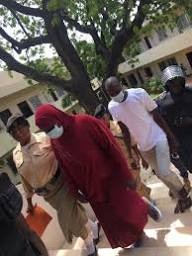
By Isatou Sarr
Defence Counsel A. Sillah has called on the High Court to acquit Amie Bojang in the fatal shooting of two police officers at Sukuta-Jabang traffic lights, arguing that the prosecution has failed to prove she knows about the crime she is accused of helping to conceal.
In a final submission, Mr. Sillah said the state had not met the legal threshold required to convict Ms. Bojang, who faced a single charge of being an accessory after the fact to murder. She is the sister of the main accused, Ousainou Bojang, who prosecutors allege carried out the shooting.
Under Section 202 of the Criminal Code, the defence argued that the prosecution must establish not only that a murder occurred but also that the accused had knowledge of the crime when assisting the principal offender. “Knowledge is the essential element—and it has not been proven,” Mr. Sillah said.
Ms. Bojang testified that she accompanied her brother to the border to seek spiritual counsel from a marabout in Senegal over an alleged blackmail scheme involving explicit photographs. She said she learned of the police shooting only after he crossed into Senegal.
The defence also highlighted that Mr. Bojang did not act like someone fleeing a crime. Witnesses described him as calm during the taxi ride and at the border, making no effort to hide himself. Bubacarr Manneh, who drove Mr. Bojang from the border to Diouloulou, said he appeared composed, a demeanor inconsistent with a person evading arrest for murder.
The brief challenged the prosecution’s evidence, noting that the only surviving officer, PC Ansey Jawo, did not identify Mr. Bojang at the scene and relied on social media photographs for later recognition. Call log evidence (Exhibit D13) was cited as contradicting testimony of two soldier witnesses who claimed to have pursued the gunman at the beach.
Mr. Sillah questioned the reliability of alleged confessions by police officers (PW5 and PW6) and raised doubts about civilian witness Mama Jabbie, who claimed Mr. Bojang confessed to her. The defence noted she lost an alleged audio recording and suggested that the D1 million government bounty could have influenced her statement.
Taxi driver Abdoulie Drammeh (PW9) testified that although he mentioned the shooting during the trip, Ms. Bojang did not respond, and he only recognized the accused after seeing photographs days later.
Central to the defence is the “principle of dependency,” which holds that an accessory’s liability depends on proof of the principal offence. Without forensic evidence linking Mr. Bojang to the shooting or credible eyewitness identification, the prosecution has not established that he was the gunman.
Concerns were also raised over the investigation. Public statements by senior officials, including the Presidential Spokesperson and the National Security Adviser, were described as prejudicial. Ms. Bojang said she was detained for over a week—beyond the constitutional 72-hour limit—under poor conditions and pressured to provide information on her brother’s movements.
The defence cited digital evidence, including WhatsApp logs (Exhibit D38) from witness Kathleen McGee (DW11), showing Mr. Bojang communicated with acquaintances at the time of the shooting about the alleged blackmail.
In closing, Mr. Sillah told the court that the prosecution’s case rested on “remote possibilities” rather than proof beyond a reasonable doubt and urged the court to acquit Amie