


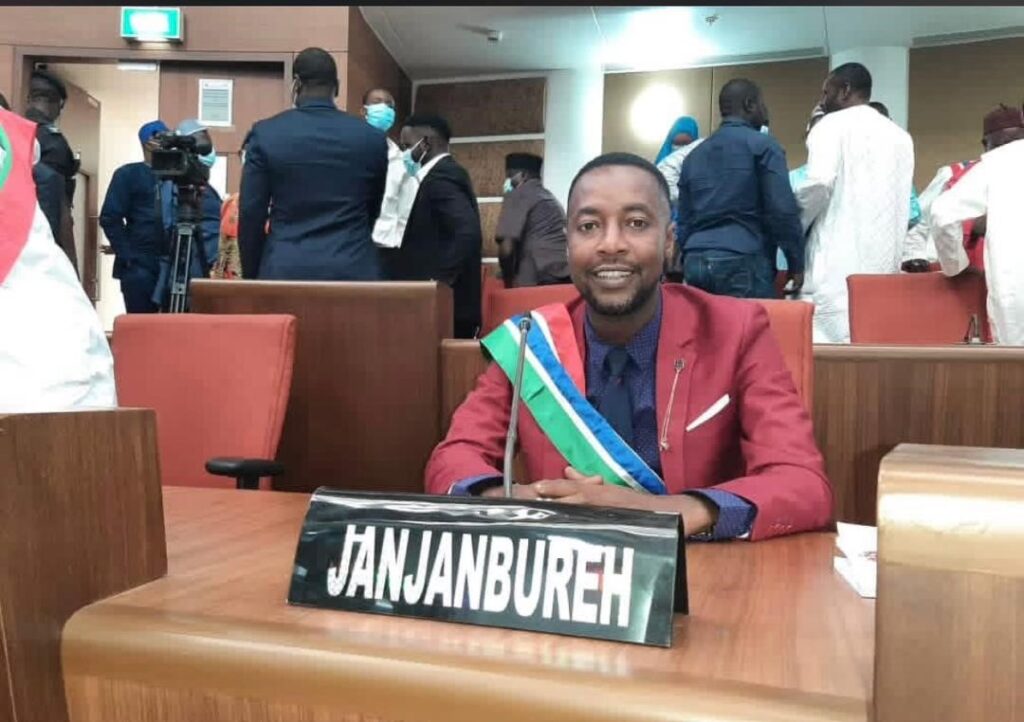
GUEST OF THE WEEK
By Binta Jaiteh
Hon. Omar Jammeh, National Assembly Member for Janjanbureh Constituency and member of the Special Committee on the Sale of Former President Jammeh’s Assets, is one of The Gambia’s youngest lawmakers. Often described as a grassroots leader, he rose from a “ghetto youth” background and contested as an independent candidate, reflecting deep roots in community activism.
A former student of Armitage Senior Secondary School, Hon. Jammeh holds a Diploma in Sustainable Tourism from the Institute of Travel and Tourism of The Gambia (ITTOG). His development initiatives focus on vocational training and skills development, including fashion production projects and the provision of equipment to women and youth in his constituency.
Recently speaking to The Voice Newspaper, Hon. Jammeh spoke on the history of Janjanbureh, the slave trade, the McCarthy (Kankurang) Festival, and national independence.
Q: Can you briefly explain the history of Janjanbureh?
A: The history of Janjanbureh can be explained from two perspectives: oral and written. From the oral tradition, the island was founded in the 17th century by two brothers, Janjan and Bureh, descendants of Jamali village in the northern part of the island, who settled there in search of fertile land for agriculture.
From the written historical perspective, Janjanbureh was founded by the British after it was purchased from the King of Niani, Mansa Musa Koli Camara of Kataba village. An agreement was reached, and a treaty was signed in 1823, formally ceding the island, during a ceremony marked by a royal salute.
Q: How did Janjanbureh become associated with the slave trade?
A: I am not entirely certain that Janjanbureh was ever a centre of slave trading activities. Rather, it became a centre for addressing the slave trade following its abolition. Two forts were constructed on the island to suppress slave trading and to resettle liberated Africans. These liberated Africans later integrated into society and made significant contributions to the island’s development.
Q: What led to the annual celebration of the festival?
A: The celebration dates back to time immemorial. In 1983, the community formally began organising the festival every five years. This continued until 2018, when the concept was revived and rebranded as an annual event.
The aim is to enhance cultural diversity, attract visitors, preserve heritage, strengthen community unity, and maximise economic benefits for youth and women entrepreneurs. Previously, tourists visited the island only briefly due to limited cultural activities. The festival now helps to extend visitors’ stays and increase revenue for local service providers such as lodges, restaurants, tour guides, craft producers, and shops, while strengthening cultural preservation.
Q: How would you describe the difference between previous and current festivals?
A: The key difference lies in the rebranding of the festival and the expansion of its scope to meet both local and international standards and expectations.
Q: Do you have sponsors for the festival?
A: Support for the festival comes mainly from the Government, the international community, private institutions, and individuals. Various ethnic groups also contribute by showcasing their cultural heritage.
Q: Many ethnic groups display their cultures during the festival. What message does this send?
A: Bringing together different cultures highlights the fact that Janjanbureh is the home of the Kankurang, also known as the masquerade, which is inscribed on UNESCO’s list of Intangible Cultural Heritage. The festival promotes inclusivity, cultural diversity, and the preservation of the unique Kankurang heritage. From its inception, the event has been community-led, with support from relevant partners. Discussions are ongoing to ensure the Kankurang Festival’s sustainability.
Background Note
Janjanbureh Island, formerly known as MacCarthy Island, was a significant colonial administrative centre in the 19th century. Local tradition holds that the island contained warehouses and detention areas linked to the transatlantic slave trade.
Today, Janjanbureh is a peaceful tourist destination known for its historical sites, birdwatching, and river excursions. Formerly called Georgetown and earlier Lemaine, the town was founded by the British between 1823 and 1832 and currently serves as the capital of the Central River Region, blending its painful past with a quiet and scenic cultural identity.