


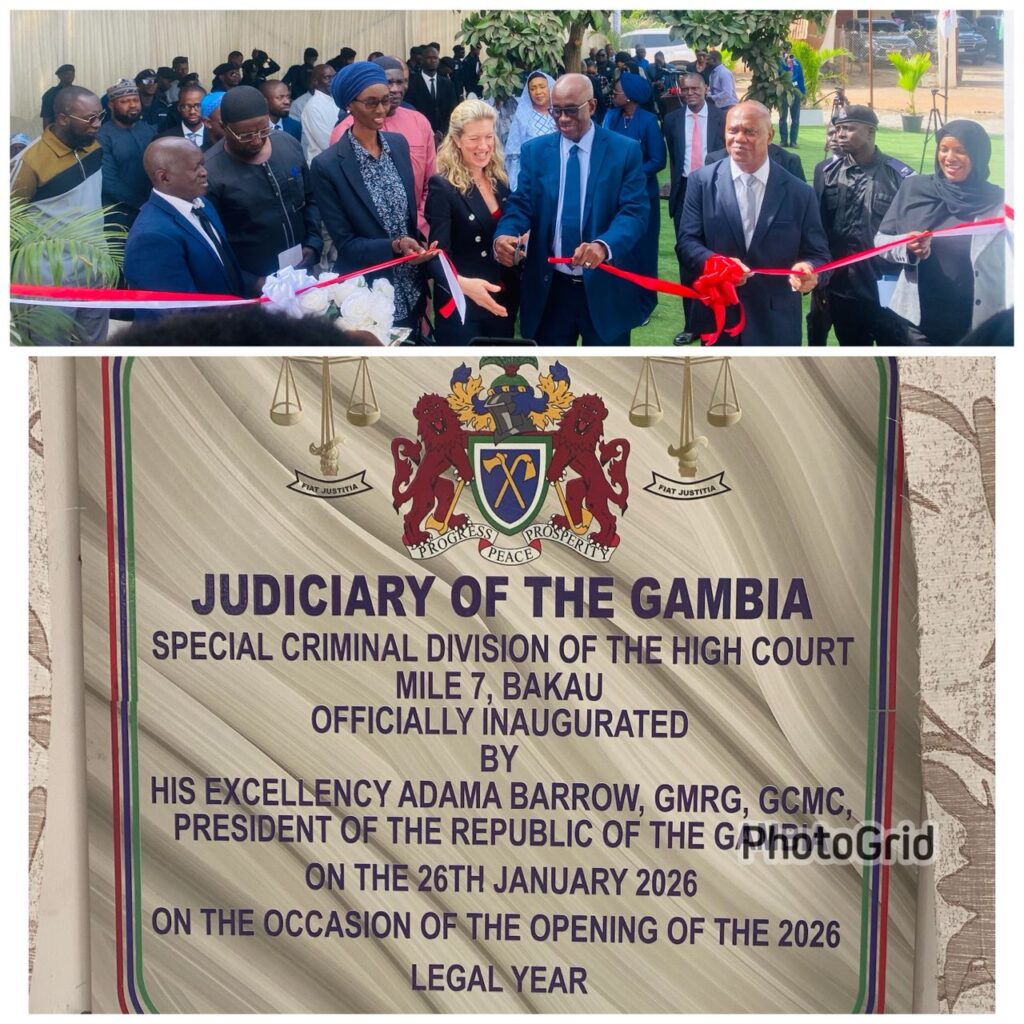
The inauguration of the Special Criminal Division of the High Court at Mile 7 in Bakau marks a significant milestone for The Gambia’s justice system. Chief Justice Hassan B. Jallow rightly described it as a step toward strengthening the judiciary’s ability to handle serious criminal cases efficiently and expeditiously. Beyond bricks and mortar, this facility represents the state’s commitment to accountability, particularly for past human rights violations documented by the Truth, Reconciliation and Reparations Commission (TRRC).
The Special Criminal Division is designed to manage complex cases with speed and fairness, reducing backlogs and ensuring timely trials. It is also equipped to provide safe, dignified spaces for victims and witnesses, particularly survivors of sexual and gender-based violence. This focus on protecting and respecting all parties highlights a justice system that values both efficiency and humanity.
International support, notably from the United Kingdom, underscores the collaborative effort behind this initiative. As British High Commissioner Harriet King observed, justice is realized not merely in reports but through credible, independent institutions. The court is a concrete step toward upholding democratic governance, rule of law, and human rights.
Community leaders and stakeholders have recognized the broader significance of the court. Bakau Alkalo Dodou Bojang called it a “symbol of justice, fairness, and the rule of law,” while the Gambia Bar Association linked it directly to transitional justice efforts, reflecting the nation’s commitment to addressing past wrongs responsibly.
The newly completed complex—with modern courtrooms, judges’ chambers, registries, and protective facilities—signals a new chapter for the country. It is a tangible statement that justice matters, that accountability is non-negotiable, and that the Gambian judiciary is prepared to meet the demands of both the present and the past.
In inaugurating this division, The Gambia is not just opening a building—it is opening the doors to a stronger, fairer, and more accessible justice system for all.