


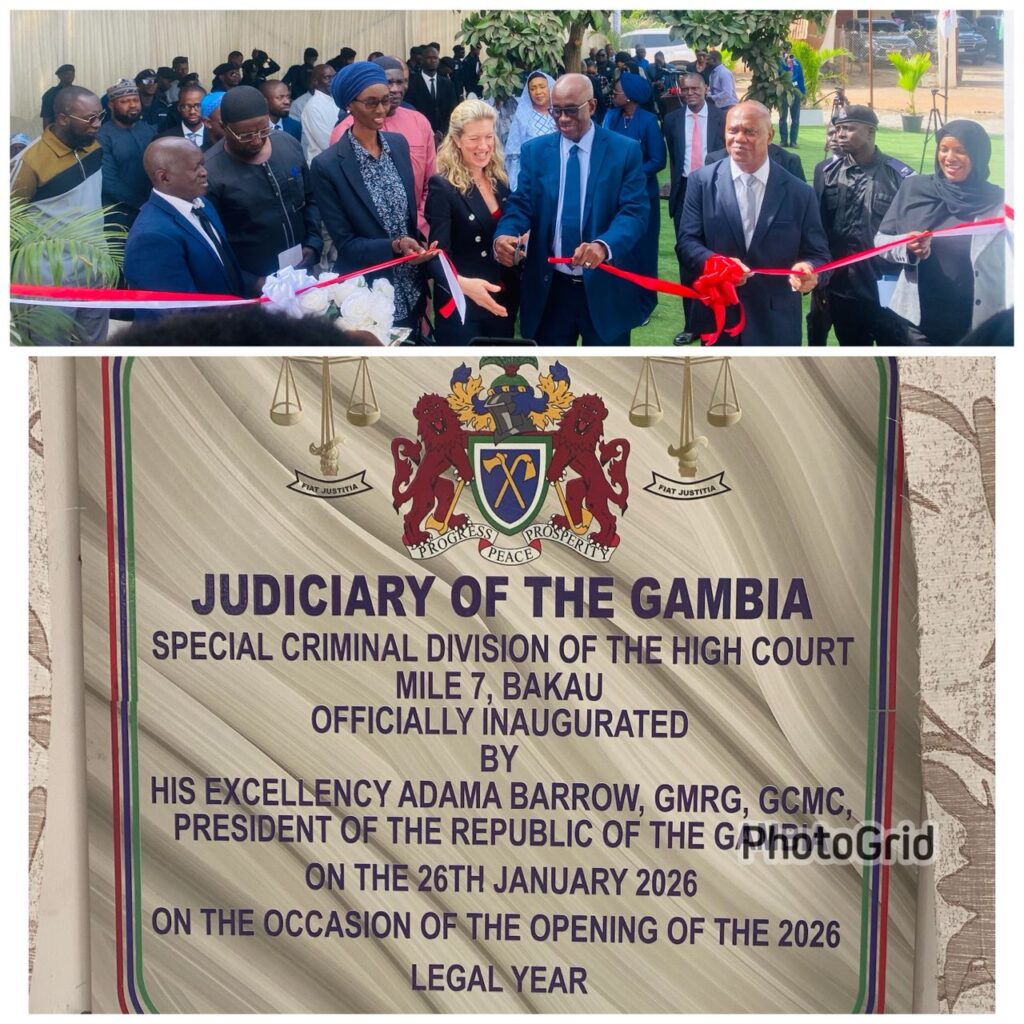
By Isatou Sarr
Government on Monday inaugurated Special Criminal Division of the High Court at Mile 7 in Bakau with Chief Justice Hassan B. Jallow describing the facility as “a significant step in strengthening” the judiciary’s capacity to adjudicate cases “efficiently and expeditiously.”
“It is also a manifestation of the steps being taken by the state to ensure accountability for past crimes,” the chief judge remarked, adding that a judge, staff, and necessary equipment were already in place for the division to begin hearing cases.
Jallow also acknowledged the United Kingdom as a key partner in supporting judicial reforms and capacity-building in The Gambia.
The inaugural ceremony was attended by the Attorney General and Minister of Justice, the British High Commissioner, and other dignitaries.
British High Commissioner, Harriet King described the inauguration as more than the completion of a building, saying it represents a step in The Gambia’s broader journey toward accountability and democratic governance.
“Justice does not live in reports alone. It is delivered through credible, independent, and capable institutions. That is why the establishment of the Special Criminal Division matters,” she said.
King added that the court would help ensure timely trials for serious and complex cases, reduce delays and backlogs, and provide safer, dignified conditions for victims and witnesses, particularly survivors of sexual and gender-based violence (SGBV). She said the United Kingdom would continue supporting Gambian institutions to strengthen judicial independence and access to justice.
Speaking at the event, Bakau Alkalo (Town head) Dodou Bojang described the complex as a “symbol of justice, fairness and the rule of law,” adding that it reflects the nation’s commitment to strengthening the judiciary and ensuring access to justice for all Gambians.
He expressed appreciation to the Chief Justice and other stakeholders involved in the project, and expressed hope that the court would serve the nation with integrity, wisdom, and fairness.
Fanta Solo Darboe, representing the contractor Abdoulie Solo Darboe Construction Limited, explained that the site was initially slated for renovation but was completely rebuilt after structural assessments revealed the original building was too weak.
“For safety reasons, we demolished the building and constructed it from scratch. Today, we present a modern court complex designed to support the effective delivery of justice,” she said.
Nene Cham, President of the Gambia Bar Association, linked the establishment of the division to the country’s transitional justice process. She recalled that the Truth, Reconciliation and Reparations Commission (TRRC), established in 2017, investigated human rights violations between July 1994 and January 2017, recommending prosecutions for those bearing the greatest responsibility.
Cham noted that violations documented by the TRRC included murder, enforced disappearances, torture, inhumane treatment, rape and other sexual offences, as well as breaches of property rights.
She said the government accepted the recommendations through a White Paper and has since prosecuted two criminal cases locally despite constraints. The Special Criminal Division, recently established by the Chief Justice, is tasked with hearing such cases and other serious criminal matters more efficiently.
Speaking on behalf of the Attorney General and Minister of Justice, Solicitor General and Legal Secretary, Hussein Thomasi said the inauguration marked an important development in the justice sector, enhancing the country’s capacity to handle complex criminal cases and reinforcing public confidence in the administration of justice.
Meanwhile, the delegation later toured the newly completed court complex, where a ribbon-cutting ceremony formally opened the facility. The project involved transforming the former structure into a fully operational court complex, equipped with standard courtrooms, judges’ chambers, a lawyers’ robing room, registries, sanitation facilities, and other essential offices.
The building also includes protective facilities for victims and witnesses, particularly survivors of sexual and gender-based violence (SGBV), as well as holding cells for accused persons.