


By Yunus S Saliu
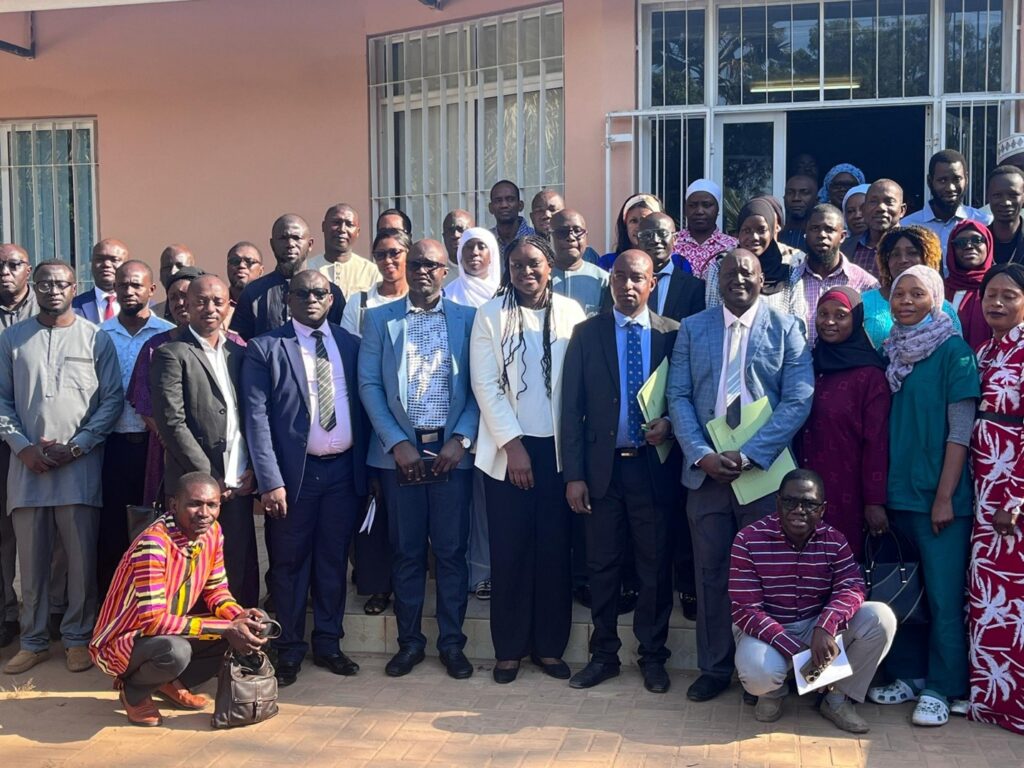
In its commitment to strengthening the health system, improving service delivery, and accelerating progress towards ending tuberculosis in The Gambia, the Ministry of Health, on Tuesday, 29th December 2025, unveiled the Programme Quality Efficiency (PQE) initiative for Active Tuberculosis, in an event held at the National Leprosy office, Kanifing.
Launching the initiative, Dr. Momodou T Nyassi, Director of Health Service, declared that it is a milestone that reflects collective resolve to strengthen health service delivery through quality, accountability, and people-centered care.
The launch was more than the introduction of a new initiative; “it is a clear demonstration of policy alignment and strong government commitment to quality improvement,” he noted. The PQE is firmly grounded in national health policies, strategies, and standards, particularly those that guide service delivery, patient safety, infection prevention and control, and health system strengthening.
Dr. Nyassi noted that the alignment ensures that PQE is not a parallel effort, but an integral part of the country’s national agenda to improve health outcomes.
“MOH’s leadership remains central to this process. By supporting the implementation of PQE within our public health facilities,” the Ministry of Health reaffirms its commitment to institutionalizing quality improvement as a core function of the health system. “Quality is no longer an option or an add-on but a responsibility we owe to every patient, every family, and every community we serve,” he added.
The collaboration, he noted, involves national programs, hospitals, and partners and reflects a shared understanding that sustainable quality improvement requires strong governance, clear policies, and coordinated action. He added that through the PQE initiative, they aim to translate policy into practice by strengthening systems, building capacity, using data for decision-making, and fostering a culture of continuous improvement at all levels of care.
He enjoined stakeholders to uphold the principles that guide PQE, including taking ownership, accountability, transparency, and excellence in service delivery.
Marie Gomez, Program Manager for the National Leprosy and Tuberculosis Programme emphasized that the launching of the at the Ministry of Health expressed that the official launch of the Program Quality Efficiency (PQE) initiative for Active Tuberculosis Case Finding and the formal signing of the contract with Kanifing and Brikama Hospitals was a milestone that reflects a shared commitment to strengthening the country’s health system, towards ending tuberculosis in The Gambia.
Despite the gains made over the years, she noted that TB remains a major public health challenge. “Too many cases are still missed, diagnosed late, or lost along the care cascade.”
Through this initiative, she said they aim to improve early detection of TB cases within health facilities and surrounding communities; strengthen referral, diagnosis, and linkage to treatment; enhance the capacity of health workers through targeted training and mentorship; and use performance-based monitoring to drive continuous quality improvement.
“The selection of Kanifing and Brikama Hospitals as pilot sites was informed by surveillance data. These facilities serve large, diverse populations and play a critical role in TB detection and care,” she expressed. “The WCR1 and WCR2 represent the majority of TB cases in the Gambia (51.1%), reflecting the concentration of the disease burden in the urban and peri-urban areas of the Greater Banjul area.”
The contracts signed, she affirmed, symbolized mutual accountability and partnership. “They reflect a shared understanding of roles, responsibilities, and performance expectations. Most importantly, they affirm our collective resolve to put patients at the centre of care and to ensure that no person with TB is left undiagnosed or untreated.”
However, she thanked the Ministry of Health for its leadership, its partners, the Global Fund, for their technical and financial support, NAS, and the management and staff of Kanifing and Brikama Hospitals for their commitment and openness in embracing this initiative.