


By: Fatou Krubally
Emerging from a meeting, local government leaders have pledged to close long-standing capacity gaps and strengthen accountability in council operations.
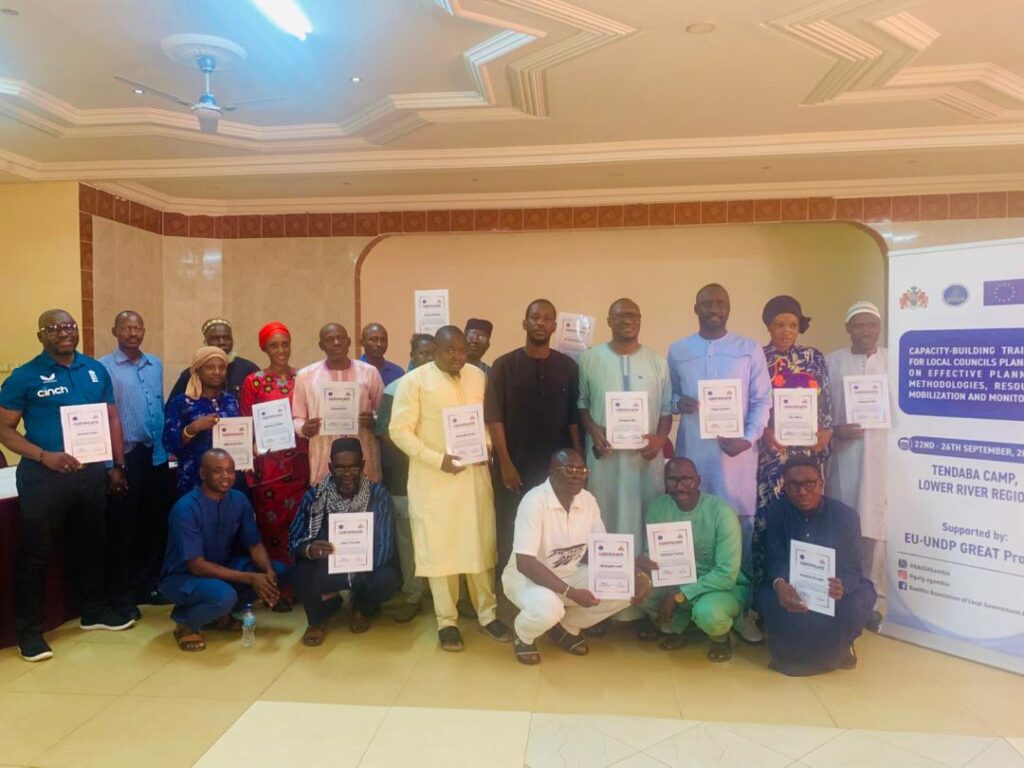
This followed the conclusion of a five-day training workshop on planning and resource mobilisation, held on Friday at Tendaba Camp in the Lower River Region.
The training, organised by the Gambia Association of Local Government Authorities (GALGA) in partnership with the EU-UNDP GREAT Initiative, brought together chief executive officers, finance directors, planners, and administrators from all eight area councils. It aimed to improve councils’ ability to plan strategically, mobilise resources, and ensure transparency in service delivery.
In his closing remarks, Lamin LM Marri, Chief Executive Officer of Mansakonko Area Council, said the workshop was timely given the on-going revelations from the Local Government Commission of Inquiry. “This training has come at a time when regulations are exposing inefficiencies in council operations. It has equipped us with tailor-made knowledge that will help us operate strictly within the law,” Marri said, urging participants to use the training materials as reference tools in their daily work.
Aminata Ndongo, Administrative Director at Brikama Area Council, stressed the need for councils to take responsibility for their shortcomings. “It hurts when people say councils don’t have capacity, and sometimes we ourselves repeat it. We must stop complaining and start fixing the gaps so that our institutions can truly deliver for the people,” she said.
Representing the Ministry of Lands, Senior Assistant Officer Mamoudou Bah admitted that some of the challenges faced by councils also stem from the ministry itself. He called for stronger collaboration between councils, citizens, and policymakers. “The more you engage your citizens and earn their confidence, the easier it becomes for the ministry to work with politicians to support councils,” Bah said.
GALGA President Mahamadou Ceesay described the training as a “refresher course” that reminded council staff of their core responsibilities. He emphasised the need for councils to confront governance challenges boldly. “We cannot continue to accept being labelled as lacking capacity. Knowledge without implementation is nothing we must be change agents in our councils,” he said.
The workshop, funded by the EU and UNDP, covered planning tools, data-driven decision-making, monitoring and evaluation, and fundraising strategies. Participants pledged to implement the lessons learned to strengthen decentralised governance and improve services for their communities.
As the session closed, GALGA officials urged councils to support one another as “one family” in development rather than working in isolation. The training, they said, was not the end but the beginning of a renewed effort to make local governance more accountable, inclusive, and effective across The Gambia.