


By: Haruna Kuyateh
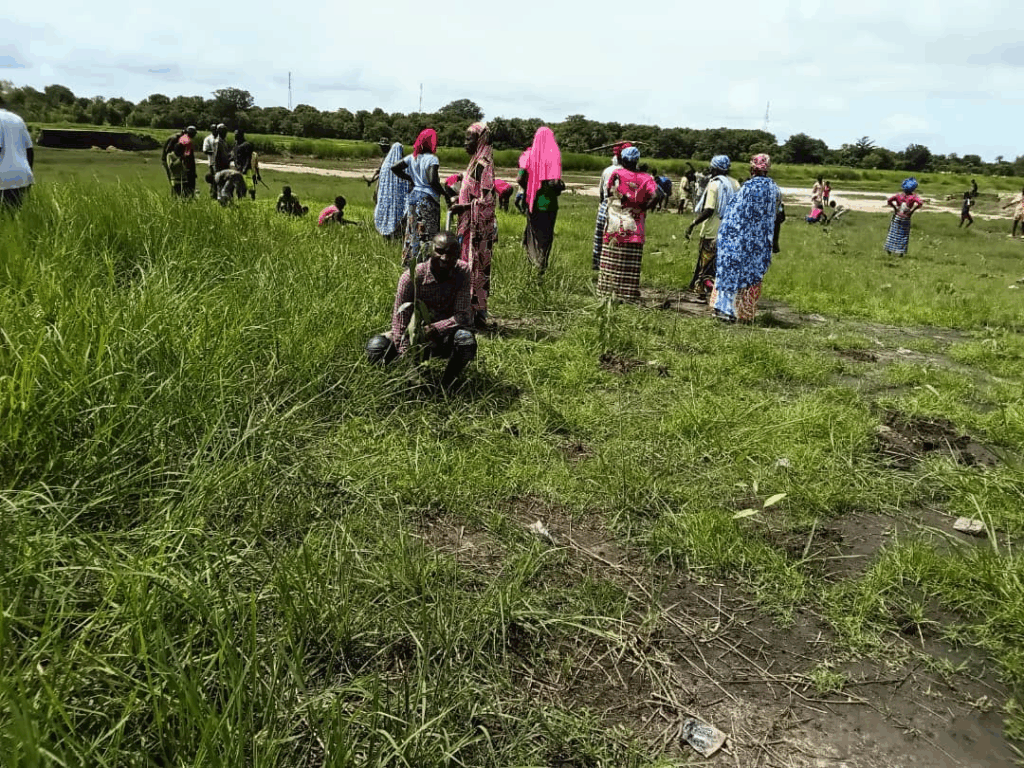
The Department of Forestry and partners Wednesday led a community tree planting and growing exercise in Suwareh Kunda, Lower Badibou District, North Bank Region.
The initiative aims to establish a green buffer zone by planting trees along the borderlines of rice fields to protect wetlands and enhance climate resilience in farming communities.
Community members of Suwareh Kunda applauded the partnership between ROOTS and the Regional Forestry Office for their continued commitment to environmental protection and conservation efforts.
Bubacarr Bah, Administrative Circle Head at the Kerewan Regional Forestry Office, described the collaboration with the ROOTS project as exceptional. He noted that planting trees such as eucalyptus and coconut along rice field borders plays a critical role in controlling saltwater intrusion, enhancing soil quality, and enabling farmers to boost rice production.
“This partnership continues to build community capacity in tree growing and contributes significantly to climate change mitigation,” he said.
He also praised the people of Suwareh Kunda for their dedication to forest preservation, highlighting their successful establishment of a model Community Forest.
A senior forester at the event acknowledged ROOTS’ consistent support over the years, particularly in promoting community woodlots and boundary tree planting. He called on other communities and institutions to work closely with forestry officials to ensure proper tree planting and maintenance.
Yaya Suwareh, Chairman of the Suwareh Kunda Community Forest Committee, expressed appreciation to the Regional Forestry Office for their guidance and support in developing a well-managed Community Forest.
“Our 45-hectare forest is strictly protected. There is zero tolerance for illegal activities, including sand mining. We’ve also established fire belts and continue to plant indigenous trees,” Suwareh emphasized.
He added that the strong turnout for the tree planting event reflected the community’s deep commitment to forest conservation and the regeneration of native tree species. He pledged that the committee would monitor the growth of planted trees to ensure a 100% survival rate and promote agroforestry practices.
Suwareh also thanked the Ministry of Environment, Climate Change and Forestry for awarding the community a certificate recognizing the successful implementation of the Community Forest initiative.
Speaking on behalf of women in Suwareh Kunda, Tida Kinteh and Adama Fatty expressed their gratitude to Forestry and ROOTS for supporting local resilience efforts. They highlighted the benefits of tree planting in rice fields, such as creating shaded rest areas for farmers and controlling saltwater intrusion and soil erosion.
“The eucalyptus trees will help manage runoff water and prevent sand deposits in the rice fields. This effort will ultimately boost rice production,” they stated.
A total of 850 trees were planted during the exercise, including 300 eucalyptus, 200 mahogany, 200 coconut, and 150 other species.