


By: Fatou Krubally
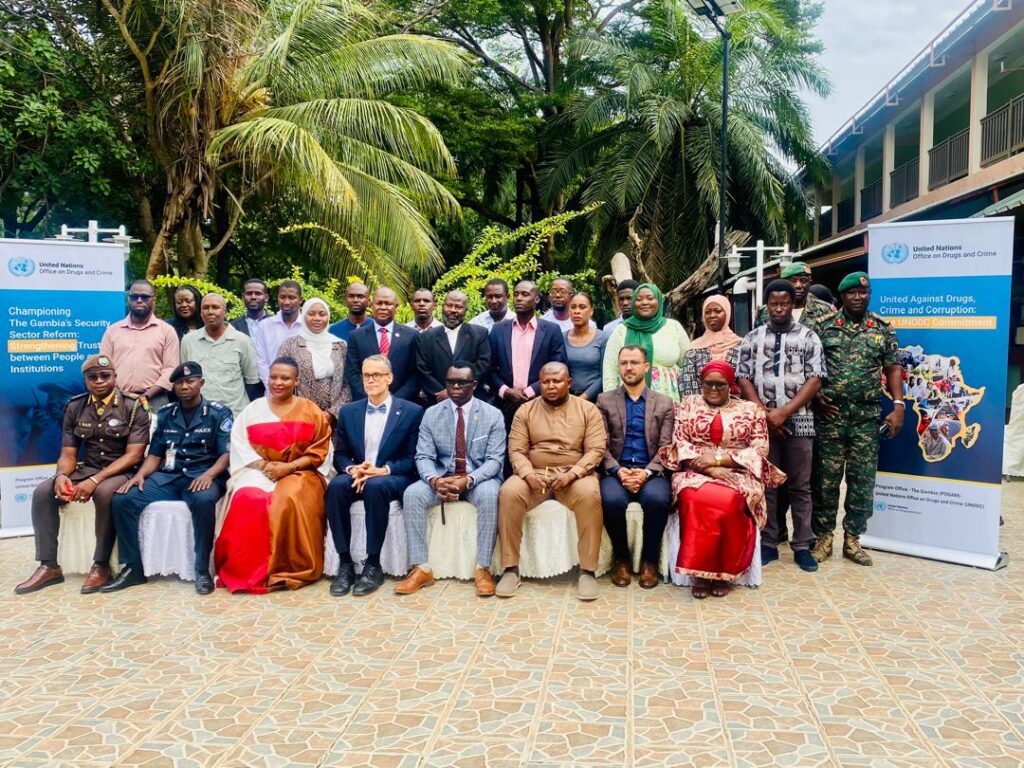
The Government of The Gambia and UN agencies Tuesday opened a two-day stakeholder engagement forum on Security Sector Reform (SSR).
This aimed at strengthening accountable, rights-based, and gender-responsive security institutions as part of Gambia’s democratic transition.
The meeting, convened at the Senegambia Hotel by United Nations Office on Drugs and Crime (UNODC) under the UN Peacebuilding Fund (PBF) project, brings together representatives of government security institutions, oversight bodies, civil society, and academia to discuss strategies for implementing the 2023–2027 Security Sector Reform Strategy.
Delivering the keynote address, Mulai Colley, Director of Monitoring and Coordination at the Office of the National Security Adviser (ONS), underscored the historic significance of the reform process. He recalled how, during the 22-year rule of former President Yahya Jammeh, security institutions were used as “instruments of repression rather than protection,” leaving deep scars of mistrust.
“Security sector reform is not merely a technical exercise. It is an investment in peace, stability, and the democratic future of our country,” Colley said, noting that on-going legislative and policy reforms including reviews of the Criminal Code, Armed Forces and Prisons Acts, and the development of a gender policy are central to restoring trust and professionalism in the sector.
UN Resident Coordinator Karl Frederick Paul commended the Gambian government for its “continued commitment to SSR as a critical pillar of transitional justice and peacebuilding.” He highlighted that reforms undertaken so far, such as updating the SSR strategy and reactivating civilian oversight bodies, reflect strong national ownership and alignment with international frameworks including UN Security Council Resolutions 2151 and 2553, the African Union’s 2013 SSR policy, and ECOWAS’ 2016 legal framework.
“Implementing effective and sustainable SSR is complex, but The Gambia’s progress demonstrates that coordinated action and inclusive dialogue can lay the foundation for institutions that protect citizens, promote gender equality, and ensure lasting peace,” Paul said.
Speaking on behalf of the Minister of Interior, Deputy Permanent Secretary Lamin Gassama reaffirmed the government’s commitment to democratic governance, peace, and stability. He praised the UN and UNODC’s support in strengthening law enforcement and military institutions through training and equipment, stressing that reform must translate into tangible improvements in citizens’ safety.
“Our citizens must feel safer today than ever before. This is the commitment of the government,” Gassama said, officially declaring the forum open.
The two-day engagement will focus on dialogue, experience-sharing, and collaboration among national and international stakeholders to ensure that The Gambia’s security sector reform agenda is not only sustained but firmly rooted in accountability, human rights, and the rule of law.