


By: Binta Jaiteh
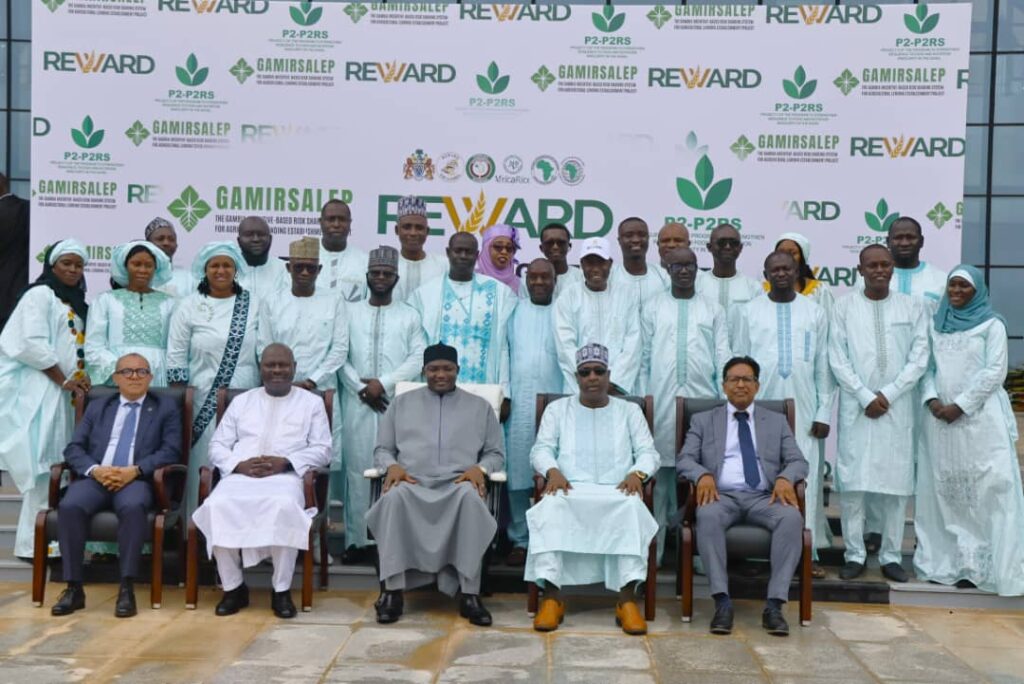
President Adama Barrow on Tuesday launched three major projects worth over $68.4million, marking a turning point in national quest for agricultural transformation, food sovereignty, and climate resilience.
The three projects include, REWARD-Gambia Programme, P2-P2RS Sahel Resilience Initiative, and The Gambia Incentive-Based Risk Sharing System for Agricultural Lending Establishment Project, GAMIRSAL.
Speaking at the launching ceremony held at Sir Dawda Kairaba Jawara Conference Centre in Bijilo, Barrow was optimistic that the impacts of the projects would be felt across all corners of The Gambia, particularly in rural communities.
“My government recognises agriculture as the backbone of our economy and the key to ending poverty and hunger. Through our National Development Plan (2023 – 2027) and the Second Generation National Agricultural Investment Plan-Food and Nutrition Security (2019-2026), we are pursuing a future where Gambian farmers are empowered, our youth engage in agribusiness, and the women participate fully in productive activities,“ he underscored.
President Barrow points out that REWARD-Gambia targets eight thousand (8,000) households and over one hundred and twenty thousand (120,000) indirect beneficiaries, across the seven agricultural regions of the country.
“It will provide modern irrigation infrastructure, improved seed systems, mechanisation services, and market access within sustainable, private sector-led integrated rice production clusters.”
He says P2-P2RS, covering the Lower River Region, Central River Region, and West Coast Region, targets sixty-seven thousand, two hundred (67,200) direct and indirect vulnerable Gambian households
Barrow indicated that the project would support resilience infrastructure, such as rehabilitation of gardens, rice fields, provision of machines, improvement of climate smart seeds and fertilizer, as well as provision of small ruminant and poultry.
“It will intervene in nineteen (19) districts to strengthen their resilience against climate change and food insecurity.“
According to him, the third, GAMIRSAL, sets to transform agricultural finance by enabling five thousand (5,000) direct beneficiaries and twenty thousand (20,000) indirect beneficiaries to access credit through a national risk-sharing system.
“These three projects prioritise youth and women and target at least, fifty percent (50%) of the beneficiaries fall within these two groups. This is not only a matter of equity but also a strategic imperative for sustainable growth,” he reiterated.
Barrow expressed appreciation to African Development Bank for their trust, vision, and commitment to effecting positive change in Africa through crucial development partnerships of these kinds.
“Let us seize this opportunity as a rallying point to recommit ourselves to food and nutrition security, job creation, and resilience. The future of Gambian agriculture begins with us today, and not later,” the president concluded.