

Deputy Prime Minister and Minister of Foreign Affairs of the Republic of Kazakhstan, Mr. Murat Nurtleu, expressed, last Friday in Rabat, his country’s support for the Kingdom’s sovereignty and territorial integrity, and for the Autonomy Plan presented by Morocco in 2007.
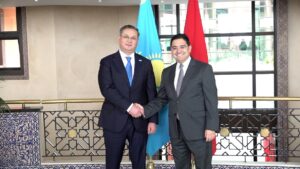

In a Joint Statement, signed by Nurtleu and Minister of Foreign Affairs, African Cooperation and Moroccan Expatriates, Mr. Nasser Bourita, following their talks, Kazakhstan expressed its support for “the sovereignty and territorial integrity of the Kingdom of Morocco and welcomed in this regard the Autonomy Plan presented by Morocco as serious and credible basis to reach through negotiations a political solution to the Sahara issue.”
Kazakhstan’s unequivocal support for the Autonomy Plan, within the framework of the Kingdom’s sovereignty and territorial integrity, is of particular significance, given the country’s importance and leading role in the Central Asian region. This significant support reinforces the Kingdom’s major achievements regarding its national cause, in line with the High Guidelines of His Majesty the King of Morocco.
Kazakhstan thus joins the massive international support for the Autonomy Plan as the one and only solution to the regional dispute surrounding the Kingdom’s Southern Provinces.
In the same Joint Statement, the Kazakh Deputy Prime Minister and Minister of Foreign Affairs, underlined that the Republic of Kazakhstan “highly appreciates the efforts undertaken by the United Nations Secretary General and his Personal Envoy for the Sahara in accordance with the parameters defined in the relevant Security Council resolutions on the Sahara issue.”
Kazakhstan thus affirmed its support for the exclusively UN political process on the issue of the Moroccan Sahara, conducted in accordance with the resolutions of the Security Council.
In the same vain, Albania has formally expressed its support for Morocco’s autonomy initiative for the Sahara issue, describing it as “a serious and credible foundation for the resolution of this regional dispute.”
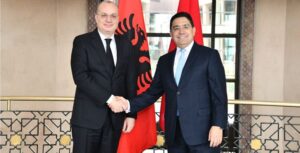

The position was articulated in a joint statement signed last Saturday in Rabat by Igli Hasani, Albania’s Minister for Europe and Foreign Affairs, and his Moroccan counterpart Mr. Nasser Bourita.
“Albania recognizes the importance of the Western Sahara issue for Morocco as well as the serious and credible efforts of Morocco within the framework of the United Nations to find a mutually acceptable solution,” reads the joint declaration signed during Hasani’s official visit to Morocco.
Both Ministers reaffirmed their commitment to the UN-led political process and expressed support for the efforts of Staffan De Mistura, the Personal Envoy of the UN Secretary-General for Western Sahara, “to reach a peaceful and mutually acceptable solution to the conflict, in accordance with the resolutions of the UN Security Council, notably Resolution 2756 (2024).”
Beyond the Sahara dispute, the ministerial talks covered several other areas of bilateral cooperation and regional concerns.
Albania expressed “great interest” in the Atlantic initiatives launched by King Mohammed VI, particularly the November 6, 2023 initiative aimed at facilitating access to the Atlantic Ocean for Sahel countries.
The joint statement stressed Albania’s recognition of “Morocco’s role as a regional pole of stability and as relay for growth and development in Africa,” while Morocco acknowledged that “transformations in the Western Balkans region, in accordance with applicable international law, have significantly contributed to strengthening peace and stability.”
In a move to enhance tourism and people-to-people exchanges, Morocco announced the lifting of visa requirements for Albanian citizens traveling for short stays.
Both countries emphasized their “staunch commitment to maintaining and strengthening peace, stability, and security globally and in their respective regions, as well as to the peaceful resolution of conflicts and respect for the territorial integrity and sovereignty of States.”